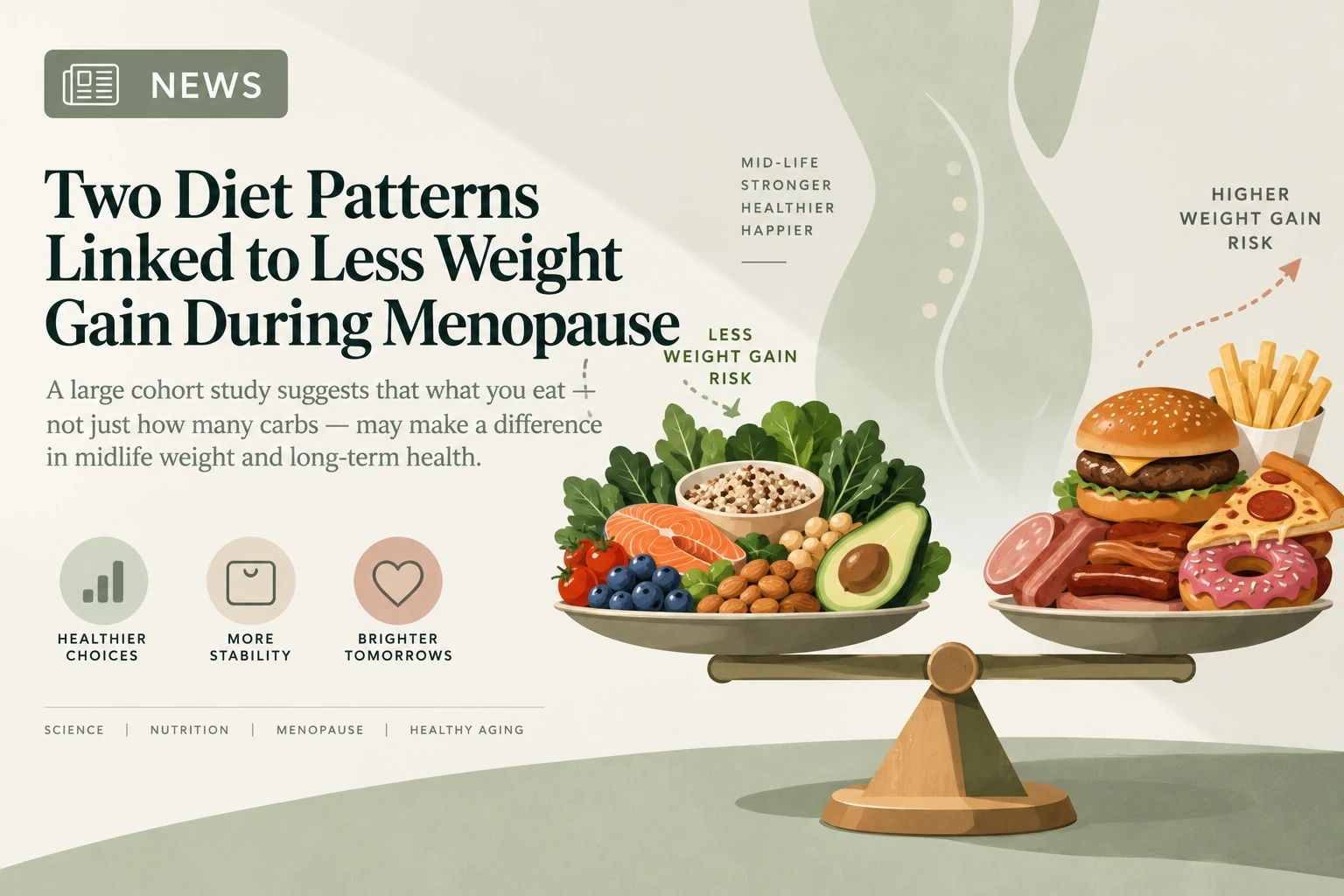
A cohort study of 38,283 women looked at weight gain during menopause and found that low-insulinemic and Planetary Health dietary patterns were linked to the best outcomes. The low-insulinemic pattern showed the largest association with less annual weight gain, about a quarter-kilogram less per year than women with the lowest adherence. The Planetary Health Diet showed the lowest observed risk of developing obesity, roughly half that of women with the lowest adherence.
The findings were published in JAMA Network Open and summarized by Harvard T.H. Chan School of Public Health. The data comes from more than three decades of the Nurses’ Health Study II.
What the Researchers Measured
Researchers followed 38,283 women in the Nurses’ Health Study II, who completed detailed diet questionnaires every four years starting in 1989. The team focused on the roughly 12-year window surrounding each woman’s menopause: six years before and six years after.
They compared 11 dietary patterns, including Mediterranean, DASH, plant-based, low-carbohydrate, and Planetary Health diets. Over the study period, the average participant gained 0.80 kg per year, and 5,214 women developed obesity.
Which Diets Were Linked to Less Weight Gain During Menopause
Researchers compared women in the top fifth of adherence to each diet against those in the bottom fifth. A low-insulinemic pattern, characterized by lower intake of red and processed meat, sodium, and French fries, showed the largest difference: about 0.28 kg less weight gain per year.
Several other healthy patterns, including Mediterranean, DASH, and the Planetary Health Diet, were also linked to smaller yearly weight gains, though the size of the effect varied by pattern.
Which Diet Was Linked to the Lowest Obesity Risk
For obesity specifically, the Planetary Health Diet, a plant-forward pattern built around vegetables, whole grains, nuts, and legumes, was linked to the lowest risk. Women in the top fifth were roughly half as likely to develop obesity as those in the bottom fifth.
The low-insulinemic pattern showed a similar reduction. DASH also lowered obesity risk, though by a smaller margin than the other two patterns.
What Made the Difference
The foods behind these results were consistent across both patterns. Diets linked to less weight gain and lower obesity risk were higher in nuts, legumes, unsaturated fats, whole grains, and plant protein. They were lower in red and processed meat, sodium, potatoes, and French fries.
The opposite mix of foods tracked with more weight gain.
Low-Carb Isn’t One Thing
One finding complicates a common assumption: low-carbohydrate diets, on their own, weren’t the deciding factor. A “healthy” low-carbohydrate pattern, built around vegetable protein and unsaturated fats, was linked to less weight gain, while an unhealthy low-carbohydrate pattern was linked to more. The type and quality of foods replacing carbohydrates may matter as much as carbohydrate restriction itself.
Tong Xia, the study’s lead author, said the goal was to identify which approach actually works. As she put it, “Until now we didn’t know which specific diet actually helps most.”
What This Doesn’t Prove
This is an observational study, not a controlled trial. It can show that certain diets were associated with less weight gain, but it can’t prove the diets caused that difference. Women who eat this way may also differ in other habits, like exercise or smoking, that researchers adjusted for but couldn’t fully rule out.
The Takeaway
For women approaching or in menopause, the specifics matter more than following one named diet. What mattered for weight gain during menopause wasn’t low-carb yes or no, but food quality: more nuts, legumes, whole grains, and vegetables, less red meat, processed meat, sodium, and fried potatoes.
That shift fits into a Mediterranean, DASH, plant-based, or even a well-built low-carb approach. The label matters less than what’s actually on the plate.
Common Questions
Does this mean low-carb diets are bad for menopause weight gain?
Not exactly. A “healthy” low-carbohydrate pattern built around vegetable protein and unsaturated fats was linked to less weight gain, while an unhealthy low-carbohydrate pattern was linked to more. Diet quality mattered more than carb count alone.
Does this study prove a certain diet prevents weight gain during menopause?
No. It’s an observational study, so it shows an association, not a cause-and-effect relationship. Randomized trials would be needed to confirm whether adopting these diets actually reduces weight gain.
Who was studied?
The 38,283 participants were mostly white registered nurses in the Nurses’ Health Study II, so the findings may not generalize to all populations. The researchers noted that future work should include more diverse groups.
Keep Reading
Curious what to actually put on your plate to support this during menopause? Here’s what I learned about fiber and fermented foods for gut health after 40.
This article is for informational purposes only and is not a substitute for professional medical advice. Talk to your doctor about any concerns regarding your weight or metabolic health.