
I wrote a while back about why midlife stress hits differently than it used to. One question kept following me around while I worked on that piece: was some of what I was feeling less about age or circumstances, and more about something as basic as nutrients?
So I dug into four contenders: omega-3, vitamin D, magnesium, and B vitamins. Some had evidence in specific situations. One looked much weaker once you isolated the properly placebo-controlled trials from the rest. And the least-hyped one turned out to have the clearest evidence of all. Just for a much narrower claim than anyone markets it for.
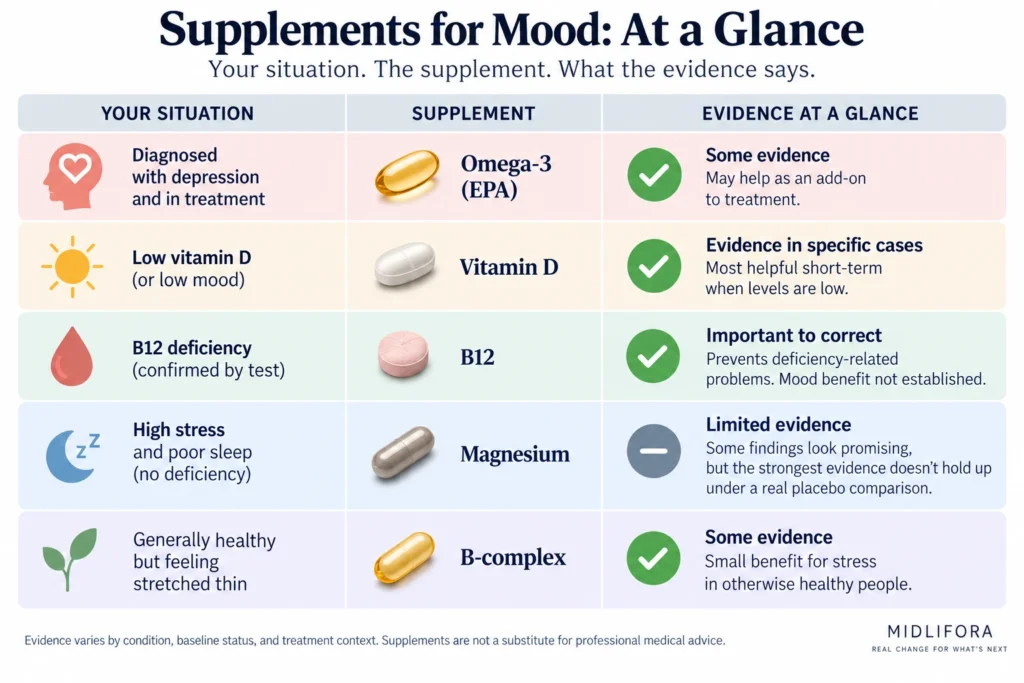
Here’s what I mean, situation by situation:
- Already diagnosed with depression and currently in treatment? One of these four has real, if uncertain, evidence as a supportive add-on — worth raising with your doctor.
- Blood test confirms a deficiency, or your mood is already low right now? Two of the four have short-term evidence for exactly that. Neither is meant to be taken for years as prevention.
- Nothing’s diagnosed, but life is just a lot right now? One of the four (not the one usually recommended for this) has the best evidence in people who are simply stressed, not clinically low.
- You probably already own a bottle of the most popular one. Its most-cited number doesn’t survive a real placebo comparison. I’ll show you exactly where it falls apart.
- Low B12 on a blood test? Fix it. The reason has nothing to do with your mood, though — it’s about something more serious.
Omega-3 and Vitamin D
Skip both if you don’t have depression. The largest trial ever run on either supplement, 18,353 adults over 50 tracked for five years, found no mood benefit from either one, and omega-3 even nudged depression risk slightly higher.
If you already have depression, both are worth a look. Omega-3, specifically EPA and not the DHA-heavy blends most bottles default to, modestly lowered depression scores in a Cochrane review of 1,848 people already in treatment. Vitamin D helped too, but only short-term: a 2024 review found real improvement in the first six months, gone after a year. The dose behind that research was 2,000 IU a day.
Magnesium
Not there yet, despite the hype. A widely cited 2023 study found a huge drop in depression scores from magnesium supplements, but that number only holds up in small, unblinded trials. Add a real placebo group, and a 2018 analysis found the effect nearly disappears. There’s a bigger, more convincing signal from diet: people who eat more magnesium tend to have lower rates of depression. But that’s a pattern in food intake, not proof a supplement works. Low-risk to try if your kidneys are healthy. Just don’t expect it to move your mood yet.
B Vitamins
The one with the least hype has the best evidence — for stress, not mood in general. A 2019 meta-analysis of over 2,000 people found no real effect on depression or anxiety, but a small, real drop in stress specifically. If nothing’s diagnosed and you’re just stretched thin, this is the one with something behind it. Look for a formula with B6, B9, and B12 together, not just one B vitamin alone. B12 and folate are a separate case: they matter for mood only if a blood test confirms a real deficiency, not as a general boost.
Saffron and St. John’s Wort
Saffron beat placebo in a 2025 trial of 202 people with mild depression, though the effect held up better on how people rated themselves than on clinician ratings.
St. John’s Wort works about as well as standard antidepressants for mild-to-moderate depression. The catch: it interacts with a long list of medications, including birth control, blood thinners, and some antidepressants. Effectiveness isn’t the question here. Drug interactions are.
What Supplements Can’t Fix
No supplement explains why my mood shifted in the first place. It can influence the outcome without ever touching the cause.
Sleep is part of what these numbers miss entirely. On the nights mine falls apart, I notice it almost immediately the next day. Shorter patience. Everything harder to shrug off. If you’ve ever wondered how one bad night wrecks the next day’s mood, that connection is real. No pill in this article touches it.
There’s a quieter risk to flag too. If B12 is low, anemia and nerve damage usually show up together. High-dose folate can correct the anemia on its own. Bloodwork looks normal. But the nerve damage keeps progressing underneath.
If a low mood isn’t a bad few days but something that’s stuck around, that’s a conversation for a professional. Same if it’s interfering with work, relationships, sleep, or eating. Not a supplement aisle.
Common Questions
How long before I’d notice a difference?
For vitamin D, the effect showed up mostly within 24 weeks. For B-complex and stress, the timeline was similar: weeks, not days. If nothing’s changed after a couple of months, that’s information, not a reason to keep going indefinitely.
What’s the best form of magnesium to try?
Magnesium oxide, the cheapest and most common form on shelves, is also the worst absorbed and the most likely to just give you diarrhea. Glycinate or citrate are absorbed better and gentler on the stomach. None of the mood research compares forms directly, so this isn’t about which one works better for your mood. It’s about which one you’ll actually tolerate long enough to find out.
How do I know if I’m actually vitamin D deficient?
A blood test for 25-hydroxyvitamin D is the only reliable way. Levels under 20 ng/mL are generally considered deficient, and 20 to 30 ng/mL insufficient. Fatigue and low mood are too nonspecific to diagnose it yourself.
Is St. John’s Wort safe with my current medications?
Not automatically. It interacts with birth control, blood thinners, and some antidepressants specifically, through the same liver pathway. Check with a doctor or pharmacist before starting, not after.
What are the signs of a B12 deficiency, and do I need a blood test to confirm it?
Fatigue that doesn’t improve with rest, tingling or numbness in your hands and feet, memory problems, and unusual paleness are the classic signs. Vegetarians and people on long-term acid-reducing medication or metformin are at higher risk. A blood test is the only way to know for sure. Fixing a confirmed deficiency matters for the nerve and blood reasons already covered here, not for a mood boost if your levels are already normal.
Knowing B-complex has evidence behind it for stress specifically, I’m trying it — the one I wasn’t expecting to (not the magnesium everyone already has in their cabinet, though if you’re curious whether it helps stress or sleep instead of mood directly, I looked at that separately). Looking back at the moments that actually got to me, snapping at my son, losing patience behind the wheel, none of it came down to one missing nutrient. It felt more like stress that had been building and finally had somewhere to go.
Keep Reading
Curious what’s actually changing in your body during this decade that makes everyday stress land so much harder? Midlife stress feels different for a reason, and it changes how a supplement fits into the picture.
Still working on the habit side of managing stress day to day? My stress-relief habits piece covers what’s actually helped outside of anything you’d take as a pill.
This article is based on personal experience and publicly available research. It is not a substitute for medical diagnosis or treatment. Please consult a healthcare professional about any health condition or medication.