
When menopause arrived, the first thing to change — and the most obvious — was my sleep. For years I could lie down and stay out cold until morning. Then, somewhere along the way, I started waking in the middle of the night for no reason, and mornings stopped feeling like rest.
So before changing what I ate or adding new supplements, I did something quieter first: I started rebuilding my sleep hygiene after 40 from the ground up, looking at my whole day one hour at a time. If sleep had come undone, it made sense to start with the hours leading up to it.
This is a record of what I actually tried and the research I dug into along the way. I didn’t set out to build a perfect routine — I added one thing at a time and kept whatever actually helped.
Why Sleep Hygiene After 40 Feels Different
It turns out I wasn’t imagining it, and I wasn’t alone. Across the research, somewhere between 40 and 60 percent of women in the menopause transition report sleep problems. Waking often, lying awake before drifting back off, sleeping a full night and still feeling unrested — that was my exact list.
The “why” isn’t a single thing, though. Hot flashes and night sweats, the swings in estrogen and progesterone, mood shifts like anxiety or low spirits — they’re all tangled together, and even combined they don’t explain everything.
On top of that, the body’s internal clock — the circadian rhythm — tends to drift earlier with age. Melatonin starts releasing sooner than it used to, the rhythm flattens a little, and waking at 3 or 4 a.m. becomes more common — I’ve unpacked why you keep waking up at 3am separately if you keep landing on the ceiling at the same hour.
Honestly, this is the part that reassured me. It wasn’t that I’d let myself go or lacked willpower; it was a fairly natural shift happening in my body. That reframed the whole thing — less “fix your bad habits,” more “rebuild your day around a body that’s changed.” (For this, I leaned on a review of sleep across the menopause transition.)
Morning Light Beats Evening Willpower
The first thing I actually changed was when I exercised. I used to run in the evening, so I moved it to the morning, while there was still sun. My reasoning was vague at first — something about sunlight helping vitamin D absorption, which was supposed to be good for serotonin.
But when I looked into it, the reason morning light helps sleep had less to do with vitamin D and more to do with the signal light sends the brain’s clock. Bright morning light nudges the circadian rhythm earlier, which tidies up when sleepiness shows up at night.
The research suggested that even 10 to 30 minutes of outdoor light within a few hours of waking can help — and I liked that it carries almost no risk. (The relationship between light, the body clock, and sleep is laid out well in this review.)
Speaking only for myself: after switching to morning workouts, the first thing that improved wasn’t sleep — it was my daytime energy. I was doing the exact same thing, just at a different hour, and that alone felt like a small revelation. That said, this is only my case. Morning people and night people differ, so I can’t promise it lands the same way for everyone. (I went deeper into how exercise affects sleep quality if you want the fuller picture.)

Build a Sleep Schedule Your Brain Can Trust
Once light was sorted, my attention drifted naturally to when I slept and woke. What surprised me was how consistently the research emphasized not “go to bed early” but “keep it regular” — and especially keeping a steady wake-up time.
Sleeping in to catch up on weekends (so-called social jet lag) can actually rattle the rhythm. So I tried to keep my bedtime and wake time within about 30 to 60 minutes of each other, day to day.
Lying in bed forcing sleep that won’t come doesn’t help either, apparently — so when I couldn’t drift off, I’d get up briefly and lie back down once I felt drowsy. That small trick ties directly into CBT-I, which comes up later. (I referred to the AASM guideline, which treats a regular schedule as central to chronic insomnia.)
Get Your Bedroom Environment Right
Best temperature for sleep
Bedroom temperature was something I got to embarrassingly late — the kind of thing where, once I read about it, I thought, why did it take me this long? So I went looking for a number to aim for.
Large observational datasets found sleep quality was best in roughly the 68–77°F (20–25°C) range, and dropped off when it was hotter or colder. I switched to more breathable bedding and started airing the room out before bed — nothing dramatic, no fancy cooling gear, just a lighter duvet and open windows — and I did seem to toss and turn less.
I’ll add an honest caveat, though. The “best” temperature varies from person to person, and most of this research is observational, so I read it as a starting range rather than “lower the thermostat and you’ll definitely sleep.” (I looked at this study on nighttime indoor temperature and sleep.)
Hot flashes at night
Layer menopause hot flashes on top of a too-warm room and waking up drenched becomes routine — this is the part that hit home hardest for me. A cooler room and breathable bedding took the edge off, but they didn’t make the hot flashes themselves disappear.
That’s an important distinction I had to make peace with: temperature control is a management tool, not a fix. If hot flashes are frequent or severe, adjusting the room alone probably won’t be enough, and the symptom itself is worth bringing up with a doctor rather than something to sleep-hygiene your way out of.
Blue light before bed — worth reducing, not obsessing over
The hardest thing in my whole routine to fix was my phone. Some of it is looking things up or replying to people, but a fair amount is just falling into the Reels-and-Shorts vortex. I wanted to cut that mindless time and actually let my brain rest, and it did not go as smoothly as I’d hoped.
So instead of white-knuckling it in the evening, I built more purposeful routines during the day to crowd the phone out.
When I finally looked into all the blue-light talk, my thinking cleared up. That bright, blue evening light suppresses melatonin and pushes back when you fall asleep — that part is reasonably well established. But the effect of “blue-light-blocking glasses” specifically turned out to be murkier. Pooled trials often showed no clear objective change in how fast people fell asleep or how long they slept, and the studies where people felt better tended to be small.
So here’s where I landed: cutting the light itself — dimming your screen, using night mode, stepping away from devices for an hour or two before bed — is worth doing, but don’t expect a pair of glasses to fix insomnia on its own. The glasses are, at best, a helper. That felt like the more honest reading of what’s out there. (An amber-lens insomnia RCT captured this well.)
Why CBT-I Is the First-Line Treatment for Chronic Insomnia
One name kept surfacing as I read: cognitive behavioral therapy for insomnia, or CBT-I. The word “therapy” put me off at first. What is this, I wondered, that shows up in nearly every source I read?
Once I looked closer, I realized the things I’d been doing one by one — a steady wake time, getting out of bed when sleep won’t come, managing time spent in bed — are actually its core pieces.
What struck me was how much the sources agreed on one point: sleep hygiene alone rarely treats chronic insomnia by itself, and a fuller approach like CBT-I is recommended first-line. In analyses focused on menopausal women, sleep quality and insomnia severity improved quite a bit — and not only in person, but through phone and online programs too. (I referred to a meta-analysis on CBT-I in menopausal women.)
I didn’t go through a formal program, so I can’t stand here and call it the answer. But if sleep has been disrupting your daily life for three months or more, I’m now convinced this is the thing to look into before piling on supplements.
Where Sleep Supplements Actually Fit
I only tried supplements after the rest of this routine was more or less in place. That order wasn’t an accident — the more I read, the more the weight of the evidence sat on the habits side. For me, supplements did help steady my sleep, but only on top of routines that had already taken hold.
Here’s an honest ingredient-by-ingredient rundown:
- Magnesium: Small randomized trials in older adults and poor sleepers showed modest gains in subjective sleep quality, efficiency, and duration. But the samples were small and the results uneven, so “proven” would be overstating it. Trial doses ran roughly 240–500 mg/day, with a note that kidney function and stomach tolerance mean you should check with a doctor first. (See the elderly-insomnia magnesium RCT.)
- Melatonin: What stuck with me is that it’s less a sedative and more a timing tool. It helps with jet lag or a shifted rhythm, but for ordinary insomnia the effect was hit-or-miss. Long-term safety data is still thin, so if you plan to take it nightly for a while, talk to a professional.
- Valerian and chamomile: Sparse data, and effects that were weak or inconsistent. Something like chamomile tea is fine as a calming pre-bed ritual, but there isn’t much basis for expecting a strong sleep effect.
One more thing worth flagging: many menopause sleep supplements combine several of these ingredients into proprietary blends, which makes it nearly impossible to tell which ingredient — if any — is doing the work. That’s part of why I preferred trying things one at a time rather than reaching for a blend.
The bottom line: a lot of the supplements and blends marketed for menopause sleep are, evidence-wise, weaker than CBT-I or managing the symptoms directly. So I kept supplements as an “extra card,” not a shortcut past the earlier steps. I’ve gone deeper on the supplements I actually tried for those 3 a.m. wake-ups, so I won’t repeat all of it here.
I’ll also leave a quick note on what I actually checked before buying anything: how much the labeled amount is in elemental terms, whether the form suits absorption, whether it’s padded with unnecessary fillers, whether there’s third-party testing (like USP), and whether the marketing outruns the evidence. Passing that check mattered to me more than any effect claim.
What Helps Most — and What Quietly Hurts
Pulling the sources together, here’s my own rough sense of the evidence for women in their 40s to 60s. (The stars are a loose reflection of evidence strength, not an absolute ranking.)
| Habit | Evidence | Rough effect |
|---|---|---|
| Consistent sleep schedule (core of CBT-I) | ★★★★★ | Strong |
| Morning light | ★★★★★ | Strong |
| Cutting alcohol and late caffeine | ★★★★★ | Strong |
| Cooler bedroom | ★★★★☆ | Good |
| Regular exercise | ★★★★☆ | Good |
| Less evening screen light | ★★★☆☆ | Moderate |
| Blue-light-blocking glasses | ★★★☆☆ | Moderate (supportive) |
| Supplements (magnesium, melatonin, etc.) | ★★☆☆☆ | Limited |
Building this table clarified something for me: the thing I reached for most often — supplements — sits in the weakest row, while the cheapest habits cluster at the top.
And the flip side matters too. Some things were quietly eating my sleep without my noticing:
- Late caffeine: It has a long half-life, so an afternoon coffee lingers into the night.
- Alcohol: You seem to fall asleep faster, but it fractures sleep structure and wakes you more in the early hours. “A drink helps you sleep deeply” is, on the evidence, closer to a myth.
- A too-warm bedroom, endless scrolling right before bed, and an erratic wake-up time.
Looking at that list, the lesson was clear: subtracting what’s already there matters as much as adding something new.
Common Questions
What’s a good bedroom temperature for sleep?
Based on the research, roughly 68–77°F (20–25°C) was a comfortable range. But the sweet spot varies by person, so treat that range as a starting point, not an absolute rule.
Does blue light really affect sleep?
Evening light does affect melatonin and when you fall asleep — that part is fairly clear. But blocking glasses alone don’t fix insomnia; reducing the light itself turned out to be the more honest approach.
Is sleep hygiene enough to treat chronic insomnia?
Usually not on its own. Habits like a regular schedule, morning light, and a cooler room help, but for insomnia that’s stuck around for months, CBT-I is the first-line recommendation — sleep hygiene works best as the foundation underneath it, not a replacement for it.
How long before this starts working?
For me it wasn’t an overnight switch — it came on gradually over a few weeks. I’d add one thing, watch how I responded, then add another, so a slow timeline actually felt natural.
Do I really need a full 8 hours?
The strict 8-hour rule turned out to be weakly supported. Everyone needs a different amount, so “do I wake up feeling rested?” is a better yardstick than the number.
So, Here’s What I Actually Do Now
Rather than trying to overhaul everything at once, if it were me, I’d start with these three — the evidence is strong and they cost next to nothing:
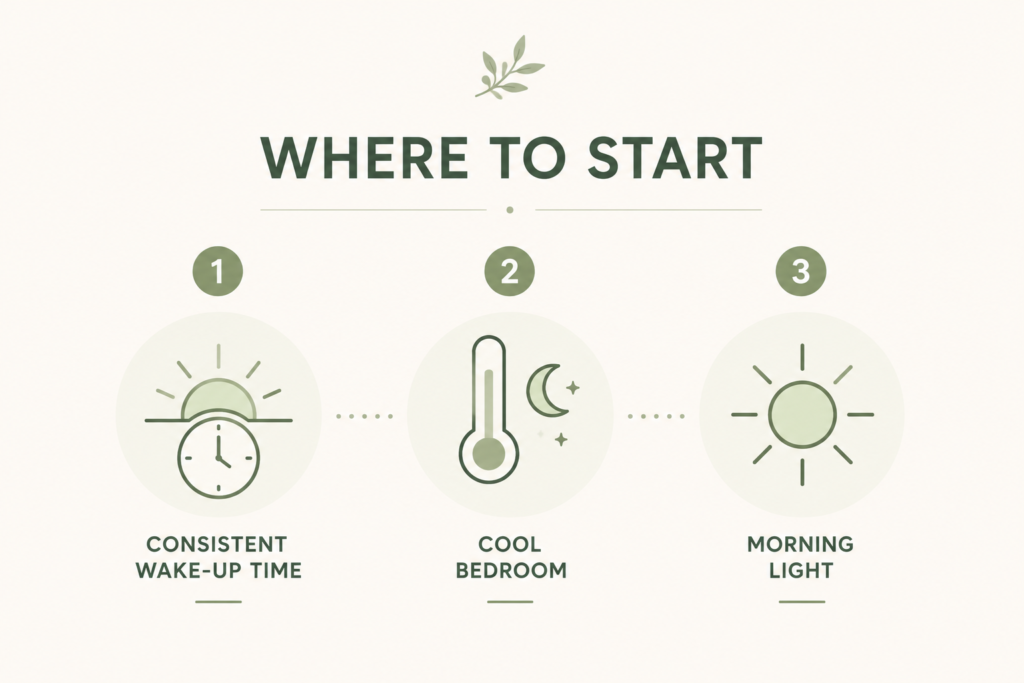
- Keep your wake-up time roughly the same every day.
- Don’t let the bedroom get too warm.
- Get outdoor light within an hour of waking.
Supplements can come after those three have settled in, and you won’t be behind for waiting. At least in my case, keeping the order this way left both my mind and body a lot less anxious — which is the version of sleep hygiene after 40 I’ve settled into.
Just because it helped me doesn’t mean it works the same way for everyone. But if you genuinely don’t know where to start, adding the well-supported things one at a time turned out to be a pretty good place to begin.
Better sleep after 40 rarely comes from finding one perfect product. More often, it comes from repeating a handful of simple habits long enough for your body to trust them again.
Keep Reading
And if you’re weighing specific products, my sleep supplement buying guide walks through what to check before you buy.
Want the bigger picture on why sleep falls apart in the first place? The full guide to sleep after 40 rounds up everything from causes to fixes.
This article is based on personal experience and publicly available research. It isn’t a substitute for medical diagnosis or treatment — please consult a qualified healthcare professional about any health concerns or medications.