
Quick Answer
Menopause brain fog usually isn’t a sign that something is wrong with your brain. It’s what shows up when several things overlap at once — hormones swinging up and down, sleep that keeps breaking, mood dipping, and the ordinary mental load of midlife.
The fuzziness is real. But on actual memory and thinking tests, most women still land inside the normal range.
There’s no single cause to fix, which is annoying. It’s also, quietly, good news.
Some days a word I’ve used a thousand times simply won’t come — I know it, I can feel its shape, and I end up talking around it like a tourist who lost her phrasebook. Once I walked into the bedroom and just stood there, no idea why.
I blamed being tired, until I heard the same stories from women my age. That’s what sent me looking into brain fog — a phrase that, it turns out, isn’t even an official diagnosis. It’s just a word people made up to cover forgetting things, losing words, and losing the thread mid-sentence. Loose and hard to pin down, which felt about right.
What Causes Menopause Brain Fog?
No two sources explain it the same way. The more I read, the less it sounded like here is the cause and the more it sounded like here are four or five things happening at the same time.
Estrogen Isn’t Only About Reproduction
Estrogen receptors sit all over the brain — think of them as docking ports the hormone can plug into. Two regions have a lot of them: the hippocampus and the prefrontal cortex.
The hippocampus turns new information into memory. The prefrontal cortex handles focus, judgment, and holding several things in your head at once.
Which is to say: the two areas richest in estrogen receptors run exactly the functions we mean when we say “my brain isn’t working lately.” That isn’t proof of anything. It does make the idea biologically plausible.
A review published through the International Menopause Society keeps returning to one point: the discomfort women report is common, while the changes that actually show up on testing are small and limited to a few areas — mostly verbal learning and memory. Even then, average scores tend to stay inside the normal range.
One caveat I want to be clear about. That paper summarizes existing research rather than reporting a new experiment. Where the receptors sit is fairly settled. Proving in living humans that hormone shifts cause thinking to slow is a different job, and most of that evidence is observational or indirect. I kept bumping into that gap while reading.

Sleep That Keeps Breaking
If I’m honest, this is the one I suspected most before I’d read a single study. Sleep is tied directly to attention, to holding information in working memory, and to the overnight process that files the day’s input into lasting memory.
If hot flashes or night sweats wake you four times, your total hours might look fine on paper. The shape of the night is wrecked. And the next day shows it.
I didn’t need a study for this part — anyone who has tried to hold a conversation after a broken night already knows. I’ve written separately about why sleep falls apart in your forties, because that piece deserves more room than one paragraph.
It’s the Swinging, Not the Low Point
This is where I had it backwards. I assumed the problem was estrogen being low. What the research points to more often is estrogen being unpredictable.
Picture a lamp on a broken dimmer. Set it low and leave it there, and your eyes adjust within minutes. Let it jump from dim to bright to dim again, a dozen times a day, and you’ll end up with a headache no matter how bright the room is.
Perimenopause is the broken dimmer. Not a steady decline — a wider swing.
That framing stuck with me because it explains something I’d heard from other women: the years before the last period are often harder than the years after. Plausible, though. A mechanism people find convincing isn’t the same as a mechanism that’s been proven.
Stress and Mood
When you’re anxious or low, focus suffers and everything runs slower. That’s true at any age.
Two things overlap here, though. Mood symptoms genuinely become more common in this window. And when you’re already feeling low, the same small mistake lands much harder.
So “how much you’re actually struggling” and “how much you feel like you’re struggling” aren’t necessarily the same number. Researchers keep flagging that gap.
The Rest of the List
Blood pressure, blood sugar, and weight show up too. Vascular and metabolic health affect the brain the way they affect everything else. Long-running stress and a heavy load at home or work get mentioned constantly.
Inflammation appears as a maybe. It sounds reasonable, but the evidence tying it specifically to this life stage is still thin — and I’d rather leave a weak claim looking weak than dress it up.
Why Some Women Have It Worse Than Others
This was the question I actually wanted answered. Same life stage, wildly different experiences. One woman barely notices. Another can’t get through a workday.
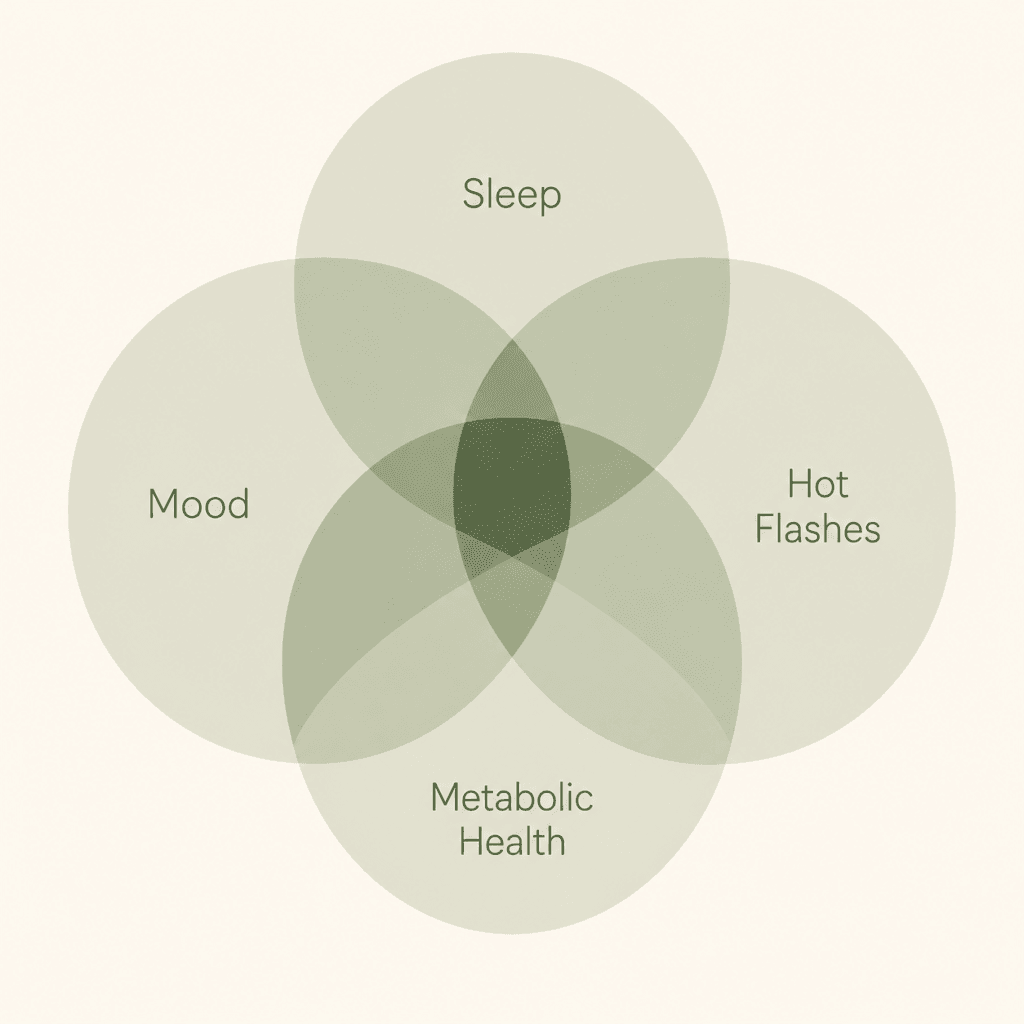
The factors named most often are poor sleep, mood symptoms, hot flashes and night sweats, and cardiovascular and metabolic health. Roughly: the more of these you’re carrying at once, the heavier it feels.
Then I read the SWAN cohort analysis — 1,903 midlife women in the US, followed for six years — and it complicated the picture.
Depression and anxiety symptoms did drag on processing speed, slightly. But even after accounting for depression, anxiety, sleep problems, and hot flashes, the dip seen in late perimenopause didn’t fully disappear.
Which means “your symptoms are fogging up your brain” is too tidy a story. Symptoms clearly matter. Clearing them doesn’t necessarily clear everything.
The limits are real. It’s observational, so it can’t establish cause and effect. It’s a US cohort, so it may not transfer neatly elsewhere. Most symptoms were self-reported. And it isn’t a recent paper. I filed it under more complicated than expected rather than answer.
Does Menopause Brain Fog Ever Go Away?
Here’s the reassuring part, and it’s consistent across sources: for most women, this is neither large nor permanent.
In the same SWAN data, women normally improve a little each time they repeat a cognitive test — simple practice effect. During the transition, that improvement stalled. After menopause, it came back. A rough patch, in other words, rather than a new baseline.
How long is a rough patch? Nobody can say cleanly. Studies follow women for different lengths of time and measure different things, so putting a number on it would be inventing a precision that doesn’t exist.
One thing does come up repeatedly, though: when sleep problems or mood problems go unaddressed, the fog tends to hang around longer.
When Should You See a Doctor?
Most of this passes on its own. Some of it shouldn’t be waited on. Book an appointment if you notice:
- Getting lost somewhere familiar
- Trouble managing money or keeping track of medication
- Losing words in a way other people are noticing
- A change in personality
- A steady decline — not good days and bad days, but a downward line — that’s getting in the way of daily life
None of that is a diagnosis. It’s a reason to see someone in daylight instead of googling symptoms at 2 a.m.
So What Actually Helps?
I’m not going to squeeze the answer in here, because each piece deserves its own space.
The short version: the evidence is thicker for treating the things sitting underneath — sleep, hot flashes, mood, vascular and metabolic health — than for anything aimed at menopause brain fog itself.
That’s why there’s no single fix. If poor sleep is driving your symptoms, improving sleep may make the biggest difference. If hot flashes are constantly waking you, addressing those may matter more than trying another supplement. The right approach depends on what’s feeding the fog in the first place.
If you want the whole map in one place, it’s in the full picture of brain fog in midlife
Common Questions
Is menopause brain fog actually common?
Very. Memory and concentration complaints are among the most frequent things women raise during this stage. The reported percentages swing wildly between surveys, though, because everyone defines and measures it differently — so I’d treat any single number with caution.
Could this be early dementia?
The sources draw a clear line between the two. Brain fog is usually mild, comes and goes, and is mostly about how things feel from the inside. Dementia is a progressive decline that erodes the ability to live independently. Most women who feel foggy during this stage don’t go on to develop it. The warning signs listed above are a separate matter, and those do deserve a proper look.
Does hormone therapy help menopause brain fog?
It isn’t recommended for that purpose — not because nobody has studied it, but because the large randomized trials didn’t deliver. The WHIMS trial, in women over 65, found a higher dementia risk with one particular hormone combination. Where hormone therapy is already being considered for other reasons, such as hot flashes bad enough to wreck your sleep, the fog may lift as those symptoms settle. That’s an individual conversation with your own doctor rather than a general rule.
Can it start before my periods stop?
Yes — and often that’s when it’s most noticeable, since the hormonal swings are widest during the transition. Plenty of women assume menopause can’t be the explanation because they’re still having periods, then connect the dots much later.
Can menopause brain fog affect my work?
For a lot of women, yes — losing a word mid-meeting or blanking on a name you know well can knock your confidence more than it affects your actual output. Small, practical fixes tend to help most: writing things down instead of trusting memory alone, building in a few extra minutes for tasks that need sharp focus, and protecting sleep as much as your schedule allows.
Here’s where I landed. There isn’t one cause. For most women it’s a stretch of road rather than a destination. And “just put up with it” isn’t the takeaway either.
The most useful thing I learned: feeling foggy while testing normal isn’t a contradiction, and it isn’t you making things up.
Keep Reading
And if you’ve been eyeing the supplement aisle with suspicion: Can Supplements Really Help Brain Fog? Evidence vs. Hype
※ This article is based on personal experience and publicly available research. It is not a substitute for medical diagnosis or treatment. Please consult a healthcare professional about any health concern or medication.