Through my thirties, I could fall asleep the second my head hit the pillow. Then I turned 47, and almost every night, I started waking up around 3AM. No obvious reason. No noise. Just — awake.
At first I blamed stress. Work had been chaotic, so it made sense. But weeks passed, and the pattern didn’t budge — even on the calm days, 3AM would roll around and my eyes would open like clockwork. That’s when I stopped assuming and started digging into what was actually going on.
If you want the fuller picture of what changes in sleep after 40, I’ve laid it all out in my complete guide to what changes in sleep after 40.
So Why Am I Waking Up at 3AM?
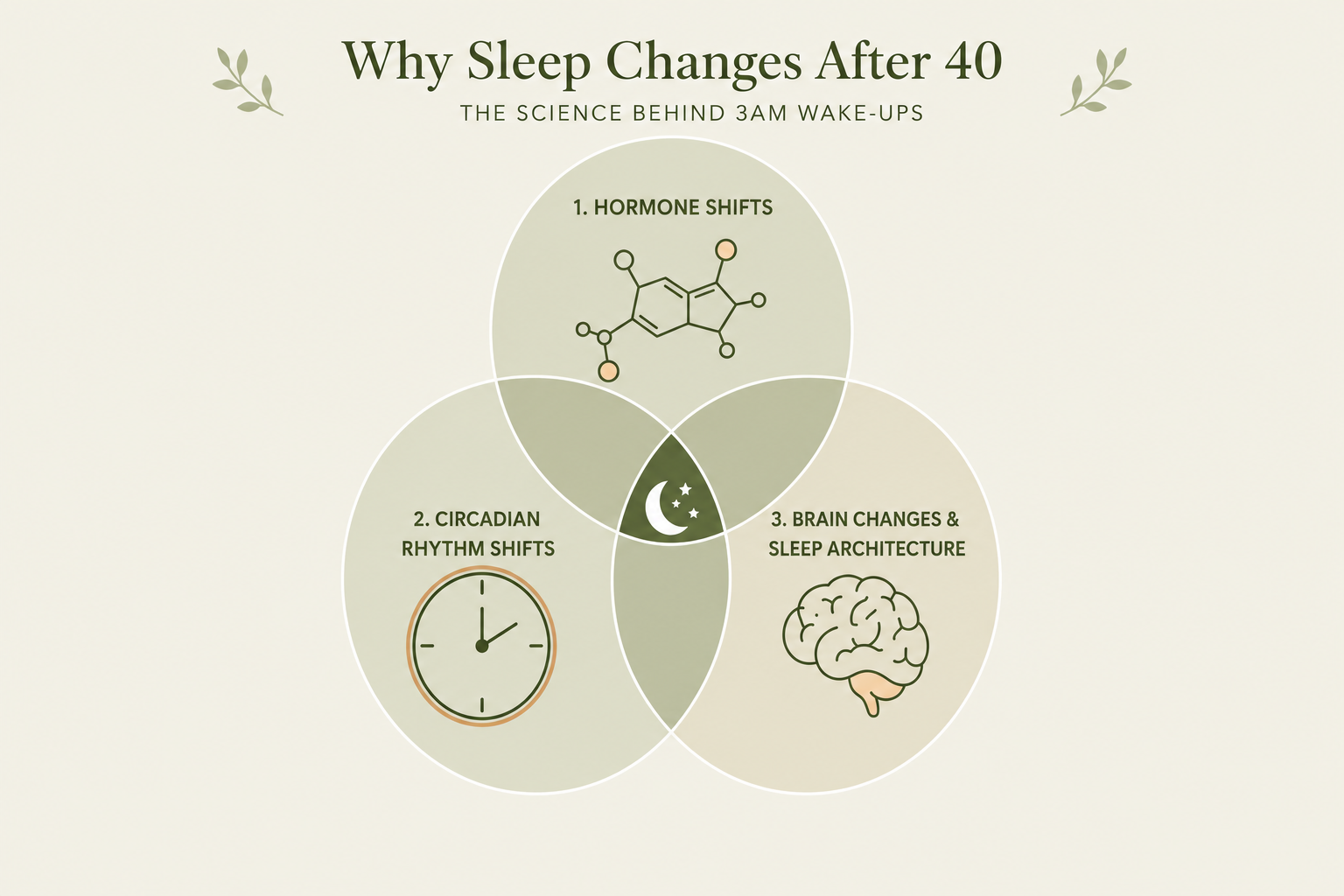
I didn’t expect to find a single answer, and I didn’t. What I found instead were three separate things — hormones, my internal clock, and changes in my brain’s sleep architecture — that all seem to overlap around this exact age. Here’s what each one looks like, and what I made of it.
The Hormone Piece I Kept Reading About
The first thing that came up over and over was estrogen and progesterone — both of which apparently play a role in body temperature regulation, stress response, and how easily we fall (and stay) asleep.
A (2020 review in Endocrinology) pulled together research across women’s lifespans and found that shifts in these two hormones were consistently tied to sleep duration, sleep quality, and insomnia symptoms. Because it synthesized a lot of individual studies, I found it fairly credible — though the review itself noted the effect sizes varied a lot study to study, so it wasn’t a clean “this explains everything” answer.
What stood out more was a( 2022 study in the Journal of Clinical Endocrinology & Metabolism) that followed women through the menopause transition over time, rather than just measuring them once. It found that night sweats, mood changes, and hormone fluctuations were each independently linked to fragmented sleep — and that time periods with bigger swings in estrogen tended to come with more time awake at night.
What I didn’t expect: some women in that same study went through similar hormonal shifts and barely noticed a change in their sleep. So individual variation is clearly a real factor here, not a footnote.
Looking back, it made sense. Around the same time my periods became less predictable, my sleep did too. I can’t say the two were directly connected, but the timing was hard to ignore.
My Internal Clock Shifted Too
Hormones weren’t the only piece. The other thing that kept showing up was the idea that our circadian rhythm itself moves earlier as we age.
One thing I noticed before I even started reading research was that I wasn’t just waking earlier — I was getting sleepy earlier too. I used to stay up until midnight without thinking about it. Now, by 10 p.m., I often feel ready for bed. That made the idea of my internal clock shifting earlier feel surprisingly believable.

Across a number of studies, body temperature, melatonin, and cortisol patterns all seem to shift roughly an hour earlier than they did in our twenties. That tracks with what I’ve noticed — getting sleepy earlier in the evening, then waking up way too early.
The Cortisol Angle
Cortisol normally starts rising right before we wake up. But apparently that rise happens earlier with age, and cortisol also tends to stay somewhat elevated overnight. Deep sleep is what usually keeps cortisol in check — so when deep sleep declines, that suppression weakens too.
If that rise happens while I’m still asleep, it could make me more likely to wake up before morning — even if nothing external disturbed me. That’s still just a theory, but it’s the first explanation that made the specific timing feel less random.
What’s Changing in My Brain’s Sleep Architecture
Out of everything I read, this felt like the most solid explanation. A (2017 review in Neuron )pulled together imaging and EEG studies and found that as we age, grey matter in the prefrontal cortex shrinks — and that decline tracks closely with a reduced ability to generate deep, slow-wave sleep.
In simple terms, the part of the brain that helps generate our deepest sleep gradually becomes less efficient with age. The same review noted something else interesting: our body’s ability to “bounce back” after losing sleep also gets weaker with age. Because this pattern showed up consistently across different research methods, it felt like one of the more trustworthy findings in everything I looked at.
There’s also a simpler stat that stuck with me: time spent awake during the night (WASO) increases by roughly 10 minutes per decade between ages 30 and 60. Ten minutes sounds small, but stretched over 30 years, that’s close to half an hour more wakefulness than I used to have. It made my own experience feel a lot less “in my head.”
Putting the Pieces Together
After reading dozens of papers, this is the simplest way I can think about it — none of these three things seem to work in isolation. They overlap and reinforce each other.
| Factor | What’s Happening | How Solid Is the Evidence |
|---|---|---|
| Hormones | Estrogen/progesterone shifts tied to sleep quality and fragmentation | Moderate — consistent pattern, but effect size varies person to person |
| Circadian rhythm | Body clock shifts ~1 hour earlier; cortisol rises sooner | Moderate — well-documented, but doesn’t fully explain why 3AM |
| Brain structure | Prefrontal grey matter loss reduces deep sleep capacity | Stronger — consistent across imaging and EEG studies |
Where the Research Runs Thin — and Where I Landed
A few honest caveats before I wrap up. Most sleep-and-aging research compares people in their 20s–30s against people in their 60s–70s. There’s a lot less data specifically zeroed in on the 40–60 range — which is exactly the group asking this question.
A lot of the studies are also observational, meaning researchers can see the correlation between hormone decline and worse sleep, but can’t fully prove that one directly causes the other. Several papers I read flagged this limitation themselves.
I’d also gently push back on any claim that says “everyone over 40 gets insomnia” or “declining estrogen is the only cause.” Individual variation is huge — plenty of women get through menopause with no real sleep disruption at all.
Knowing all this hasn’t magically stopped my 3AM wake-ups — I want to be upfront about that. But it did change something. I used to think, what’s wrong with me, why am I like this now. Now I think, this is just one of the things my body’s going through. That shift alone took a lot of self-blame off the table.
This is just my experience, though. Even people waking up for the same underlying reasons may feel it differently, or need different approaches to deal with it.
This might resonate with you if:
- You’ve been waking up at night more often since your mid-to-late 40s, without knowing why
- You’ve been chalking it up to “willpower” or “just being a light sleeper”
- You’re going through the menopause transition and noticing sleep changes, but haven’t looked into the actual cause yet
Keep Reading
Wondering if a supplement could actually help? I put together what’s worth trying (and what isn’t) for sleep after 40 Sleep Supplements After 40: What’s Worth Trying.
Curious whether movement in the day affects sleep at night? I looked into how exercise timing and type actually shift sleep quality Does Exercise Really Help You Sleep Better After 40?.
Still figuring out what to eat or avoid before bed? I dug into the diet side of this too What I Stopped Eating Before Bed After 40.
Common Questions
Why do I wake up at 3AM every night after 40?
From what I found, it’s usually a mix of things — hormone shifts, an internal clock that runs earlier, and a brain that’s gotten less efficient at generating deep sleep. There’s rarely just one cause.
Is waking up at 3AM a sign of menopause?
It can be, especially if it comes with night sweats or hot flashes. But plenty of women in the studies I read had this happen without any of those symptoms, so it’s not a reliable sign on its own.
Can hormone changes cause early morning waking?
Research suggests a link, yes — particularly during periods when estrogen is fluctuating the most. But it’s a correlation, not a proven direct cause, and not everyone with hormone changes experiences it.
Why is deep sleep reduced after 40?
The clearest explanation I found is structural — grey matter in the brain’s prefrontal cortex naturally declines with age, and that’s tied to a reduced ability to generate deep, slow-wave sleep.
Does sleep automatically get better once menopause ends?
From what I found, it really depends on the person. Some women’s sleep stabilizes. For others, things like sleep apnea or other health factors keep affecting sleep even after hormones settle down.
This article is based on personal experience and publicly available research. It isn’t a substitute for medical advice — if you’re dealing with ongoing sleep issues, please check in with a healthcare provider.