
Quick Answer
Most supplements marketed for brain fog — including menopause brain fog — have far less evidence than their labels suggest. A few nutrients can help in specific situations, but none of them fix brain fog on their own. Before you buy one more bottle, it makes more sense to figure out what’s causing your fog in the first place.
I Almost Bought Everything That Promised a Sharper Brain
It never arrived all at once. One day it was a forgotten word. Another day it was walking into a room and forgetting why I was there.
Some days I could laugh it off. Other days I couldn’t.
That’s the odd thing about perimenopause. You can feel your body changing from one month to the next. I wanted to move through it gently, so I did what I always do — I started reading. Articles first, then actual studies. Not the way a researcher reads them, more like someone skimming for the parts that applied to her own life. If you want the bigger picture of what’s happening, I walked through it in my complete guide to brain fog in midlife.
I’ll admit something: I love supplements. But this time, the more I searched, the muddier it got.
Sharper memory. Better focus. Mental clarity. Every label sounded wonderful. The evidence behind those labels was much harder to locate.
So the most useful thing I walked away with wasn’t a miracle bottle. It was this — understanding why your brain feels foggy matters far more than chasing whatever ingredient is trending this year.

Why Brain Fog Supplements Are Everywhere
There’s a reason this particular symptom and the supplement industry fit together so neatly.
Brain fog is vague. Nothing bleeds, nothing spikes on a thermometer, nothing shows up as a clear number on a lab report. Saying “my head feels cloudy lately” at a ten-minute appointment can feel like you’re wasting the doctor’s time. Yet you notice it every single day.
That combination — clearly uncomfortable, nowhere obvious to take it — pushes people toward solving it themselves. And the easiest door to walk through is a supplement.
Here’s where it gets tricky. The same phrases show up again and again on brain fog products:
- “Clinically proven to eliminate brain fog in women over 40”
- “Reverses age-related memory decline”
- “Boosts neurotransmitters for instant focus”
- “A safe, natural alternative to prescription medication”
- “Formulated using the latest neuroscience”
It’s worth asking why lines like these work on us in the first place. Uncertainty is uncomfortable, and a label that sounds completely sure of itself is easier to trust than a study that hedges every sentence. Marketing doesn’t need better evidence to be persuasive. It just needs to sound more certain than we currently feel.
Reviews that compare claims like these against the actual research tend to land in the same place: the promises reach further than the data does. What stood out most is how few studies have tested these products in the exact group they’re marketed to — midlife women dealing with menopausal brain fog. The mechanism language, too (“supports acetylcholine,” “raises NGF”), usually traces back to cell or animal studies rather than repeated trials in people.
None of that means the ads are lying. It means the gap between “this has been proposed” and “this has been confirmed in humans” disappears somewhere between the lab and the label.
What Happens When You Ignore the Marketing
Rather than ranking supplements one by one, it felt fairer to group them by how much evidence sits behind each one. Two products can both say “may help,” and the weight behind that phrase can be wildly different.
One thing to get out of the way first: within everything I read, there’s no supplement with evidence strong enough to say it reliably clears menopausal brain fog in otherwise healthy midlife women.
Strong Evidence — When You’re Correcting a Deficiency
The firmest ground here isn’t a specific vitamin — it’s a specific situation. Vitamin B12 and vitamin D belong in this category only when a test confirms you’re actually low. Take away the deficiency, and the evidence gets much weaker fast, as you’ll see below.
The comparison that helped me understand this: a car with a flat tire drives much better once you add air. But adding more air to a tire that’s already at the right pressure doesn’t make the car faster. Fixing a shortage and “boosting” a normal level are two different projects — and marketing tends to blur them into one sentence.
B12 really is necessary for building the protective coating around nerves and for a chemical process called methylation, so running low can affect thinking and mood. That part is well established. Topping up someone who isn’t low is a different story. A 2025 review pooling 17 randomized trials of B vitamins in older adults — 5,275 people total — found an effect on overall thinking ability so small (about 0.11) that it registers statistically but almost certainly wouldn’t be something you’d feel day to day.1
Vitamin D followed a similar pattern. Observational studies link low blood levels with weaker cognitive scores, but trials that actually hand people supplements haven’t reproduced that. A 24-month trial comparing 2,000 IU to 800 IU daily in adults 60 and older found no meaningful difference in cognitive performance.3
So the practical version is simple. If testing shows you’re genuinely low, filling that gap is the right move. Reasons to check include eating mostly plant-based, long-term use of metformin or acid-reducing medication, or past stomach or intestinal surgery that affects absorption. But that’s less “taking a brain supplement” and more “restocking something your body ran out of.”
Promising, But Not Settled
These two show real potential without enough evidence to call it yet.
Omega-3. DHA makes up a lot of the membrane around brain cells, and it’s involved in how flexible those membranes are, how synapses work, inflammation, and blood vessel health. That reasoning holds together. Some studies do report small improvements in memory or attention. But results bounce around, and the trials vary enormously in dose, EPA-to-DHA ratio, and length. Most were run in older adults or people with mild cognitive impairment — almost none looked at menopausal brain fog directly. Also, if you take blood thinners, high doses come with bleeding risk, which isn’t a footnote to skip.
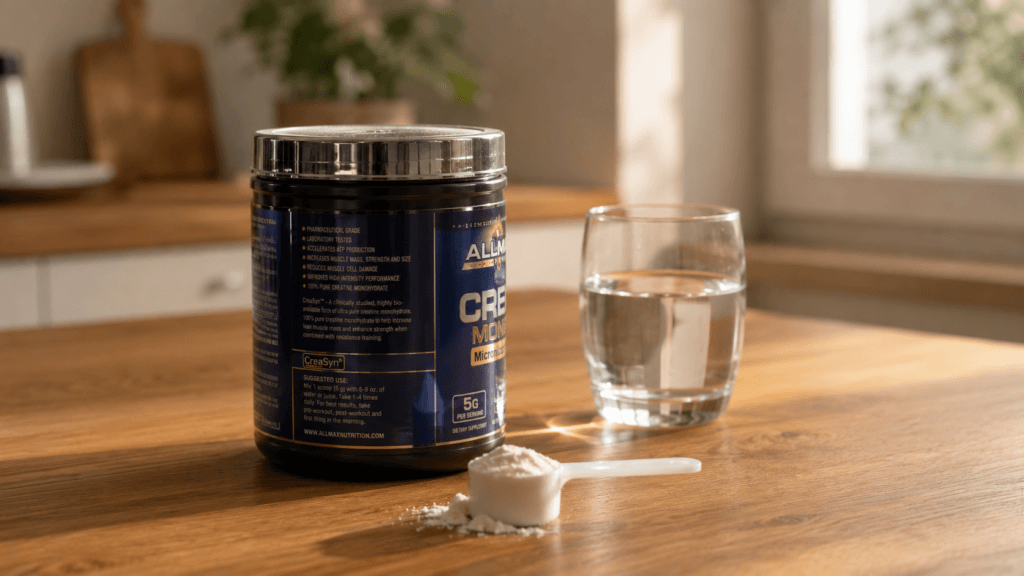
Creatine. This one interested me most. The brain burns a lot of energy, creatine acts as an energy buffer, and supplementing does raise creatine levels inside the brain. A 2023 meta-analysis found improved memory scores (effect size around 0.29), with a much larger effect in people aged 66 to 76 than in younger adults.4 A 2024 systematic review of 16 trials covering 492 people saw benefits in memory, attention-related reaction time, and processing speed — but no difference in overall cognition or executive function.2
There’s also one trial in menopausal women reporting changes in some cognitive measures and in brain creatine levels. Early result, not yet repeated by independent teams. Doses across studies range from 2 g to 20 g a day, and nobody has looked at the question that actually matters to me: does daily fogginess ease over the long run? Anyone with kidney disease should be careful with it, too.
I keep both of these filed under “reasonable candidates.” Too many blanks to call them answers.
More Hype Than Evidence
This is where the distance between the label and the literature stretches widest.
Lion’s mane. Compounds in it (hericenones, erinacines) may stimulate nerve growth factor or BDNF. A double-blind pilot trial in 41 healthy young adults found a small speed-of-performance benefit after a single dose and a trend toward reduced stress after 28 days, alongside several null results.5 There’s also a small study in older adults with cognitive complaints. The problems: tiny sample sizes, short durations, and no standardization of active compounds between products. Working out how much erinacine is in any given bottle is close to impossible. The potential isn’t zero — the marketing is simply sprinting well ahead of the science.
Nootropic blends. These make me the most cautious. When a formula contains ten ingredients, even a positive result tells you nothing about which one did the work. Studies on the finished product itself are rare. Usually the “evidence” is a collage of research on individual ingredients, often taken from completely different populations. And if the company hides amounts behind a “proprietary blend,” there’s nothing left for a shopper to evaluate.
There’s something almost comforting about a formula with ten ingredients in it. It feels like someone already did the work of figuring out what you need, so you don’t have to. That feeling isn’t evidence. But it’s a big part of what actually sells the bottle.
Magnesium and ginkgo. Both are famous enough to get name-dropped in brain fog conversations, but for cognition specifically the support is weak. Magnesium has a real case for sleep, anxiety, and correcting a shortfall — high-quality trials showing direct cognitive improvement are scarce. Ginkgo has been studied heavily, and the results keep contradicting each other; major neurology and dementia organizations don’t recommend it as standard care. If you’re on blood thinners or antiplatelet medication, bleeding risk makes it something to raise with your doctor first.
Why No Supplement Works for Everyone
This part changed how I think about the whole category.
Brain fog isn’t one condition. It’s a state that several different things can produce, often at the same time. Just the factors that come up repeatedly for midlife women:
- Hormone shifts — estrogen is tied to hippocampal function, verbal memory, and processing speed, and the transition shows small but consistent changes that aging alone doesn’t explain
- Sleep — insomnia, night sweats fragmenting your sleep, and undiagnosed sleep apnea all reliably drag down attention and working memory
- Mood — depression and anxiety often surface as slowed thinking and poor concentration, and treating the mood side frequently clears the fog with it
- Thyroid — an underactive thyroid is a classic cause of fatigue and mental sluggishness
- Low iron — low ferritin can affect both energy and attention
- Vitamin shortfalls — B12, folate, vitamin D
- Medications — certain antihistamines, sedatives, and anticholinergic drugs
- Metabolic health — insulin resistance, diabetes, vascular risk factors
Seeing that list laid out settled something for me. If broken sleep is driving my fog and I reach for creatine, I haven’t taken the wrong pill — I’ve answered the wrong question. And if omega-3 does nothing for someone whose thyroid is the real issue, that doesn’t make omega-3 useless.
I suspect this is why reviews for the same product split so violently. People were never solving the same problem to begin with. Treating supplements for brain fog as one-size-fits-all rarely works, which is why matching the symptom to the cause matters more than matching it to an ingredient. That’s also why I keep a running guide to midlife symptoms and supplements.
Scanning the positions of NIH bodies, menopause societies, neurology groups, the UK’s NICE, and Cochrane reviews, the wording varies but the message doesn’t: correct any deficiency, treat the underlying cause, and no supplement is recommended on its own as a fix for cognitive symptoms.
Four Questions to Ask Before You Buy Another One
These are the four I decided to run through before opening another product page.
Am I Actually Sleeping?
Not just hours logged — whether I wake up during the night, and whether I feel restored in the morning. When sleep is broken, there isn’t a stable foundation to build anything on top of.
Have I Checked for Deficiencies?
B12, vitamin D, ferritin, thyroid function. These aren’t things to guess at; they’re things a blood test answers. Correcting a shortfall was the only area in all of this with genuinely solid evidence behind it.
Could the Menopause Transition Itself Be the Cause?
If so, treating brain fog as its own isolated problem may be aiming at the wrong target entirely.
Am I Expecting Too Much From a Single Bottle?
That one is aimed squarely at me. I like supplements, and part of me hopes one purchase will tidy everything up. When that hope meets a well-written label, my judgment gets soft.
Common Questions
What should I get tested if I have brain fog?
The checks that came up over and over: vitamin B12, vitamin D, ferritin (your iron stores), and thyroid function. What’s appropriate for you depends on your history and symptoms, so it’s a conversation to have with your doctor rather than a fixed list.
If I’m not deficient, will a supplement still help?
Based on the current evidence, probably not much. In people without a shortfall, B vitamins produced an effect small enough that it barely rises above statistical noise.
Isn’t creatine a gym supplement?
That’s where it’s best known, but there’s a growing body of research on brain energy metabolism. Memory and processing speed show some signal; overall cognition and executive function don’t. Data specifically in menopausal women is still at the early stage.
What about all-in-one blends with a dozen ingredients?
Like most supplements for brain fog sold as blends, the core problem is that even a positive result can’t tell you which ingredient produced it. And if the amounts aren’t disclosed, you’ve lost the ability to judge the product at all.
So, Should You Take Brain Fog Supplements?
A few are reasonable to consider. Many aren’t. The deciding factor should be evidence rather than packaging.
My own conclusion, put plainly: I still like supplements and I’ll keep taking them. What changed is the order I do things in. I used to search for ingredients the moment a symptom appeared. Now I look at possible causes first, then ingredients — and I try not to stop at “this ingredient works.” I want to know who it was tested on, for how long, and at what scale.
The biggest surprise in all of this wasn’t finding out that most supplements for brain fog don’t do much on their own. It was noticing how much more certain the marketing sounds than the science ever does.
That’s really the difference this whole article comes down to. Buying hope, or making a decision based on what the evidence actually supports.
So which supplements are actually worth considering? In the next article, I rank the most popular brain fog supplements by the strength of the evidence behind them — not by how confident their marketing sounds.
Keep Reading
See how each one holds up in Best Supplements for Brain Fog: What the Evidence Supports.
References
1. Berg, J., Grant, R., Siervo, M., Stephan, B. C. M., & Tully, P. J. (2025). Efficacy of B Vitamin Supplementation on Global Cognitive Function in Older Adults: A Systematic Review and Meta-analysis. Nutrition Reviews, 83(12), 2256–2267. DOI: 10.1093/nutrit/nuaf155 (PMID: 40966571)
2. Xu, C., Bi, S., Zhang, W., & Luo, L. (2024). The Effects of Creatine Supplementation on Cognitive Function in Adults: A Systematic Review and Meta-analysis. Frontiers in Nutrition, 11:1424972. DOI: 10.3389/fnut.2024.1424972
3. Rossom, R. C., et al. (2019). Effect of 2000 IU Compared with 800 IU Vitamin D on Cognitive Performance Among Adults Age 60 Years and Older: A Randomized Controlled Trial. (PMID: 31152541)
4. Prokopidis, K., Giannos, P., Triantafyllidis, K. K., Kechagias, K. S., Forbes, S. C., & Candow, D. G. (2023). Effects of Creatine Supplementation on Memory in Healthy Individuals: A Systematic Review and Meta-analysis of Randomized Controlled Trials. Nutrition Reviews, 81(4), 416–427. DOI: 10.1093/nutrit/nuac064
5. Docherty, S., Doughty, F. L., & Smith, E. F. (2023). The Acute and Chronic Effects of Lion’s Mane Mushroom Supplementation on Cognitive Function, Stress and Mood in Young Adults: A Double-Blind, Parallel Groups, Pilot Study. Nutrients, 15(22), 4842. DOI: 10.3390/nu15224842
This article is based on personal experience and publicly available research. It isn’t a substitute for medical diagnosis or treatment. Please consult a healthcare professional about any health concern or medication.