Fiber and fermented foods both show up on almost every “fix your gut” list out there. What nobody really explains is that once they’re actually in your body, they’re doing completely different jobs.
Last time, I wrote about Gut Health After 40: When Old Habits Stop Working. Ever since, one question has been sitting in the back of my mind: okay, so what do I actually eat? Supplements were my first move (I tested a stack of them for I Tried a Lot of Gut Health Supplements After 40. Here’s What Was Actually Worth It.), and food ended up mattering more than I expected. Knowing the why turned out to be a very different problem from knowing what to put on my plate. So this time I wanted to get practical — what fiber and fermented foods actually do, and why treating them as interchangeable doesn’t quite work.
How Fiber and Fermented Foods Work Differently in Your Gut
Fiber feeds your gut microbes
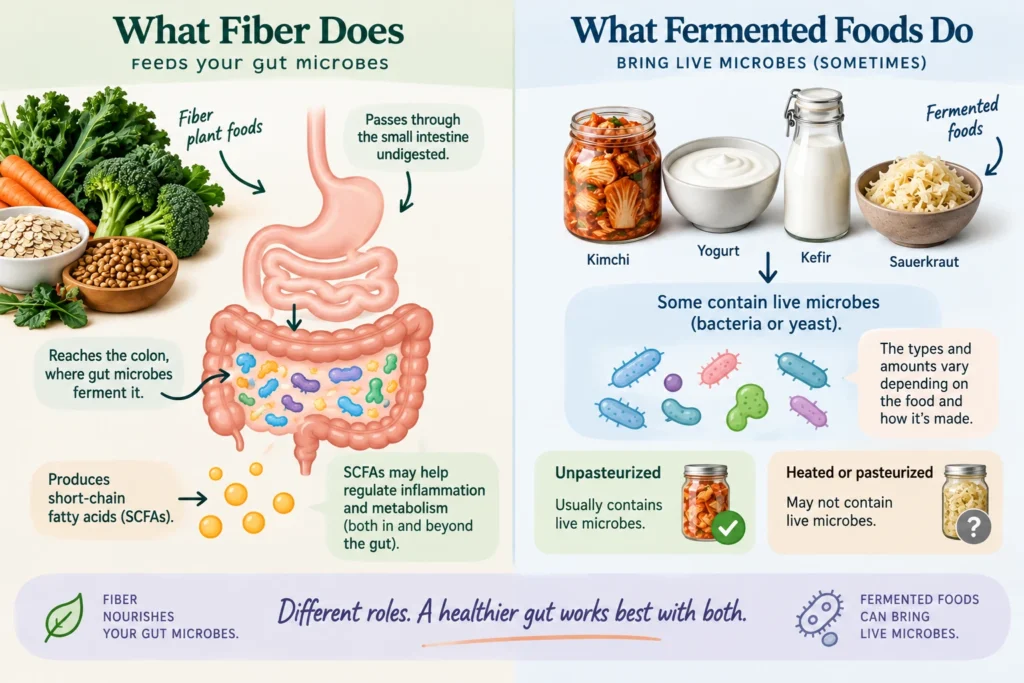
Some fibers pass through your small intestine undigested and travel down to your colon, where certain gut bacteria are able to ferment them, producing short-chain fatty acids. But that doesn’t mean every type of fiber produces the same response.
A review pooling 42 studies in healthy adults found that fewer than half showed a meaningful bump in these byproducts. The type of fiber, the amount, and the form it came in made a bigger difference than expected — the same word “fiber” clearly wasn’t doing the same thing every time. There’s research suggesting these byproducts play a role in inflammation and metabolism well beyond the gut itself, but which fiber, how much, and how your particular body responds all matter more than any blanket claim suggests.
More fiber isn’t automatically better
Ramp it up too fast, though, and bloating is a fairly normal reaction, not a red flag. More on avoiding that below.
High-Fiber Foods to Add to Your Diet
Lentils
They pack both soluble and insoluble fiber, plus a decent hit of plant protein. Easy to toss into soups, salads, or grain bowls. They contain fermentable carbohydrates, which can cause gas in some people. If you’re not used to eating legumes, a smaller serving may be more comfortable to start.
Chia Seeds
Add water and they swell into a gel. That’s exactly why they’re popular in yogurt or oatmeal. Because chia is so high in fiber, a large serving can be a lot to introduce at once if you’re not used to it.
Oats
Oats contain a fiber called beta-glucan, and the evidence for it helping with cholesterol and blood sugar is fairly solid. Whether it meaningfully reshapes gut bacteria composition is less consistent. Either way, it’s an easy one to fold into breakfast without much friction.
Berries
They bring a mix of fiber types along with various plant compounds, and frozen berries make prep painless. There isn’t much research isolating berries alone and their specific effect on gut health — I’d think of them more as boosting overall diet quality than as a targeted gut fix.
Vegetables
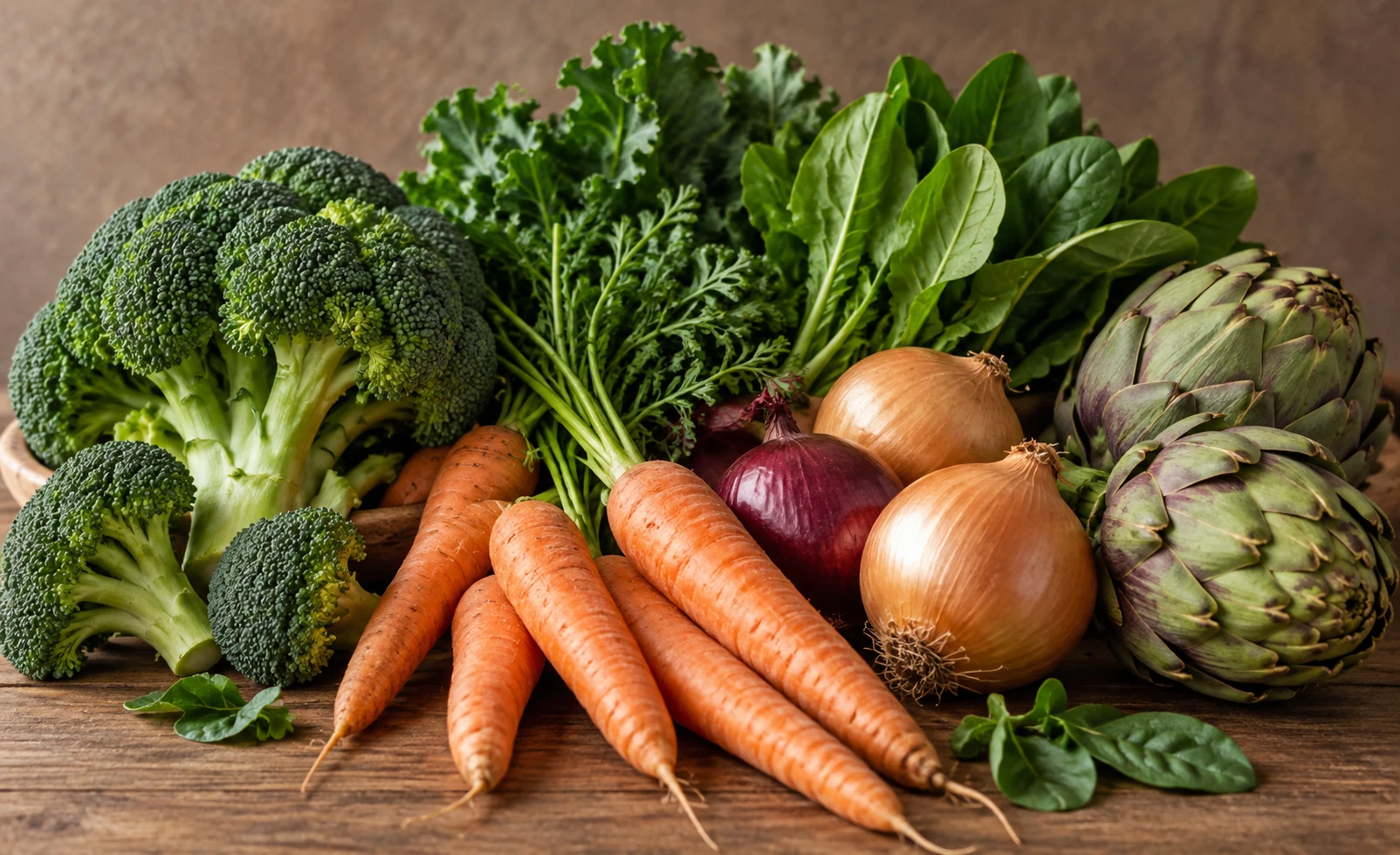
No single vegetable wins here; variety across broccoli, carrots, and leafy greens matters more than any one star ingredient. Onions and artichokes ferment easily and can trigger gas in sensitive people. Cooked vegetables sometimes sit better than raw ones.
Whole Grains
Barley, brown rice, and quinoa all contribute fiber, with some overlap with oats. The point here is variety rather than any single grain being superior. If a coarser texture feels rough on your system, starting with finer-grained options is a reasonable entry point.
Fermented Foods to Know for Gut Health
Yogurt
The thing to check is whether it contains live active cultures — meaning the bacteria used to ferment it are still alive in the product, not killed off during processing. This varies a lot by brand. Heat-treated yogurts and dessert-style yogurt products may not have any live cultures left at all.
Kefir
Kefir often carries a wider, more variable mix of bacterial and yeast strains than yogurt does, but exactly how wide depends a lot on the specific product. It’s harder to boil down to one simple thing to check for, the way you can with yogurt.
Kimchi and Sauerkraut
Here’s the part I want to spell out clearly: fermented doesn’t automatically mean it’s carrying beneficial bacteria (probiotics). Unpasteurized kimchi or sauerkraut still has live microbes in it. Heated or pasteurized versions may not.
There was one genuinely surprising finding here. A 2025 study with 87 participants compared fresh sauerkraut against pasteurized sauerkraut. Over four weeks, overall gut bacteria composition didn’t shift dramatically in either group, though a handful of individual species did change. What stood out was different: the group that showed a meaningful rise in absorbed short-chain fatty acids was the pasteurized sauerkraut, the one without live bacteria. The fresh version didn’t show that same change. That runs against the usual assumption that “fresh fermented is always better.” One small study can’t establish that pasteurized is generally the better choice, either — it’s a good example of why fermented foods don’t all work the same way, not a reason to switch which jar you buy.
Are Fermented Foods the Same as Probiotics?
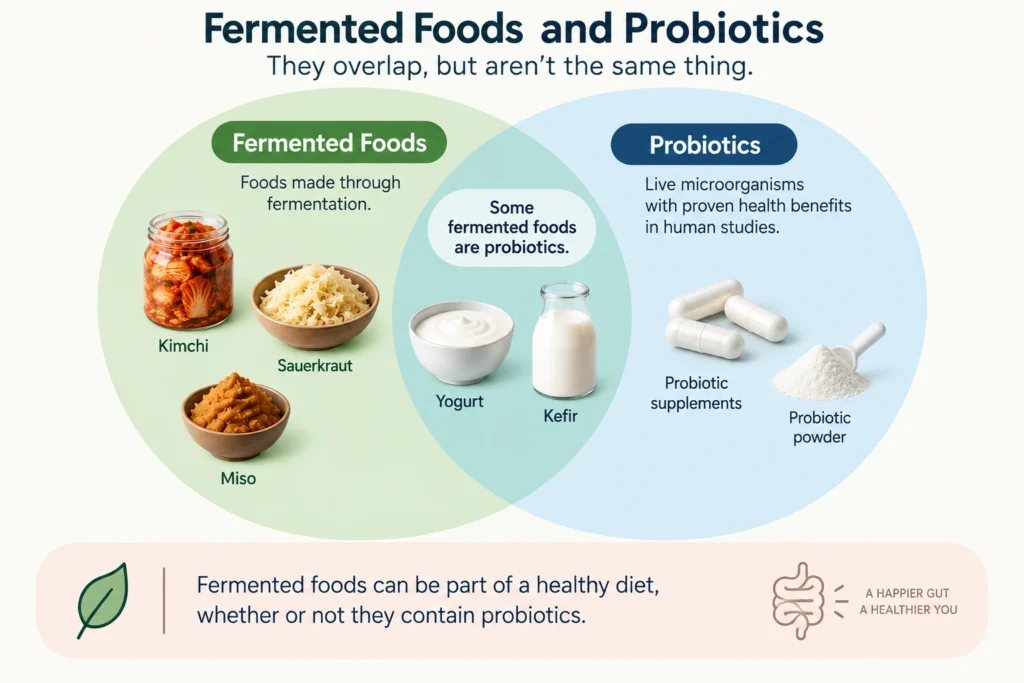
No. They’re not the same thing, and this isn’t just marketing language — it’s a real distinction in the science.
The International Scientific Association for Probiotics and Prebiotics (ISAPP) consensus report draws a clear line between three terms people use interchangeably. Fermented food is anything made through microbial fermentation, even if the microbes don’t survive (bread and wine count). Live cultures means the microbes are still alive in the product. A probiotic is stricter: an identified strain with clinical evidence it delivers a health benefit. Meeting one of these doesn’t guarantee the next, which is why most everyday fermented foods on the shelf never clear the probiotic bar.
Useful to know when you’re reading a label, but it doesn’t answer the more practical question: how much of any of this should you actually be eating, and how do you add it without your gut protesting?
How to Increase Fiber Without Bloating
Increase fiber gradually. This is common advice, and the logic makes sense: give your gut bacteria time to adjust. But the one trial that actually tested it found something more complicated. Participants were split into an immediate high-dose group, a gradual-increase group, and a placebo group. The immediate group’s symptoms settled down by week two, while the gradual group reported ongoing bloating and fullness through all three weeks, worse once they hit the highest dose in week three. It was a small trial (32 people completed it, funded by the barley product’s maker), so it’s not conclusive either way. Still, it’s a reminder that “go slow” is a reasonable default, not a proven fix.
Drink enough fluids. Some fibers, like chia seeds or psyllium, absorb water and turn gel-like, and they tend to pull water into the colon as they do. That’s why upping these fibers usually comes paired with advice to drink more water. That said, I couldn’t find much direct clinical proof that hydration alone eliminates bloating — most of it is reasoning from how the mechanism works, not a tested outcome.
Watch your own tolerance. The same fiber affects different people differently, depending on existing gut bacteria and the type and amount of fiber involved.
Don’t change everything at once. This one’s less about research and more about practicality: ramping up several fibers and fermented foods simultaneously makes it hard to trace what your body actually reacted to later. Changing one thing at a time makes the pattern easier to see.
What If Fiber Still Makes You Feel Worse?
Sometimes adding more fiber genuinely makes things feel worse, not better. Usually that traces back to increasing too fast, a specific food that never agreed with you, or trying to change too many things at once.
One thing to say plainly: if bloating or digestive discomfort keeps going for weeks, or gets progressively worse, food swaps alone aren’t the answer — that’s a reason to see a doctor. That’s especially true alongside blood in your stool, unexplained weight loss, fever, nighttime symptoms, or trouble swallowing. A persistent or unexplained change in bowel habits also deserves medical attention. These aren’t signals to try to manage through diet.
A Simple Day of Fiber and Fermented Foods
This isn’t meant to be “the perfect diet.” Just one reference point.
Breakfast: oats + berries + yogurt or chia seeds Lunch: lentils + vegetables + whole grains Dinner: your usual meal + a small serving of fermented vegetables (kimchi or sauerkraut)
Common Questions
What are the best high-fiber foods for gut health?
There’s more evidence behind mixing several sources (lentils, chia seeds, oats, berries, vegetables, whole grains) than there is behind leaning on any single food.
Which fermented foods are good for gut health?
Yogurt, kefir, kimchi, and sauerkraut can all be reasonable choices. Whether live cultures actually survive depends on how the product was processed, so checking the label is a habit that pays off.
Can eating more fiber cause bloating?
Yes, especially if you increase your intake quickly. It’s commonly recommended to increase gradually to avoid this, though the evidence on whether that actually helps is more mixed than the advice suggests.
Are fermented foods the same as probiotics?
No. Only some fermented foods meet the actual definition of a probiotic — most don’t.
There’s no single “perfect” food here. It’s more about working fiber and fermented foods into your day as a mix, and paying attention to how your own body responds. Starting slowly and actually noticing what happens next — that’s turned out to be the most realistic approach I’ve found.
Keep Reading
Curious what actually happens to digestion after 40, and why old habits stop working the way they used to? I broke it down in Gut Health After 40: When Old Habits Stop Working.
Wondering whether a gut health supplement could speed things up before overhauling your whole diet? Here’s I Tried a Lot of Gut Health Supplements After 40. Here’s What Was Actually Worth It..
This article is based on personal experience and publicly available research. It isn’t a substitute for medical diagnosis or treatment. Please consult a healthcare professional about any health concerns or medications.