
If you’re wondering whether you need gut health supplements after 40, here’s the short answer: probably not all of them. Maybe not any of them.
If your diet is already solid, adding more supplements might not do much. But if you have real symptoms, or real gaps in your diet, some ingredients can genuinely help.
So don’t start by asking “which supplement is best.” Start with “what do I actually need right now.”
I already ate a lot of vegetables and whole grains. That’s probably why a fiber supplement barely made a difference for me. That’s really the whole point of this piece. More supplements isn’t the answer. Figuring out what your body is missing is.
One quick note on the title. “Worth it” here doesn’t mean a supplement is proven to work for everyone. It means there was enough evidence to make it reasonable to consider for a specific problem, and in some cases, my own experience gave me another reason to keep it on my list.
Why I Started Looking Into Them
My Digestion Changed, So I Started Trying Things
I never thought my stomach was sensitive. I don’t eat huge meals. I’m not into spicy food. For most of my life, digestion just wasn’t something I thought about.
Then, somewhere in my 40s, small problems started showing up. Nothing dramatic. Just enough to notice.
I saw a doctor. My tests came back normal. But normal results didn’t make the discomfort go away, so I started trying things on my own. By now, I’ve tried almost every gut supplement sold near me.
Some Helped. Some Didn’t.
I want to be upfront: this isn’t a success story. Some things worked. Some did nothing at all. A couple helped, but not for the reason I expected. I’ll walk through each one below, and what I think was actually going on.
What “Gut Health” Actually Means
“Gut health” sounds like one big thing. But the research behind most of these supplements is aimed at something much smaller: one symptom, one diagnosis, sometimes even one specific extract.
So instead of asking “is this good for gut health,” I asked a better question. What exactly is this shown to help with? Does that match what I’m dealing with?
If you want the bigger picture on why digestion changes in the first place, the Gut Health After 40 guide covers that separately.
Which Symptoms Can Gut Health Supplements Help With?
Breaking things down by symptom made this whole search a lot more useful than another “Top 10 Gut Supplements” list.
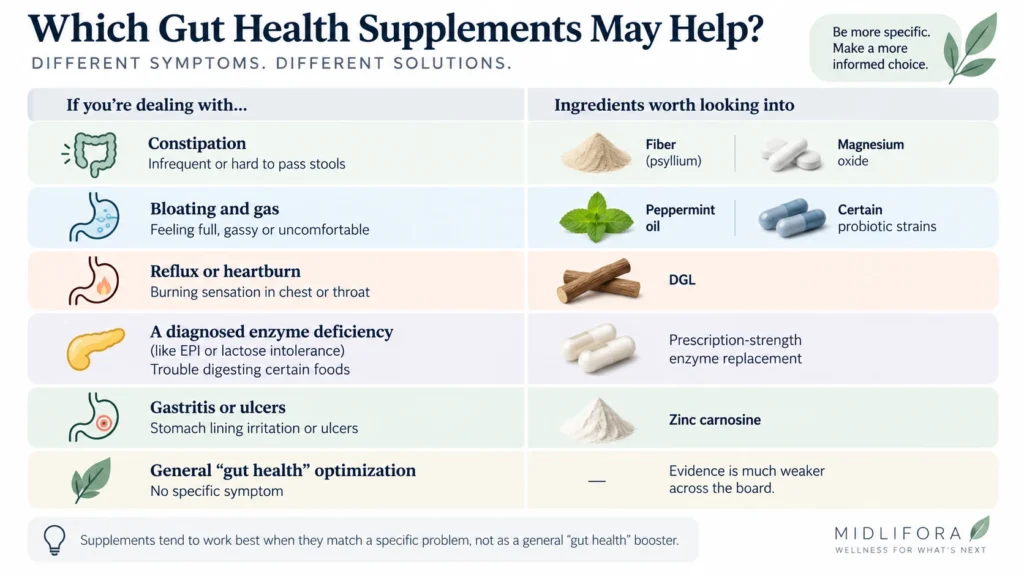
This isn’t the whole picture, but it’s a better starting point than “what’s good for gut health.” Below, I go through each ingredient: what it’s studied for, how strong the evidence is, and what happened when I tried it.
Which Supplements Are Worth Considering?
Feeling a difference and having strong research behind something are two separate things. One doesn’t prove the other.
Probiotics
I didn’t try probiotics this time, so this section leans more on research than my own experience.
The evidence is narrower than the marketing suggests. Some probiotic strains can reduce the risk of diarrhea caused by antibiotics. For some IBS symptoms, certain strains help too, but which strain matters a lot, and that detail usually gets left off the label.
For healthy people with no symptoms, taking probiotics just to “optimize” gut health is a different story. Studies show only small, temporary shifts in gut bacteria, with no clear long-term benefit. Major medical guidelines agree there isn’t enough evidence yet to recommend probiotics for most digestive symptoms.
If you’re on antibiotics, or you have IBS and want to try a specific strain, that’s reasonably well supported. If you’re healthy and just adding probiotics as general maintenance, the evidence is thin.
Fiber Supplements
I already ate a fair amount of vegetables and whole grains, so when I tried a fiber supplement, I didn’t notice much of a difference.
That matches the research. In people with constipation, fiber supplements, psyllium especially, clearly help. But if you’re already getting enough fiber from food, adding a fiber supplement may not give you much extra benefit. That’s probably the gap I fell into.
If constipation or low fiber intake is your actual issue, a fiber supplement is a different story.
Peppermint Oil
I didn’t try peppermint oil this time, but it has some of the more consistent evidence on this list. Several studies found it works better than placebo for IBS-related belly pain and overall symptoms.
The one catch: if you have reflux, peppermint oil can relax the valve between your stomach and esophagus and make heartburn worse. Since I was also dealing with reflux-type symptoms, this wasn’t one I was eager to try.
Magnesium Oxide
Another one I didn’t personally try. But the evidence for constipation specifically is solid: studies show it improves how often you go and how the stool looks.
High doses can cause diarrhea, and it needs caution if you have kidney disease, so more isn’t automatically better.
Digestive Enzymes
I didn’t try digestive enzymes on their own. I took an over-the-counter apple cider vinegar and enzyme blend alongside DGL (more on that below), so it’s hard to say how much credit belongs to which one. But digestion noticeably improved during that stretch. I couldn’t find solid evidence either way for apple cider vinegar alone, so I’d credit the enzyme blend, the DGL, or the combination before I’d credit the vinegar specifically.
“Digestive enzymes” actually covers two very different things. One is prescription-strength enzyme replacement for a diagnosed condition, like a pancreas that isn’t working properly or lactose intolerance. That category has solid evidence behind it. The other is over-the-counter enzyme blends sold for general digestive discomfort, and that evidence is much thinner. One small, short study found a multi-enzyme blend reduced bloating after meals, but it only involved a small group of people, so I’d be careful about applying that too broadly.
Unless you have a specific diagnosis, the evidence for over-the-counter enzyme blends is still pretty weak.
Zinc Carnosine
My doctor mentioned some mild gastritis, so I tried zinc carnosine. I took it for about three months, without any other stomach supplements in the mix, and my stomach discomfort noticeably improved during that time.
Zinc carnosine (also sold as polaprezinc) is used clinically in Japan as a stomach-protective agent, including after certain endoscopic procedures. In a trial of over 200 patients with procedure-related ulcers, adding it to a standard acid-reducing drug healed ulcers about as well as adding a standard comparison drug. Research also shows it may modestly improve success rates when added to standard treatment for H. pylori, a stomach bacteria. What I didn’t find was evidence for the broader “heals your gut lining” claims used in general gut-health marketing.
The evidence is real, but it only applies to diagnosed conditions like gastritis or ulcers. Keep that in mind if you’re considering it for something more general.
Mastic Gum
Mastic gum was the first thing I tried. At the time, my main complaint was food sitting heavily, like water wasn’t going down properly. It didn’t touch that symptom at all.
Mastic gum isn’t without evidence, though. A placebo-controlled study in people with dyspepsia found it clearly helped more than placebo, and it’s also been studied for its effect on H. pylori. On its own, though, it didn’t reliably clear the infection, and results were mixed when combined with standard treatment.
It didn’t work for me, but that might say more about my specific symptom not matching what these studies were testing than about mastic gum itself.
DGL (Deglycyrrhizinated Licorice)
Right after I finished a bottle of mastic gum, I moved on to DGL. Out of everything I tried, this made the biggest difference. Nighttime heartburn eased up a lot, and my mornings felt more regular. I was still taking the apple cider vinegar enzyme blend at the same time, though. So I honestly can’t say if that was a combined effect, or DGL doing the work on its own.
DGL is licorice root with glycyrrhizin (the part that can raise blood pressure) taken out. In a placebo-controlled trial, a month of a specific DGL extract clearly improved dyspepsia symptoms and quality of life. A separate trial with 200 adults found a similar extract improved reflux symptoms like heartburn over four weeks. One catch: most of these trials tested one specific branded extract and were fairly small.
There’s real evidence here, but given the size and brand-specific nature of the studies, I’d take it with a bit more caution than the results alone suggest.
L-Glutamine
When my stools got thinner and gas became a regular annoyance, someone recommended glutamine. It didn’t do much for me either, though I suspect that’s more about the product or dose than glutamine being ineffective in general.
The research helped explain why. Glutamine’s evidence is concentrated in a very narrow group: people with IBS-D that started after a gut infection, who also have measurably “leaky” intestines. In a well-designed trial with that exact group, glutamine led to a much higher response rate than placebo. But a broader 2024 review found no clear effect on gut permeability outside that narrow group, and only a small effect at much higher doses. The general “heals leaky gut” claim doesn’t hold up well outside that specific case.
I don’t fit that narrow profile, as far as I know, so there really isn’t enough evidence to say whether glutamine would help someone like me. I may simply not have been the kind of person represented in those studies.
Manuka Honey
I’d heard manuka honey on an empty stomach was good for digestion, so I gave it a try. About two months in, I hadn’t noticed much. It’s possible two months wasn’t long enough, and manuka honey quality varies a lot by grade, so a higher-grade product might have gone differently. For the product and timeframe I used, though, it didn’t do much.
The research on manuka honey is still early. Small, preliminary studies suggest it might help with reflux and dyspepsia symptoms, but they’re small, and some haven’t been formally published yet. One study in healthy people found no real change in gut bacteria.
Manuka honey seems safe, but the evidence for general “gut health” benefits is still thin.
What Didn’t Work for Me — and Why That Matters
A Supplement Can Be Useful Without Being Useful to You
Both mastic gum and glutamine have real evidence behind them. Neither did much for me. That doesn’t mean the ingredients don’t work. It more likely means my symptoms or my body’s situation didn’t match the cases where they’re shown to help. The fiber supplement barely moving the needle fits the same pattern: not a lack of evidence, just an area my diet already covered.
More Supplements Don’t Always Mean Better Gut Health
At one point I was taking several things at once, and it got hard to tell what was actually doing anything. DGL and the apple cider vinegar enzyme blend were a good example: the combination seemed to help, but I still can’t say for sure which part deserves the credit. Starting too many things at once makes it a lot harder to figure out what’s actually working, and I learned that one the hard way.
How to Choose a Gut Health Supplement After 40
Start With Your Symptom, Not the Supplement
“Good for gut health” is the wrong starting point. What you’re actually dealing with, whether that’s bloating, constipation, or heartburn, points to completely different ingredients.
Look at the Evidence for the Specific Ingredient
A broad “supports gut health” claim doesn’t tell you much. Checking what an ingredient is actually shown to help with, and how strong that evidence is, made a real difference in what I chose to try. The breakdown above is a decent starting reference.
Consider What You’re Already Getting From Food
Fiber, fermented foods, variety, and overall nutrient intake are the first things to check. If you’re already eating enough vegetables and whole grains like I was, you may not need to add a fiber supplement at all. High-Fiber and Fermented Foods for Gut Health
Don’t Start Everything at Once
Trying one thing at a time, and watching what actually changes, is a much better way to figure out what’s genuinely helping. I learned this firsthand, the slow way.
Know When a Supplement Isn’t the Answer
If symptoms are persistent or severe, get the cause checked before trying supplement after supplement. I saw a doctor first and only started experimenting after that.
The Bottom Line: You May Not Need More Supplements
The point of this piece isn’t to convince you to take more supplements. It’s closer to figuring out what your gut actually needs, if anything.
For me: DGL and zinc carnosine felt genuinely helpful. Mastic gum, glutamine, and manuka honey didn’t do much. Two things surprised me more than any single supplement, though. Trying one thing at a time made it much easier to see what was working. And a diet already built around vegetables and whole grains was doing more of the work than I gave it credit for.
There’s no solid evidence that everyone needs a gut health supplement after 40. Gut bacteria do shift with age, but that doesn’t automatically mean everyone needs to supplement for it. Figuring out what symptom you’re actually dealing with, and which ingredients have evidence for that specific symptom, still seems like the most realistic starting point.
Common Questions
Is there one “best” gut health supplement after 40?
Not really. It depends entirely on what you’re dealing with. Bloating, constipation, and heartburn point to completely different ingredients, so a single “best” pick doesn’t hold up.
Do I need to take probiotics every day?
Unless you’re on antibiotics or managing IBS with a specific strain, the evidence for daily probiotic use in otherwise healthy adults is fairly weak.
I already eat a lot of vegetables. Do I still need a fiber supplement?
Probably not much of a difference, based on both my experience and the research. If you’re already getting fiber from food and don’t have constipation, adding a supplement may not do much.
How long should I try something before deciding it’s not working?
It varies by ingredient, but most of what I tried, I gave around 2 to 3 months before deciding either way. DGL showed a difference faster than that; others I gave the full stretch before giving up.
Can I just take everything that might help at once?
I wouldn’t recommend it. Taking several things together makes it nearly impossible to tell what’s actually helping, which defeats the point of trying supplements in the first place.
Sorting through which supplements actually match your symptoms, one at a time, is really the whole exercise here. There’s no shortcut that skips that step.
Keep Reading
Curious why digestion shifts so much in the first place? Gut Health After 40: When Old Habits Stop Working breaks down what’s actually changing.
Wondering if food alone could cover what you’re looking for? High-Fiber and Fermented Foods for Gut Health walks through the food-first approach.
Sources
The claims above that needed outside evidence are backed by these studies:
- Zinc carnosine and ulcer healing: J Clin Gastroenterol, 2021
- Zinc carnosine and H. pylori treatment: Nutrients, 2022
- DGL and functional dyspepsia: Evid Based Complement Alternat Med, 2012
- DGL and reflux symptoms: Complement Med Res, 2025
- Glutamine and post-infectious IBS-D: Gut, 2019
- Glutamine and gut permeability (broader review): Amino Acids, 2024
This article is based on personal experience and publicly available research. It is not a substitute for medical diagnosis or treatment. Please consult a healthcare professional about any health concerns or before starting a new supplement, especially if you take medication or have an existing condition.