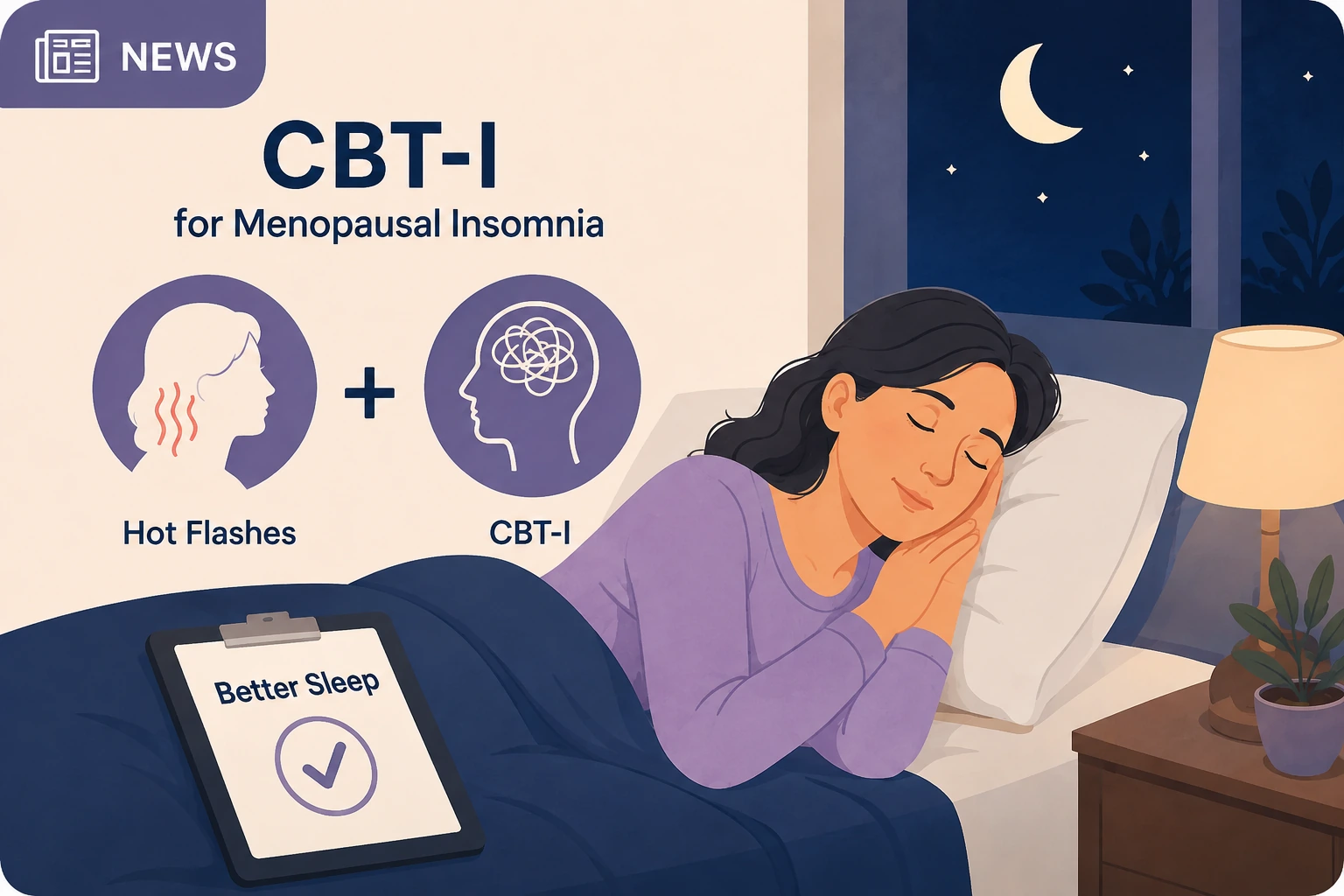
Up to 70% of women experience sleep disruption during the menopause transition, often driven by nighttime hot flashes. A new pilot study from the University of Texas Medical Branch (UTMB), published in the journal Menopause, found that combining cognitive behavioral therapy for insomnia (CBT-I) with hot flash-specific education improved sleep more than education alone. Full details are available from UTMB News. The trial specifically tested CBT-I for menopausal insomnia in women whose sleep is disrupted by nighttime hot flashes, not insomnia alone.
Why This Study Was Needed
CBT-I is already recognized as a first-line treatment for insomnia, as effective as short-term sleep medication and more durable once treatment ends. But most CBT-I research has targeted insomnia on its own, without accounting for nighttime hot flashes, which affect 60-80% of women during the menopause transition and are a major reason midlife women wake up repeatedly. Before running the trial, the researchers interviewed gynecology-clinic patients and providers. Patients named sleep disruption and hot flashes as top complaints; providers said they often lacked the training to treat or refer patients for either problem. That gap is what the study, called CBT-MI (cognitive behavioral therapy for menopausal insomnia), was designed to test: whether CBT-I for menopausal insomnia works better when hot-flash-specific content is folded in, for women whose insomnia and nighttime hot flashes occur together.
Who Took Part
The trial enrolled 43 perimenopausal and postmenopausal women, averaging 53.6 years old, recruited through flyers at gynecology clinics affiliated with UTMB in the Galveston, Texas area. To qualify, participants had to meet DSM-5 diagnostic criteria for insomnia disorder and report at least one nighttime hot flash a night over a prior seven-day period. The sample was more racially and ethnically diverse than much of the existing research in this area, including about 23% Hispanic/Latino and 23% non-Hispanic Black participants. Women were excluded if they were on hormone therapy, taking medications known to affect sleep or hot flashes, or had a sleep disorder other than insomnia; overnight sleep monitoring was used to rule out sleep apnea.
What the Researchers Did
Participants were randomly assigned to one of two groups. Eighteen women received CBT-MI: four individual 50-minute sessions over eight weeks that combined standard CBT-I components (sleep restriction, stimulus control, cognitive restructuring around sleep-interfering thoughts) with hot-flash-specific elements, including education about menopause, relaxation training, and restructuring negative beliefs about hot flashes. The other 25 women received a single 50-60 minute menopause-education session (MEC) using written materials from The Menopause Society, the National Institute on Aging, and the National Heart, Lung, and Blood Institute, plus general sleep hygiene tips — without the active behavioral components of CBT-I.
Both groups’ sessions were delivered by nurses and social workers who were trained and supervised by a sleep psychologist, rather than by sleep specialists themselves. Researchers tracked insomnia severity, hot flash interference, sleep self-efficacy, and mood at baseline, immediately after treatment, and at one- and three-month follow-ups.
What They Found
At the end of treatment, insomnia severity (ISI) scores fell by an average of 10.2 points in the CBT-MI group, compared with 6.2 points in the MEC group (P = 0.007). That left CBT-MI participants with a lower average ISI score after treatment (4.9) than the MEC group (8.8, P = 0.01). By that point, 69% of CBT-MI participants scored in the “no clinically significant insomnia” range, compared with 30% of the MEC group. Hot flash interference with daily life and women’s confidence in their own ability to sleep well (sleep self-efficacy) also improved significantly more in the CBT-MI group, and those gains held at the one-month follow-up.
Lantz said the program “helped women sleep better and reduced disruptions caused by these symptoms.”
Mood also improved: depressive symptom scores declined more in the CBT-MI group at the one-month follow-up, though anxiety levels didn’t differ significantly between groups at any point.
CBT-I for Menopausal Insomnia: What This Means
For women who’d rather not use medication or hormone therapy, CBT-I for menopausal insomnia offers a nonpharmacological option worth discussing with a provider — particularly one that specifically targets the hot flash-related awakenings that standard insomnia treatment doesn’t always address. The fact that non-specialist nurses and social workers delivered the program under supervision also suggests it could eventually be offered through regular gynecology visits rather than requiring a referral to a sleep clinic.
Limitations
This was a small, unbalanced pilot trial (18 women in the treatment group vs. 25 in the control group), which limits how confidently the results generalize and rules out subgroup analysis, such as looking at effects by race or ethnicity. The control group also didn’t get matched time and attention from a therapist: CBT-MI participants met with a therapist four times, MEC participants only once, so some of the benefit may reflect more contact with a provider rather than the CBT-I content itself. Group differences in insomnia severity were no longer statistically significant by the three-month follow-up, and the researchers noted that participant dropout at that point reduced their ability to detect a difference — a four-session program may also be too short to sustain gains without booster sessions. Finally, while the sample was more diverse than much of the existing literature, Black women, who face higher rates of both insomnia and hot flashes, were still underrepresented relative to that elevated risk.
Common Questions
What is CBT-I?
Cognitive behavioral therapy for insomnia is a short, structured treatment that targets the thoughts and behaviors that perpetuate poor sleep, rather than treating sleep problems with medication.
Is it more effective than medication?
This study didn’t directly compare CBT-I with medication. Prior research has found CBT-I performs about as well as short-term hypnotic medication, with more durable results after treatment ends.
How long do the benefits last?
Improvements held through one month in this study, but the difference between groups was no longer statistically significant at three months, so longer-term durability is still an open question.
Keep Reading
Wondering why you keep waking up in the middle of the night? Why You Keep Waking Up at 3AM After 40: The Science Explained breaks down what’s behind it.
Ready for a full sleep reset after 40? Sleep After 40: The Complete Guide to What Actually Helps is a good place to start.
This article is for informational purposes only and is not a substitute for medical advice. Talk to your healthcare provider about your specific symptoms.