
For months, I didn’t think what I was going through had anything to do with perimenopause. My periods were still regular. There’d been no single dramatic moment to point to and say, this is it. So I told myself I still had time.
Looking back, that logic was too simple. None of the changes I’d noticed showed up as one clear event — each one, taken alone, could be explained a dozen other ways. That turned out to be the part that matters most about perimenopause hormone changes: they can rise and fall rather than following a simple, steady decline.
What Perimenopause Actually Means
Perimenopause covers the transition leading up to your final period, plus the 12 months afterward — the waiting window that has to pass before menopause can actually be confirmed. During this stretch, your ovaries make estrogen and progesterone less predictably, and ovulation stops happening on a reliable schedule.
Perimenopause, menopause, and premature menopause get lumped together constantly, but they’re not the same thing — the distinction matters because it changes what you should actually expect.
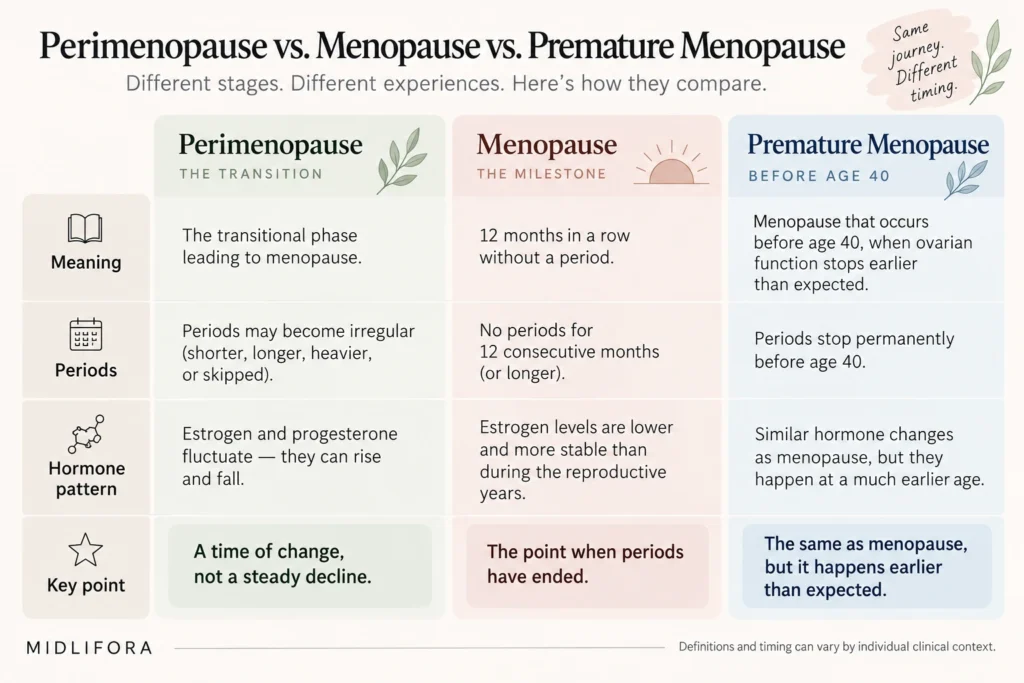
- Perimenopause: the transition toward menopause. Periods may be irregular but haven’t stopped. Hormones swing up and down rather than falling steadily.
- Menopause: reached 12 months after your last period. Hormones settle at a low, stable level.
- Premature menopause: ovarian function stops before age 40, and needs its own evaluation and care plan.
The short version: perimenopause isn’t a story about hormones dropping. It’s a story about hormones swinging.
What’s Really Happening With Perimenopause Hormone Changes
Estrogen
Estrogen doesn’t taper off steadily here — it swings, sometimes sharply, and can land higher than a typical premenopausal level before it drops again. The Menopause Society’s 2022 hormone therapy position statement notes that vasomotor symptoms can start during this variable stretch, well before hormone levels settle into the lower, steadier pattern of menopause itself.
I felt this instability firsthand. Some days I was completely fine. A few days later, I couldn’t sleep and my mood felt off for no reason I could name. I used to chalk it up to a bad week. Once I understood that perimenopause can involve fluctuating hormone levels rather than a simple decline, the unpredictability made a lot more sense.
Progesterone
Progesterone follows a different pattern. It’s made in the second half of your cycle, after ovulation, so as ovulation becomes less regular, the amount your body produces there can drop as well. This shift often shows up around the same time as the cycle changes you’re already noticing, though how much it changes varies from woman to woman.
Why Symptoms Come and Go
Because your hormones move differently month to month, your symptoms don’t stay at one steady intensity either. Some stretches feel manageable, and others feel like everything shows up at once — not from one clean trigger, but because several hormones are shifting at their own, overlapping paces.
This unevenness is part of why perimenopause is so easy to miss. If you’re waiting for one clear, unmistakable sign, you can end up overlooking the scattered ones that were the real signal all along.
Regular Periods Don’t Rule Perimenopause Out
I assumed that if my cycle was still regular, I couldn’t possibly be in perimenopause. That assumption turned out to be one of the most common misunderstandings about this stage.
A 2026 study released by The Menopause Society found that one in three U.S. women over 35 aren’t sure whether they’re in perimenopause. The same research also points to a separate pattern: symptoms often show up before cycles change in any noticeable way. Neither finding proves perimenopause is already underway the moment your periods are still perfectly regular — they just suggest the shift can be subtle enough, early on, that your cycle hasn’t caught up to it yet.
That was exactly what I’d missed. I assumed perimenopause would announce itself through my cycle first. So as long as my periods stayed the same, I kept explaining everything else away one at a time — a bad night’s sleep was just a bad night, a low mood was just stress.
The Early Signs I Didn’t Connect at First
Period Changes
Cycles get shorter or longer. Flow gets heavier or lighter. Some months get skipped entirely. These shifts track directly with irregular ovulation and the wider swings in estrogen and progesterone — though early on, the changes can be subtle enough to miss.
Sleep
I hadn’t changed my bedtime. I hadn’t started drinking more caffeine. But some nights I’d wake up and couldn’t fall back asleep, and other nights I’d sleep on schedule and still wake up foggy. At first I blamed stress or a busy week. The pattern only became visible once I stopped looking at sleep in isolation and started looking at it alongside everything else.
Not every midlife sleep problem is perimenopause. But when it shows up layered on top of other changes, it’s a pattern to pay attention to, not just a rough week. For a closer look at what’s driving it, Sleep After 40 walks through the mechanics in more depth.

Mood
Things that would normally roll off you can start landing harder, or a low mood can settle in without an obvious cause. Estrogen fluctuations interact with the brain chemicals involved in regulating mood, which is one reason this shift can feel like it’s coming out of nowhere.
Brain Fog
Words that used to come easily suddenly don’t, or focus feels harder to hold onto. Brain fog and trouble concentrating can show up during perimenopause, but these symptoms can have several possible causes — a good reason to mention it to a provider rather than assume. If this is the change bothering you most, here’s a closer look at why perimenopause brain fog happens.
Beyond Hot Flashes
Hot flashes and night sweats get most of the attention, but they’re not the only physical signs. Joint aches, headaches, vaginal dryness, and more frequent urination can show up too. Not having hot flashes doesn’t rule perimenopause out.
Vaginal and Sexual Changes
Lower estrogen affects the thickness and lubrication of vaginal tissue. Dryness or discomfort can build gradually, often over several years, rather than announcing itself all at once.
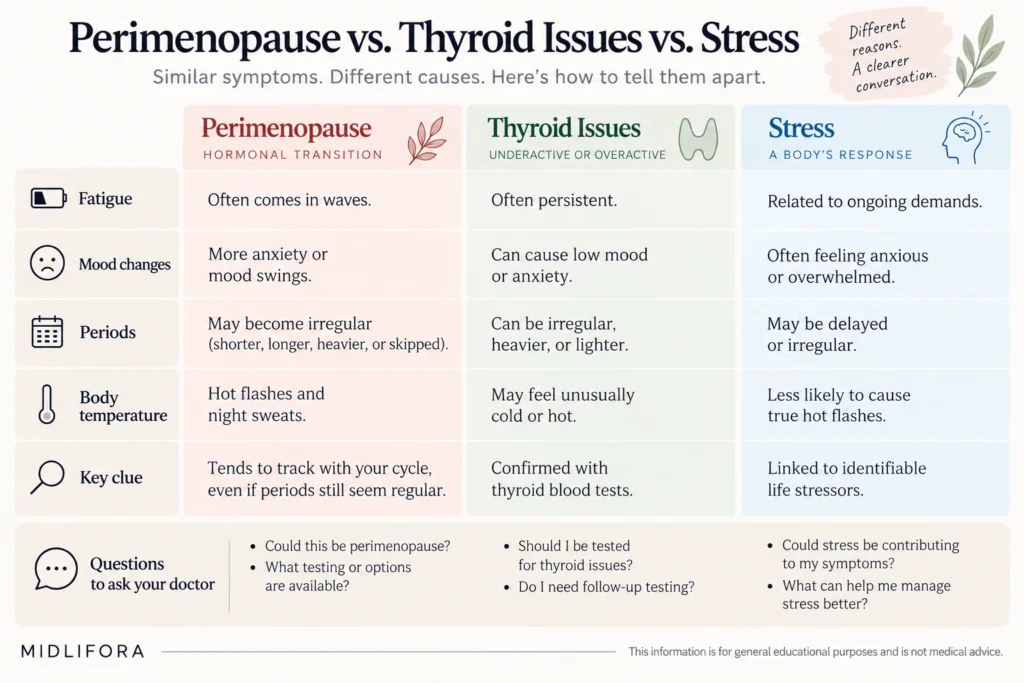
Perimenopause, Thyroid Issues, or Stress?
Fatigue, sleep trouble, mood changes, and weight shifts can come from several different places — not just perimenopause. Thyroid dysfunction and chronic stress are the two most common look-alikes, and both are genuine possibilities to rule out first.
The overlap with thyroid symptoms is real and well documented — fatigue, brain fog, mood changes, and weight shifts can look nearly identical either way. A TSH blood test is one of the more useful tools for sorting this out, though it’s one piece of the picture rather than a single definitive answer on its own.
Stress produces a lot of the same symptoms too, and it often has its own rhythm — flaring around a specific event or period and easing once that pressure lifts. If stress feels like the bigger piece of your picture, why midlife stress feels harder than it used to covers that on its own. But stress and perimenopause aren’t mutually exclusive; either can happen without the other, and both can happen at once. The point isn’t to self-diagnose from a symptom list. It’s knowing the overlap exists, so you bring the full picture to a provider instead of guessing alone.
Do You Need Hormone Testing?
Usually not. The Menopause Society has noted that there’s no single lab test or biomarker that can definitively confirm which stage of perimenopause you’re in, because hormone levels swing too much month to month for one blood draw to capture the picture.
Instead, most diagnoses come from putting your symptoms, cycle pattern, and overall clinical picture together — age is one data point, not the deciding one. Testing becomes more useful when symptoms start before 45, when another cause like thyroid dysfunction is suspected, or when a hysterectomy makes it impossible to track cycle changes directly.
What Helped Me Make Sense of the Changes
Tracking What Changes
Logging your cycle alongside sleep, mood, and hot flashes makes the pattern easier to see — and gives you something concrete to bring to a medical appointment instead of a vague “I just don’t feel like myself.”
Sleep, Activity, and Nutrition Basics
Regular strength training, enough protein, and paying attention to when you have caffeine all provide a foundation that makes symptoms more manageable. Exactly how much and what kind depends on your own health picture, so I’m keeping this general here — Natural Supplements for Hormone Balance: What Research Says goes into specific options in more depth.
Medical and Non-Hormonal Options
When symptoms start interfering with daily life, hormone therapy or non-hormonal medications are both worth discussing with a provider. What’s actually appropriate depends heavily on your own history: breast cancer, cardiovascular disease, and other factors all shift the calculation. This is a conversation for a clinician, not something to sort out alone.
What to Watch Out For
Be wary of “one supplement fixes everything” marketing, and don’t skip a medical opinion in favor of self-diagnosis. Heavy bleeding, chest pain, or a serious mood decline are reasons to see a provider now, not later.
Common Questions
Can stress cause the same symptoms as perimenopause?
Yes. Chronic stress can cause fatigue, sleep problems, mood changes, and trouble concentrating — nearly the same list perimenopause produces. The clearest tell is timing: stress symptoms tend to rise and fall with a specific situation, while perimenopause symptoms are more likely to persist or track with your cycle regardless of what else is going on.
Do I need a hormone test to know if I’m in perimenopause?
Usually not. Hormone levels swing too much from week to week for a single blood draw to pin down your stage reliably. Most providers diagnose perimenopause clinically, based on your symptoms, cycle pattern, and overall history — testing is reserved for symptoms starting before 45, a suspected thyroid issue, or a hysterectomy that makes cycle tracking impossible.
How long does perimenopause usually last?
Estimates vary depending on which numbers you’re looking at. The Office on Women’s Health puts the average at 4 years, with a range of 2 to 8. A 2026 study in Menopause puts the average closer to 6 years, with symptoms sometimes starting in your 30s and lasting up to a decade. Either way, this isn’t a process that wraps up in a few months.
What symptoms should send me to a doctor right away?
Heavy or unusual bleeding, heart palpitations paired with chest pain, a serious mood decline, or any of these symptoms starting before age 40 shouldn’t wait for your next scheduled checkup.
Is there one “official” age when perimenopause starts?
No single age applies to everyone. It typically begins in your mid-to-late 40s, but research shows it can start as early as your 30s for some women. Genetics, lifestyle, and overall health all play a role, so starting earlier or later than your peers isn’t unusual on its own.
Looking back, it wasn’t any single symptom that made this stretch difficult. It was not knowing whether the changes were connected. I thought perimenopause would announce itself with a clear line I’d cross one day. It didn’t work that way.
Once I stopped looking at each change on its own, I started to see they might all be part of the same shift. Perimenopause hormone changes don’t have to announce themselves in one obvious way to be real.
Keep Reading
Curious which supplements actually have evidence behind them? Natural Supplements for Hormone Balance: What Research Says
Trying to figure out if hormone therapy makes sense for you? Hormone Therapy for Perimenopause: What to Know Before You Decide
This article is based on personal experience and publicly available research. It is not a substitute for medical diagnosis or treatment. Please consult a healthcare professional about any health concern or medication.