
Mention HRT to a group of women and the room splits into two camps. One says absolutely not, because of breast cancer. The other says that’s old news, everyone’s on it now. I didn’t know which side to believe, so I started digging into the HRT for perimenopause question myself. Turns out they’re both a little right and a little wrong. More than twenty years of research since the 2002 WHI study says this was never a simple “safe or dangerous” question. The combination, the timing, the route, and your own situation all matter.
So here’s what I found, sorted by situation. Find the line that matches yours.
- If breast cancer runs in your family, that alone doesn’t rule you out. This is something to raise with your doctor, weighing your actual risk against your symptoms (a BRCA mutation or your own cancer history changes the picture — more on that below).
- If your periods are still happening but irregular, being in perimenopause isn’t a reason to wait. If symptoms are disrupting your life, that’s reason enough to bring it up now.
- If you’ve had a hysterectomy, estrogen alone is an option — no progesterone needed. Still have your uterus? You’ll usually need a progestogen alongside it (more on why below).
- If you’re worried about weight gain, the evidence for that fear is thin. Age, muscle loss, and metabolism explain most of the midlife weight shift.
- If you have clotting risk factors (obesity, a past clot), the way estrogen is delivered may matter — a patch or gel is something to bring up with your doctor.
Here’s why it breaks down that way.
Still Getting Your Period? HRT for Perimenopause Timing Explained
“You have to be fully in menopause to start” is a myth I believed for a while too. Perimenopause — periods still happening, just unpredictable — is not a waiting room. If symptoms are bad enough, HRT can start here. (If you want the fuller hormonal picture behind this transition, I broke it down separately in Perimenopause Hormone Changes Aren’t Just a Decline.)
What surprised me was how little research is designed specifically around this messy in-between stage. That helps explain why groups like NAMS treat dosing here as more of an individual conversation than a standard protocol — hormone levels are swinging unpredictably, so one-size dosing doesn’t fit. If you still have a uterus, a progestogen is part of the picture, period status aside. There’s another wrinkle: ovulation hasn’t fully stopped yet, so HRT alone won’t prevent pregnancy (more on that below).
What HRT Actually Helps — and Where the Evidence Gets Shaky
Where the Evidence Is Strongest
Hot flashes, night sweats, vaginal dryness, and pain during sex — this is where HRT has the clearest track record. Multiple medical societies list it as first-line treatment here, and the research backing it up is about as solid as this topic gets. Bone density and fracture prevention also have strong support, though using HRT for that reason alone, long-term, comes down to an individualized conversation with your doctor rather than a blanket yes.
Still Debated or Weak Evidence
Mood and cognition are murkier the more I read. Some women starting early in the transition report less depression and less brain fog — but it’s unclear whether that’s the hormones directly or just better sleep having a ripple effect. Estrogen isn’t approved as a mood treatment in its own right, which is worth knowing going in. If cognition specifically is what worries you, HRT and Dementia Risk: What This New Study Actually Shows looks at the newest data on that exact question.
When HRT May Not Be Appropriate / Common Side Effects
Unexplained vaginal bleeding, a history of estrogen-sensitive cancer, an active or past blood clot, or unexplained liver disease — these are situations where HRT usually isn’t the right fit. Common side effects (breast tenderness, irregular bleeding, bloating) are usually manageable with a dose adjustment. The more serious risks are blood clots and stroke, and both show up more with oral estrogen than with patches or gels — which is exactly why clotting risk factors point people toward the transdermal route.
Does HRT Increase Breast Cancer Risk?
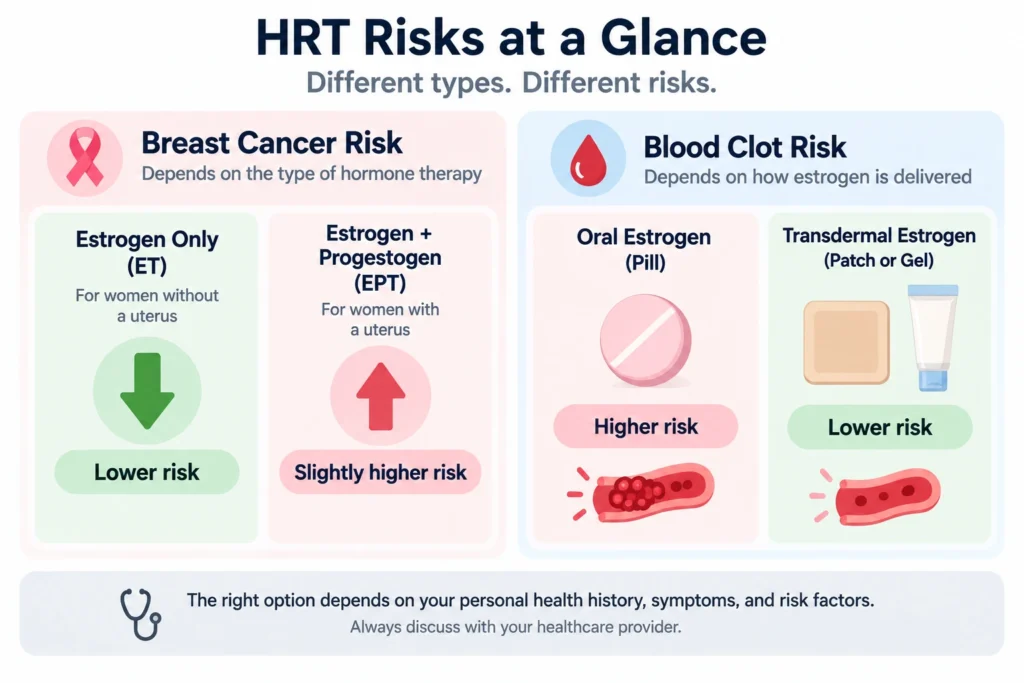
Breast cancer risk with HRT depends on more than just how long you use it — which type of therapy you’re on matters just as much. When WHI results made headlines in 2002 and HRT use dropped by nearly half in a year, the number everyone remembers only applied to estrogen combined with a progestin. Estrogen alone told a different story the whole time, and that distinction went largely unreported for two decades, which genuinely annoyed me when I came across it.
There’s also a newer piece of this. In February 2026, the FDA removed the breast cancer, cardiovascular disease, and dementia warnings from the boxed warning — the label’s highest-level alert — on several HRT products, saying the old blanket warning no longer matched the evidence. That doesn’t mean the risk disappeared; the fuller prescribing information still covers it. But it was one of the clearest signs to me that the conversation around HRT has actually moved on since 2002.
Risk Depends on the Combination, Not Just How Long You Use It
Estrogen-only therapy (used by women who’ve had a hysterectomy) trends toward lower breast cancer rates compared to no treatment. A recent Cochrane review breaks this down by regimen: combined therapy shows a modest increase in risk after several years of use, and the absolute increase is small for many women. Exactly how small depends on the type of hormone therapy, how long you use it, and your own risk factors — not one flat number. When I read that Cochrane review alongside NAMS’s 2022 position statement, the numbers looked at first like they were telling two different stories. They weren’t. Once I looked closer, both were describing that same small increase, just from different angles.
The type of progestogen seemed to matter too, which I didn’t expect going in. Some evidence suggests synthetic and micronized (body-identical) forms don’t carry quite the same risk in the first few years, though that gap isn’t strong or consistent enough to call micronized progesterone simply “safer.” I wanted “natural progesterone is just safe” to be the takeaway — the evidence doesn’t quite support that as a blanket claim.
A Family History Doesn’t Automatically Rule You Out
I assumed family history was an automatic dealbreaker. It isn’t. If your absolute risk is still low and your symptoms are seriously affecting your life, this is something to work through with your doctor rather than a hard no. A BRCA mutation or your own history of breast cancer is a different situation — that’s when non-hormonal options usually come first, and how close a relative and at what age they were diagnosed shapes that conversation more than any single test result.
HRT vs. Birth Control Pills: Two Things People Mix Up
Different Goal: Treating Symptoms vs. Preventing Pregnancy
More people confuse these than I expected. Both use estrogen and a progestogen, but the goal and the dose are different. Low-dose birth control is built to suppress ovulation. HRT is built to ease menopausal symptoms, at a lower dose than birth control needs. When irregular periods and symptoms overlap during perimenopause, the pill can sometimes do both jobs at once.
HRT Doesn’t Protect You From Pregnancy
This one caught me off guard. Perimenopause means ovulation gets irregular — not that it stops. HRT isn’t designed to suppress ovulation the way birth control is, so it doesn’t work as contraception. If you’re still getting periods and relying on HRT alone, you still need separate contraception.
What Progesterone Actually Does
Why You Need It If You Still Have a Uterus
This is the part I had to read twice to actually get: estrogen thickens the uterine lining, and left unchecked, that lining keeps building instead of shedding — which over time raises the risk of endometrial hyperplasia and eventually endometrial cancer. Progestogen counteracts that buildup. That’s the whole reason estrogen-only therapy isn’t used in women who still have a uterus.
When Estrogen Alone Is Enough
After a hysterectomy, there’s no lining left to protect — so there’s no reason to add a progestogen. Skipping it, where possible, is actually the better call given the breast cancer angle covered above.
Before You Start: What I Wanted to Know First

Before you turn an HRT for perimenopause question into an actual prescription, here’s what to sort out first.
Do You Actually Need Hormone Testing?
Hormone levels swing daily during perimenopause, so one blood test can’t tell you “yes, start now.” Diagnosis usually comes from your symptoms and period pattern rather than a single lab number, though your age and situation can change how much testing makes sense. Testing still has a place — mostly to rule out other causes, like a thyroid issue.
If “does this feel bad” isn’t specific enough, a validated symptom score can help. I used one to put an actual number on what I was feeling — something more useful to bring into a doctor’s appointment than “I’ve just been off lately.”
What About Weight Gain?
The “HRT makes you gain weight” idea doesn’t hold up well. Weight and body composition do shift around menopause, but that’s driven more by age-related muscle loss and a slower metabolism. Some observational data even shows slightly less weight gain in women on HRT than those without it — I looked at this more closely in Two Diet Patterns Linked to Less Weight Gain During Menopause.
Questions to Bring to Your Doctor
This is the list I put together for myself while researching: Given my family and personal history, is ET or EPT the better fit? Would oral or transdermal match my risk factors better? How often should we reassess? When symptoms ease, when do we talk about tapering off?
How Long Until It Works — and How Long Can You Stay On It?
Hot flashes typically start easing within a few weeks; the full effect can take a couple of months. The detail that stuck with me was that there’s no hard age cutoff — turning 60 or 65 doesn’t automatically mean stopping. Instead, it comes down to periodic check-ins, often around once a year: are symptoms still there, has anything about your risk changed.
Common Questions
Is bioidentical HRT actually safer than standard HRT?
Depends which kind you mean. FDA-approved bioidentical options, like micronized progesterone, go through the same safety testing as any other HRT product — “bioidentical” there just describes the hormone’s structure, not a safety guarantee. Compounded bioidentical hormones, sold outside FDA-approved products, are a different story. They skip that standardized testing, and the FDA has said there’s no good evidence they’re safer or more effective than approved options.
Can I switch directly from birth control pills to HRT?
Usually, yes, once you and your doctor agree you’re ready — but it’s a switch, not an overlap. Since the two are dosed differently, your doctor will typically have you stop the pill and start HRT at a specific point in your cycle rather than layering them.
What if HRT doesn’t fully relieve my symptoms?
That doesn’t mean you’re stuck with what you’ve got. Sometimes it’s a dose or formulation issue — a different estrogen type, route, or progestogen can make a real difference. If symptoms persist despite adjustments, that’s a good reason to check back in with your doctor rather than assume this is as good as it gets.
Does HRT interact with other medications?
It can, so it’s something to flag to whoever prescribes it. Blood thinners and certain antidepressants are two common ones that can interact with hormone therapy, and your doctor will want your full medication list before settling on a formulation.
What happens if I stop HRT — will my symptoms come back?
Often, yes, at least for a while. Stopping usually isn’t dangerous, but hot flashes and other symptoms can return, sometimes within weeks. Tapering off gradually rather than stopping all at once tends to make that transition smoother.
I started this because I couldn’t tell which camp to believe — the “never” crowd or the “it’s all fine now” crowd. Neither one turned out to be the real picture. The honest shape of the HRT for perimenopause question is this: not risky-or-safe, but which combination, starting when, for how long.
This isn’t really a decision to make alone with a search engine, mine included. It’s one to bring to a doctor who actually knows your history and your risk factors. If the checklist above makes that conversation a little easier to start, that was the whole point of writing this down.
Keep Reading
Curious what’s actually driving the mood swings and fog during this transition? Perimenopause Hormone Changes Aren’t Just a Decline breaks down what’s really happening hormonally.
Wondering whether a non-hormonal route could work instead? Natural Supplements for Hormone Balance: What Research Says covers what the evidence actually supports.
This article is based on personal experience and publicly available research. It is not a substitute for medical diagnosis or treatment. Please consult a healthcare professional about any health concern or medication.