
“Hormone balance.” That phrase kept showing up as I started reading about menopause, and it bugged me. What exactly in my body is a supplement supposed to be balancing?
I’m the type who researches before I buy, so I went looking for an answer before I’d bought a single bottle labeled “menopause supplement.”
Here’s the short version: some supplements for hormone balance do have real research behind them for specific symptoms. None of them balance hormones, not in the way the phrase implies. It depends entirely on what’s actually bothering you.
Some of the most popular menopause supplements also turn out to have the most mixed evidence. One ingredient nobody talks about much had numbers I wasn’t expecting. Here’s how it breaks down by situation:
- If hot flashes or night sweats are the main complaint → there’s an option with the largest evidence base of anything here, though how well it works may partly depend on whether your gut bacteria can convert a soy compound into its more active form.
- If sleep is the problem — trouble falling asleep, or waking up and staying up → there’s a mineral you could try, but keep expectations modest. Results in midlife women specifically haven’t matched what shows up in general adult sleep research.
- If anxiety or mood swings are the hardest part → one herb has the most striking numbers of anything on this list, though it’s still just a single small trial, so “promising” is the right word, not “settled.”
- If vaginal dryness or pain during sex is the issue → this isn’t really a supplement problem. A prescription option has solid evidence here; oral supplements don’t have that same evidence behind them.
- If several symptoms are stacked at once and you don’t know where to start → pick the one bothering you most and check the evidence for that symptom specifically. Nothing here fixes everything at once.
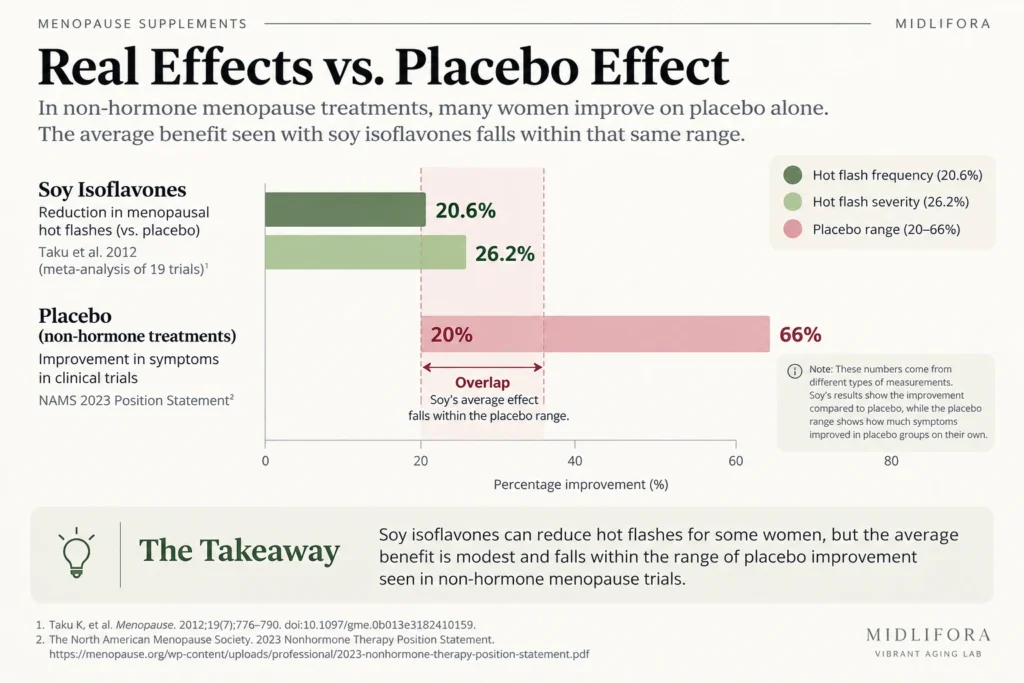
Here’s why I’d hold that number loosely: trials of non-hormone menopause treatments see placebo groups improve anywhere from 20% to 66% on their own, according to a 2023 position statement from The North American Menopause Society. Hormone therapy is still the most effective option on the table for symptom relief.
Supplements sit well below that, and part of what they’re competing against isn’t a placebo — it’s your body’s own tendency to feel better over time regardless. That doesn’t make the real effects fake. It just means the honest number is smaller than the marketing number.
Here’s what each ingredient actually has behind it.
Black Cohosh
Not there yet, despite being the first name that comes up. A 2012 Cochrane review pooled 16 trials and just over 2,000 women and found the evidence too thin to recommend black cohosh for menopause symptoms, largely because the studies used different extracts that don’t pool cleanly. NAMS doesn’t recommend it for hot flashes either.
That’s not the same as “proven not to work.” It’s closer to “not proven enough to recommend.” One thing worth flagging: rare cases of liver problems have been reported, so talk with your clinician first if you have liver disease or a hormone-sensitive condition.
Soy Isoflavones
This one has the biggest evidence base on the list. A 2012 meta-analysis pooling 19 trials found soy isoflavones cut hot flash frequency by about 20% and severity by about 26% versus placebo.
There’s a genetic wrinkle, too. Some people can convert a soy compound called daidzein into a more potent form called equol, and that ability may be one reason soy works better for some women than others. Roughly a quarter of Western women can make that conversion, versus more than half of Asian women. So the same supplement, same dose, might do a lot for one person and much less for another.
At typical doses, current evidence doesn’t show soy isoflavones raising breast cancer risk.
Red Clover
Red clover is the ingredient where studies genuinely disagree, and it’s usually not the ingredient’s fault. A 2013 Cochrane review found no significant difference between red clover and placebo. A newer meta-analysis, though, found close to two fewer hot flashes a day.
One 2021 meta-analysis found a larger reduction among women taking at least 80mg of isoflavones daily for 12 weeks or more, particularly those starting with 5 or more hot flashes a day. But that’s one analysis, not a settled rule. Government reviewers still describe the overall evidence as inconsistent, with some trials carrying a high risk of bias.
If you’re on blood thinners like warfarin, red clover’s coumarin content can interact, so check with your doctor first.
Magnesium
Magnesium is popular for menopause sleep trouble, but the evidence is a mixed bag once you look closely. The largest recent trial, 155 adults with self-reported poor sleep, found a modest improvement in insomnia scores after four weeks. But the capsule combined magnesium with a large dose of glycine, so it wasn’t a clean test of magnesium alone. It also wasn’t a menopause-specific trial. Studies done directly in menopausal women haven’t found a clear benefit over placebo.

I’ve kept taking it anyway, alongside what’s actually helped with my own 3 a.m. wake-ups, and falling asleep has gotten noticeably easier since I started. That’s my own experience, though, not a reason to expect the same result.
Skip it if your kidneys aren’t working well, and space it a few hours from thyroid medication — otherwise it’s one of the lower-risk options on this list.
Ashwagandha
Ashwagandha produced the most striking result of anything on this list, in one small trial. A 2026 trial of 60 women found that 56 days of KSM-66 extract dropped menopause symptom scores from about 31 to about 19 on a standard scale, while the placebo group barely moved.
That’s a large number, but the trial is also the limit of what it proves: one site, 60 people, and an extract supplied free by its own manufacturer. The National Center for Complementary and Integrative Health currently says there isn’t enough evidence to determine whether ashwagandha helps with menopause at all. One promising result from a single trial doesn’t outrank that yet.
Watch out if you have hyperthyroidism or take thyroid medication, since ashwagandha can raise thyroid hormone levels, and it may add to sedation if you’re already on sleep aids.
Do Supplements for Hormone Balance Actually Balance Hormones?
This was the question that started the whole search. Plant compounds like the isoflavones in soy and red clover, often called phytoestrogens, bind to the same estrogen receptors your own estrogen uses. But the fit is loose, and how loose depends on the specific compound and the tissue involved.
The short version: these compounds can nudge a few estrogen-sensitive processes without acting like a full hormone.
What they don’t do is restore your pre-menopause estrogen levels. A supplement that reduces your hot flashes and a supplement that restores your hormone levels are two different claims. Almost all the research above measures the first one: symptom scores, hot flash counts, not blood hormone levels.
Ashwagandha is the one supplement here that also measured hormone levels directly, and it showed some movement in estradiol and FSH. That’s still the same 60-person trial, though, not independent confirmation.
So when a label promises that supplements for hormone balance will “balance your hormones,” what’s actually been proven, in the best case, is that certain compounds ease certain symptoms for certain people. That’s a real thing. It’s just a much narrower claim than the phrase suggests.
What These Supplements Can’t Fix
A few things deserve to be separated out clearly.
Vaginal dryness and pain during sex aren’t a supplement problem. They’re a medication problem. DHEA sold over the counter as a supplement and prasterone, the prescription vaginal insert sold as Intrarosa, are chemically the same compound. Only the prescription version has FDA approval and solid evidence for this specific symptom, and oral DHEA supplements haven’t been evaluated by the FDA for safety or effectiveness here.
B vitamins are ahead of their evidence on menopause specifically. There’s no trial showing they ease hot flashes, sleep, or mood in menopausal women. The one real reason to take them is a confirmed deficiency on bloodwork, since untreated deficiency risks nerve damage and anemia, not just a mood dip — a different situation entirely from taking them just because you’re in menopause.
Timelines vary. Some trials above ran four weeks, others ran closer to a year, but nothing here showed results within days. Anything promising a fast fix deserves a raised eyebrow.
Weight gain and brain fog get pitched supplement fixes constantly, and neither has strong menopause-specific evidence behind either one. For weight, strength training and adequate protein has a far more solid track record; for brain fog, addressing sleep and stress tends to help more than anything you’d take in pill form.
Common Questions
How long does it take for menopause supplements to work?
Give it longer than a few days before deciding. The trials above ran anywhere from four weeks to about a year, so a gradual build is normal, not a sign that something isn’t working.
Are soy isoflavones safe if I’ve had breast cancer?
For most women, typical doses of soy isoflavones don’t appear to raise breast cancer risk, and some observational research even points the other way. If you’ve had estrogen-receptor-positive breast cancer specifically, high-dose isoflavone extracts are usually avoided as a precaution. Talk to your oncologist before starting.
Should I take B vitamins for menopause symptoms?
Not on that basis alone — there’s no trial testing whether B vitamins ease menopause symptoms. The one exception is a confirmed low result on bloodwork. Untreated B12 deficiency can affect your nerves and red blood cells over time, so it’s the kind of thing to correct regardless of what’s causing it.
Can I take more than one of these at the same time?
Combining is where the interactions live, not necessarily the individual ingredients. Red clover with blood thinners, ashwagandha with thyroid medication or sedatives — these are the pairings to flag for your doctor before stacking anything.
So that’s where I landed. “Hormone balance” turned out to be a much fuzzier phrase than I expected going in. Reducing symptoms and restoring hormone levels are two different things, and almost everything on this list only does the first one, for some people.
Right now I’m still just taking magnesium. But I know what to look for next: pick the symptom that’s actually bothering me, then find out whether there’s real research behind a specific option for that symptom, not a label promising to fix everything at once.
For me, supplements are something I’ll consider for one specific symptom at a time — not a first step to take instead of talking to a doctor once symptoms start affecting daily life in a real way.
Keep Reading
If you want to understand why these hormone shifts happen in the first place, Perimenopause Hormone Changes Aren’t Just a Decline — Here’s What’s Really Happening walks through what’s actually going on.
If none of this ends up being enough, Hormone Therapy for Perimenopause: What to Know Before You Decide lays out what to weigh before that conversation.
And if anxiety or mood swings are what’s hardest to manage, Supplements for Mood: What Actually Helps—and What Doesn’t goes deeper on that specific symptom.
This article is based on personal experience and publicly available research. It is not a substitute for medical diagnosis or treatment. Please consult a healthcare professional about any health concern or medication.