(This article contains affiliate links. We may earn a small commission if you purchase through them, at no extra cost to you. As an Amazon Associate I earn from qualifying purchases.)
For a long time, I compared omega-3 bottles by brand name and nothing else. Then I learned that the oil inside often comes from a separate company, with names like AlaskOmega and Epax.
The front of the bottle says something like “Fish Oil 1,000 mg” in big type. The details that matter sit on the back and beyond it. This is how I now choose an omega-3 supplement, as part of my guide to 9 Supplements for Midlife Women: An Honest Guide to What Actually Works.
This article contains affiliate links. We may earn a small commission if you purchase through them, at no extra cost to you.
How to Choose an Omega-3 Supplement: Start With Your Situation
The biggest number on the front of the bottle turned out to be the least useful one. The most useful details sit where most people never look. Find your situation below and start there.
- If you want to take one softgel and be done → look for about 1,000 mg of EPA and DHA in a single softgel. Fewer pills can also mean a lower price per useful milligram, as the cost math below shows.
- If you’d rather read test results than trust a badge → choose a brand that publishes results for the lot number printed on your bottle. A QR code or a lookup tool should lead you to your own bottle’s numbers.
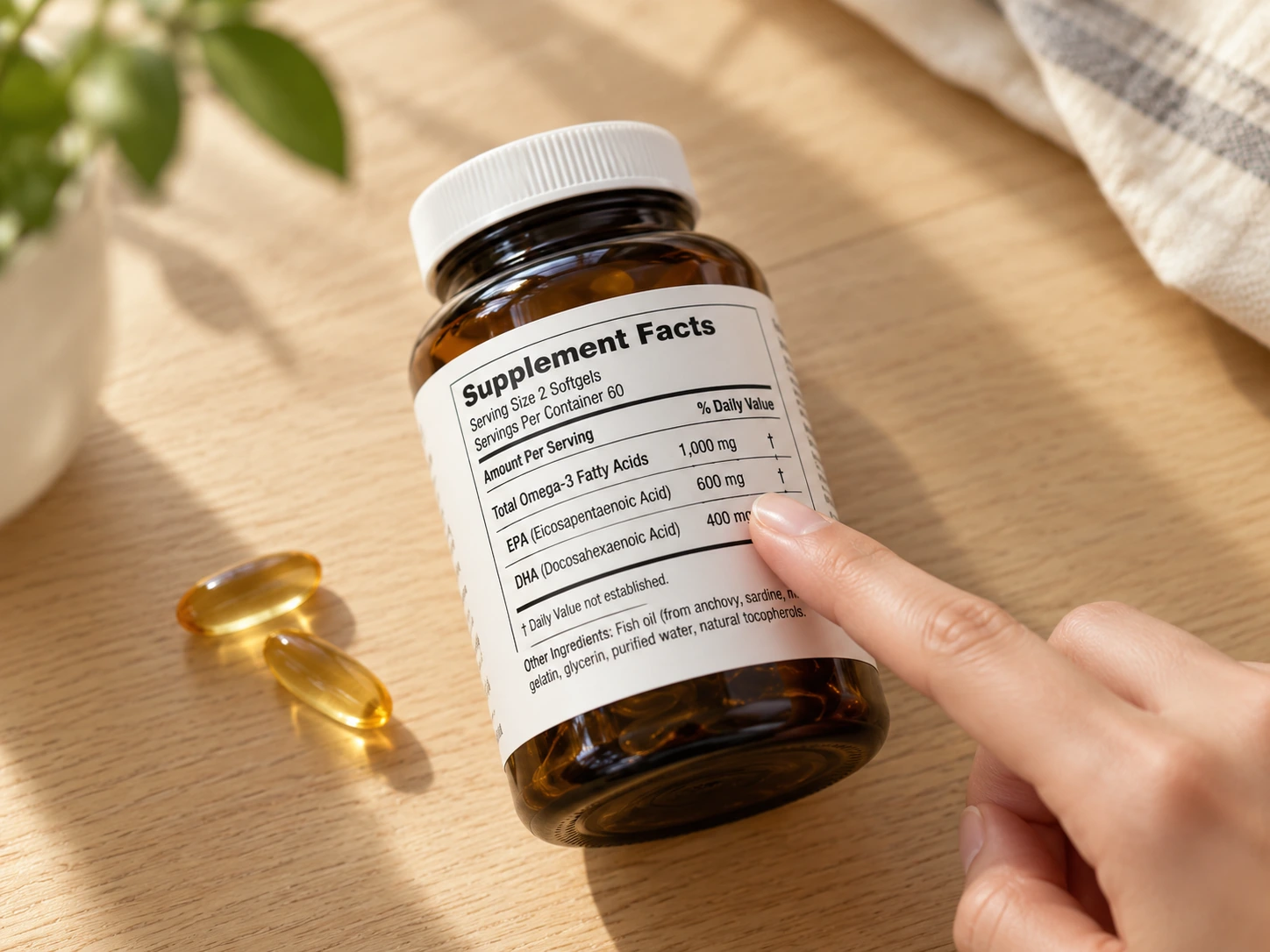
- If you’ve been reading “1,000 mg” on the front as your dose → turn the bottle around and add up EPA and DHA. Those two numbers are what I use to compare products.
- If rancid oil worries you → ask for oxidation numbers instead of trusting your nose. Some brands publish them.
- If you want an EPA-heavy formula and three softgels a day is fine → judge it by the daily total, not the amount per capsule. A high daily total is also more than most adults need.
- If you have heart disease or take blood thinners → talk to your doctor before choosing anything high-dose. The reason is in the dosage section below.
Here is why I landed there, one piece at a time.
EPA and DHA Content
The big number on the front is the weight of the oil. The dose is the EPA plus DHA listed on the back. Say a label reads 1,250 mg of fish oil, with 690 mg EPA and 260 mg DHA. Your dose is 950 mg, not 1,250.
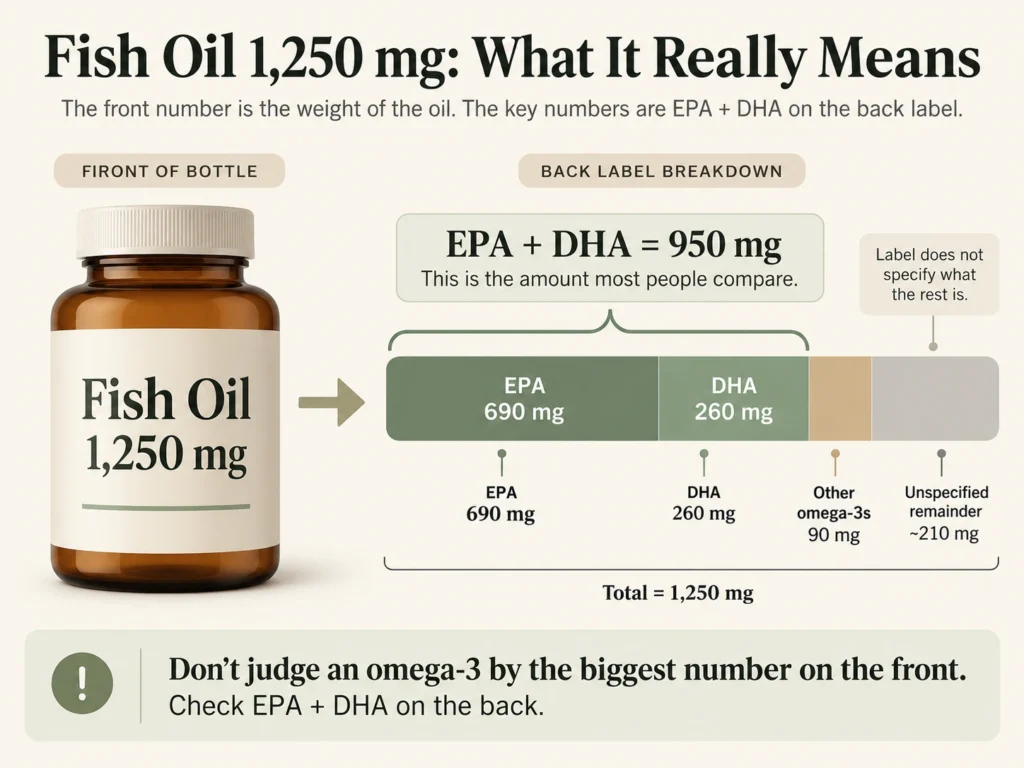
The remaining 300 mg is other fats, and about 90 mg of that is other omega-3s. The label doesn’t say what the rest is.
EPA and DHA also do different jobs. DHA is a building block for brain and eye cells. EPA is raw material for signaling molecules that help regulate inflammation. Ratios differ from product to product, and no ratio is automatically better. I just check both numbers.
How Much Do You Need?
Less than you might think. EFSA sets an adequate intake of 250 mg of EPA plus DHA a day for adults. Its later safety review cites 250 to 500 mg as the range recommended for heart health. One softgel of a concentrated oil already reaches it.
There is one caution at the high end. A 2026 analysis of 35 trials and about 114,000 people tied extra atrial fibrillation, an irregular heartbeat, only to doses above 1,500 mg a day in people already at high heart risk (full paper).
The added risk was 0.8 percentage points. Doses at or below 1,500 mg a day were not linked to extra cases, even in high-risk groups. The authors work at an omega-3 research institute, so I read it with that in mind.
If you have heart disease or take blood thinners, ask your doctor before choosing a high-dose product.
Oxidation and Freshness
Omega-3 oil spoils easily, and smell is not a measurement. Labs track spoilage in two steps. Peroxide value (PV) shows early damage, and anisidine value (p-AV) shows later damage. Double the first, add the second, and you get TOTOX, the total.
The industry group GOED sets limits of 5, 20 and 26 for the three. In a study of 44 supplements sold in the UAE, the average TOTOX was 23.8, just under the limit, and not every product passed (PLOS ONE). That is why I look for numbers instead of trusting my nose.
Testing and Raw Material Source
A brand and the company that makes its oil are sometimes two different companies. Some brands name the oil maker on the label, like AlaskOmega or Epax.
That is a good sign, but it doesn’t prove the finished oil is better. The names matter less than the traceability behind them. What I want is either a named oil supplier or test results for the exact lot on my bottle.
IFOS is a testing program built for fish oil. A five-star report means one lot passed checks for label accuracy, oxidation, contaminants such as PCBs and dioxins, and heavy metals.
Here is what one of those reports looks like. It covers a single lot, not the bottle in your hand, and not every brand takes part. Some brands run their own lot lookup instead, where you type the number from your bottle.
I used the same lot-level logic when I shopped for magnesium, in How to Choose a Magnesium Supplement: 6 Things I Check Before Buying.
TG, rTG, and Ethyl Ester
Omega-3 oil comes in three chemical forms. Natural triglyceride (TG) is how the oil sits in fish. Re-esterified triglyceride (rTG) rebuilds that structure after the oil is concentrated. Ethyl ester (EE) is what you get when the concentrated oil is left as it is.
In a two-week trial of 72 people taking about 3.3 g a day, rTG was absorbed better than ethyl ester, 124 percent versus 73 percent of natural fish oil (Dyerberg, 2010). That dose is far above a typical supplement.
In a six-month trial of people with high blood fats on statins, rTG lowered blood triglycerides compared with placebo and ethyl ester didn’t, but the two forms did not differ significantly from each other (Schuchardt, 2011).
Better absorbed isn’t the same as better results. I treat rTG as a nice extra, and dose, freshness and test results come first.
Cost per 1,000 mg of EPA+DHA
Bottle price is a bad comparison.
A softgel with 300 mg of EPA and DHA and one with 1,000 mg can sit side by side at the same shelf price, but they don’t cost the same per dose. So I convert everything to price per 1,000 mg of EPA plus DHA.
The math is simple. Divide the bottle price by the number of softgels, divide that by the EPA plus DHA in one softgel, then multiply by 1,000. Price is the last step when I choose an omega-3 supplement.
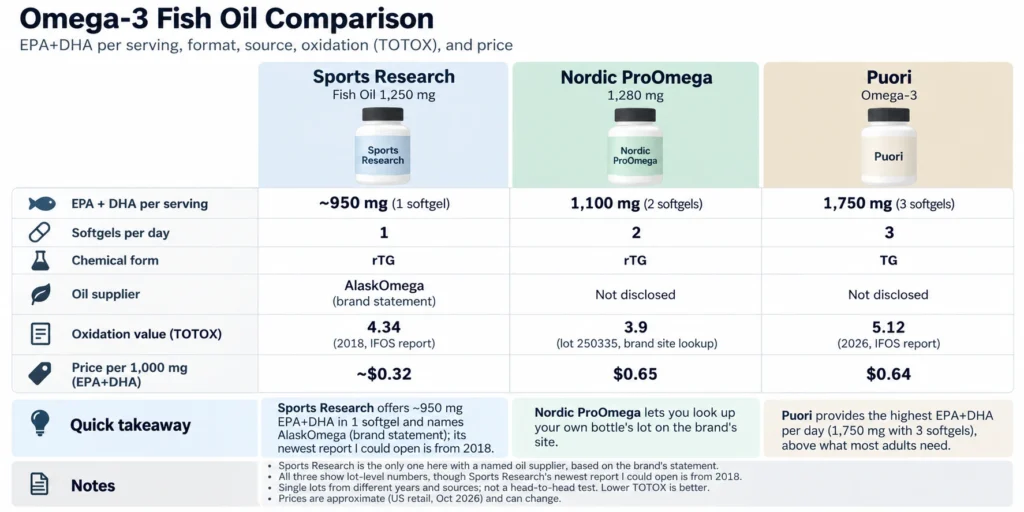
For the three products below, I land at about $0.32 for Sports Research, $0.65 for Nordic Naturals and $0.64 for Puori, based on US retail prices I checked in October 2026. Prices move, so recheck before you buy.
An expensive bottle isn’t automatically better. A cheap one isn’t automatically worse. The number only tells you what a dose costs.
The Omega-3 Supplements I Would Consider
To choose an omega-3 supplement without guessing, I held three products against the criteria above. Each one misses somewhere, and I say where.
I chose concentrated products because concentration makes purity, testing, capsule count and cost easier to compare. That doesn’t mean everyone needs a gram of EPA and DHA. The serving size on a label is not a target intake for everyone.
Puori sits well above the dose most adults need, and Nordic’s two-softgel serving sits above it too.
Sports Research Triple Strength
Why I picked it. Sports Research Triple Strength Omega-3 puts about 950 mg of EPA and DHA into one softgel, in rTG form, from wild Alaska pollock. A daily dose is one pill. At roughly $0.32 per 1,000 mg, it was also the cheapest of the three.
It is the one product here with a named oil maker. The brand says its oil is AlaskOmega.
What I don’t like. The IFOS note on the Amazon page is dated April 2016. The newest report I could open for this version comes from a 2018 lot, with a TOTOX of 4.34 against a limit of 19.5. Check your own bottle’s lot number in the IFOS registry.
EPA runs well ahead of DHA, 690 mg against 260 mg. The brand also sells a newer version with DHA 310 mg and Norway-sourced oil, so check which one you receive.
Nordic Naturals ProOmega
Why I picked it. Nordic Naturals ProOmega is rTG oil with 1,100 mg of EPA and DHA in two softgels. Nordic lets you type the lot number from your bottle into its website. For example, ProOmega lot 250335 lists a TOTOX of 3.9, along with heavy-metal and PCB results.
What I don’t like. Nordic doesn’t name its oil maker, and the results live on its own site, not an independent registry.
Two softgels is more than double the top of the 250 to 500 mg range, and one softgel brings you to about 550 mg. At roughly $0.65 per 1,000 mg on the Amazon price I saw, it costs about twice what Sports Research does.
Puori O3
Why I picked it. Puori O3 publishes independent IFOS reports for its lots. A 2026 lot report lists TOTOX at 5.12 against an IFOS limit of 19.5, and an older lot came in at 6.86. It is sold in triglyceride form, in black capsules that block light.
What I don’t like. You take three softgels a day. The label gives 1,250 mg EPA and 500 mg DHA, which is 1,750 mg.
That is well above what most adults need, so I’d treat it as the pick for readers who specifically want a higher-dose formula. It costs about $0.64 per 1,000 mg, roughly twice Sports Research.
Common Questions
Does a fishy smell mean the oil is rancid?
I can’t say. I didn’t find a study showing that smell reliably separates fresh oil from oxidized oil, so I don’t trust my nose in either direction. Lemon flavoring makes smell even harder to read. I look for PV and p-AV numbers, or at least a lot-level test report.
Do I need rTG instead of ethyl ester?
No. rTG is absorbed better in short trials, but better health results haven’t been shown. I’d put the label dose and the test results first, and treat the form as a tiebreaker.
Can I take omega-3 with blood thinners?
Ask your doctor first. Omega-3s can affect clotting, and product labels carry that caution. The heart-rhythm signal in trials also appeared at high doses, so a higher-dose product deserves an extra conversation.
What does an IFOS five-star rating actually cover?
One lot, tested for label accuracy, oxidation, contaminants and heavy metals. It doesn’t certify the bottle in your hand or every lot the brand sells. That is why I look for results tied to a lot number.
I used to pick omega-3 by brand name. Now I turn the bottle around first, add up EPA and DHA, and ask who made the oil. Then I look at oxidation numbers and test results, and I check price last. With that order, front-of-bottle claims stop steering me.
Each pick gives something and holds something back. Sports Research names its oil maker, but the newest report I could open for it is from 2018. Puori and Nordic show recent lot-level numbers without naming their oil makers. That is the trade-off I’d rather know before buying.
Keep Reading
Curious which supplements have real evidence for mood, omega-3 included? Read Supplements for Mood: What Actually Helps—and What Doesn’t.
This article is based on personal experience and publicly available research. It is not a substitute for medical diagnosis or treatment. Please consult a healthcare professional about any health concern or medication.