
(This article contains affiliate links. We may earn a small commission if you purchase through them, at no extra cost to you. As an Amazon Associate I earn from qualifying purchases.)
Vitamin D labels are confusing. One bottle says 600 IU, the next says 5,000 IU, and every one promises strong bones and a healthy immune system.
I read a lot of studies and guidelines before I picked a product. I’m not a doctor, so I only leaned on big trials and official sources. This is the post I wanted to read first about vitamin D supplements.
What I read was messier than I expected. Some big claims did not hold up in large trials. A few signals did. And the label on the bottle ended up mattering more than the brand name.
Here is the short version, so you can spot your own situation:
- If you are healthy, under 75, and only want “extra insurance,” the research does not show a clear payoff. A plain D3 in the 600 to 2,000 IU range is the safe lane if you still want one.
- If something makes low levels likely, like little sun, gut problems, or past weight-loss surgery, ask your doctor about a blood test before you pick a dose.
- If you are 75 or older, pregnant, or have high-risk prediabetes, a major guideline suggests supplements for you. Ask your doctor which amount fits.
- If you are thinking about 5,000 IU or more, start with a blood test and plan a recheck. That amount is above the upper limit.
- If you take warfarin, talk to the doctor who prescribes it before you start any product with vitamin K2.
- If the labels all look the same, check three things on the bottle itself: D3, the amount, and an outside certification for that exact product.
Here is how I got there.
What the Research Actually Shows
Most of the big trials I read on vitamin D supplements tested healthy adults. They were mostly men 50 and older and women 55 and older.
For bones, the answer was no. A 2026 review in The BMJ pooled 69 trials and about 154,000 adults. Vitamin D alone did not change the chance of breaking a bone. The biggest single trial, VITAL, gave 2,000 IU a day to 25,871 people for about five years. It got the same result.
Two limits matter here. In most trials in the BMJ review, the average age was 65 or older, so the results may not match women in their 40s. And VITAL did not pick people because of a deficiency, so it can’t tell us much about people who are truly low.
The BMJ review also left out people who were taking osteoporosis medicine.
One result looked better. In VITAL, people taking 2,000 IU had 22% fewer new autoimmune diagnoses, such as rheumatoid arthritis or thyroid disease. In plain numbers, that is about 2 or 3 fewer people per 1,000. The result barely crossed the line for statistical significance, so I call it a maybe.
Vitamin D plays a role in how immune cells work, but the latest pooled trials did not clearly show that it prevents infections. Large trials also did not show clear benefits for mood, heart disease, or cancer prevention.
The same VITAL trial tested fish oil too, which I covered in How to Choose an Omega-3 Supplement: What Actually Matters.
Who May Need More Vitamin D
Most healthy adults do fine with the standard daily amount. Some things make low levels more likely, according to the NIH Office of Dietary Supplements.
Getting older is one. So is getting little sun, living with obesity, or having had gastric bypass surgery. Conditions that make it hard to absorb fat can also lower your levels, such as celiac disease, Crohn’s disease, or ulcerative colitis.
Kidney problems matter too, because the kidneys help turn vitamin D into its active form. Steroid medicines can change how your body uses it as well.
Darker skin makes less vitamin D from sunlight. The NIH adds that it is not clear whether those lower levels hurt health.
The Endocrine Society’s 2024 guideline names a few groups that may benefit from supplements. They are children and teens, pregnant people, adults 75 and older, and adults with high-risk prediabetes.
For prediabetes, it suggests supplements along with lifestyle changes, even though trial results have been mixed. For healthy adults under 75, it says the standard daily amount is enough.
If any of this sounds like you, the right dose depends on your body, not on a bottle label. That is a talk for your doctor.
Dose and Blood Testing
The Numbers to Know
Vitamin D is measured in IU, short for international units. Many labels also show mcg, short for micrograms. 40 IU equals 1 mcg.
The daily amount the US sets for healthy adults is called the RDA. It is 600 IU until age 70 and 800 IU after that. The upper limit, called the UL, is 4,000 IU a day. That is the most that is unlikely to cause harm over time. It is a ceiling, not a target.
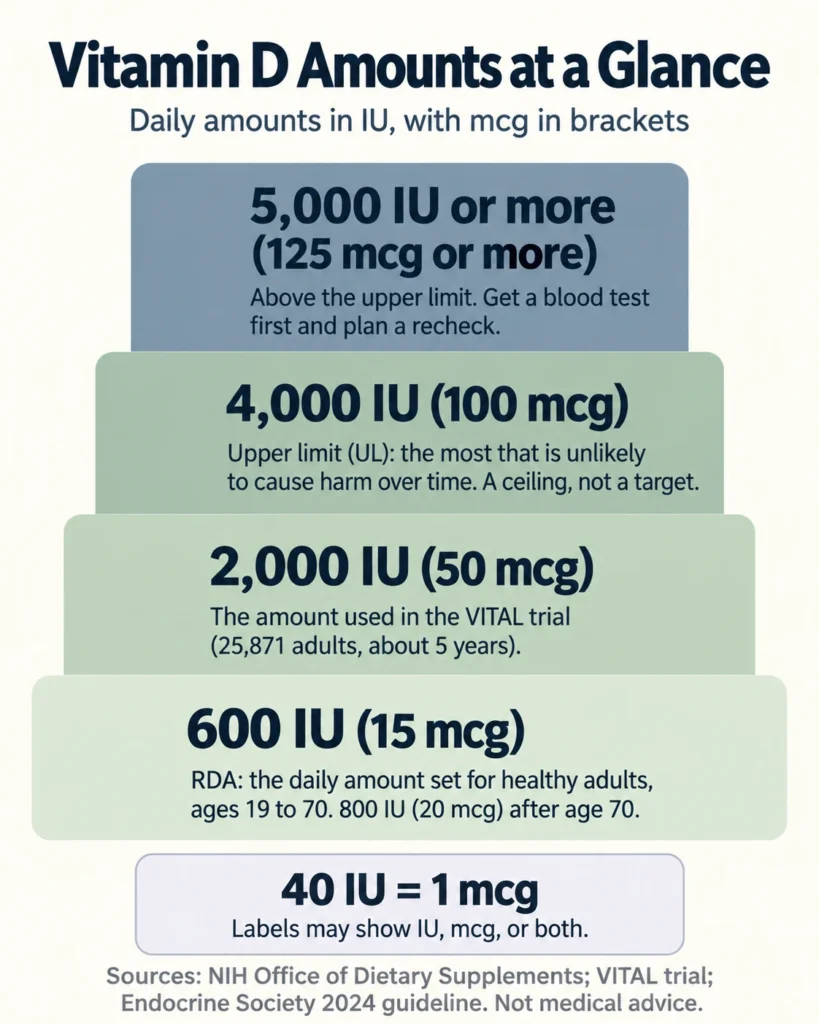
1,000, 2,000, and 5,000 IU
1,000 IU is a small step above the RDA and far below the upper limit.
2,000 IU is the amount VITAL used. After about five years, the people taking it did not have more high calcium levels or kidney stones than the placebo group. But VITAL left out people with past kidney stones or high calcium. It also allowed up to 800 IU of other vitamin D a day.
5,000 IU is above the upper limit. To see what happens near it, I looked at a 2023 analysis that pooled trials using 3,200 to 4,000 IU a day for at least six months. High calcium in the blood was about twice as likely.
The extra cases came to about 4 per 1,000 people. That is small, but it is not zero, and I saw no clear benefit for healthy people to balance it.
Doctors do use higher doses to treat a true deficiency. That comes with testing and a follow-up test, so it needs a doctor.
Do You Need a Blood Test?
The test is called 25(OH)D. Results come in ng/mL, and some labs use nmol/L. Multiply ng/mL by 2.5 to get nmol/L.
The Endocrine Society advises against routine testing in healthy adults. It says there is no proven benefit and no proven target level. The result usually would not change what you do.
A test makes sense in some cases. These include low calcium, trouble absorbing nutrients (after gastric bypass or with inflammatory bowel disease), kidney problems that waste vitamin D, or medicines that break it down faster.
Here is how to read a result, per the NIH. Under 12 ng/mL (30 nmol/L) points to deficiency. 20 ng/mL (50 nmol/L) or more is enough for most people. Above 50 ng/mL may be linked to harm. Nobody has proven the best level for preventing disease.
If I planned to take 5,000 IU or more, I would want a test first and another one later.
How to Choose Vitamin D Supplements
These label-reading habits match what I use in How to Choose a Magnesium Supplement: 6 Things I Check Before Buying. When I compare vitamin D supplements, I go in this order.
- Check that it says D3. Both D2 and D3 raise blood levels. The NIH says D3 usually raises them more and keeps them up longer.
- Pick 600 to 2,000 IU per serving. If you have none of the risk factors above, this range covers the RDA and the amount VITAL used. For 5,000 IU or more, go back to the testing part above.
- Check the unit. Labels use IU, mcg, or both. 2,000 IU is 50 mcg.
- Look for a certification on that exact product. USP Verified and NSF/ANSI 173 mean an outside group checked that product. A line like “made in a GMP facility” describes the factory, so it says less about the bottle in your hand. “Third-party tested” only helps if the brand says who tested what.
- Read the ingredient list. Check for allergens and extras. Most D3 comes from lanolin, which is sheep wool. Vegan versions use lichen.
- Pick a form you will take daily. Fat helps your body absorb vitamin D, so a meal is a good time. The NIH says some is absorbed even without fat.
- Decide on K2. The next section covers it.
- Compare price per serving. Divide the bottle price by the number of servings. That is the fair way to compare different strengths.
- Ask a doctor first if it applies to you. That means a diagnosed deficiency, a condition or surgery that affects absorption, or a medicine like warfarin.
Should You Take Vitamin D3 With K2?
Many D3 products add vitamin K2. The evidence for the combo is mixed.
One trial gave 180 mcg of K2 (as MK-7) to 244 postmenopausal women for three years. Their bone loss slowed. The company that sells that MK-7 paid for the study.
Then a 2019 review of 36 trials pooled all forms of vitamin K. For postmenopausal or osteoporotic women, it saw no clear effect on bone density or spine fractures. Broken bones overall may drop, but the authors said the evidence was too weak to be sure.
So I treat K2 as a maybe, not a must. If you want a combo anyway, I check these:
- Which K2 it is. Look for MK-7 or MK-4 on the label. The 244-woman trial used MK-7 at 180 mcg. Some Japanese bone trials used MK-4 at doses in milligrams, which is far above a label dose in micrograms.
- How much K2 is in one serving. The NIH sets 90 mcg a day as the target for adult women. That number is for all vitamin K together, not for K2 alone, so use it only as a point of comparison when you read a label.
- Whether you take warfarin. Vitamin K can interfere with it. The NIH says people on warfarin should keep their vitamin K intake about the same every day. Ask the prescribing doctor before you start or stop any K2 product.
Three Vitamin D3 Supplements to Consider
These are the three I would look at, based on the checks above. The links below are affiliate links. Brands change formulas, so read the current label before you buy. I also say where I could not confirm something.
Nature Made Vitamin D3 2000 IU Softgels is D3 only, at 2,000 IU. The label says USP verified the ingredients, strength, and manufacturing process. The softgel contains soybean oil and gelatin, so it is not vegan.
The USP mark comes from the label, so I would look up the exact product on USP’s site before buying.
21st Century Vitamin D3 50 mcg (2000 IU) is also D3 only, in a softgel. NSF’s own listing shows this exact product under NSF/ANSI 173, the standard for dietary supplements. It is the one I could confirm most directly.
Carlson Vitamin D3 + K2 is the only combo here. One serving is two capsules, and it gives 2,000 IU of D3 and 90 mcg of K2 as MK-7. The capsule is plant-based, and there is no sugar. A 120-capsule bottle is 60 servings, so use that number when you compare price.
The K2 is the same MK-7 form as the 244-woman trial, at half that trial’s dose. Carlson says the product is potency and quality tested, but I could not find a USP or NSF certification for this exact product, so that part stays unconfirmed.
Its label has a warfarin warning. If you take warfarin, skip this one unless your doctor says it is fine.
Common Questions
Is it better to take vitamin D every day or once a week?
Every day, in a lower dose. That is what the Endocrine Society suggests for adults 50 and older who have a reason to take vitamin D. It prefers that over bigger doses taken less often.
My multivitamin already has vitamin D. Do I add it up?
Yes. The upper limit is about your total intake. Add up the vitamin D in your multivitamin and any other supplements, including a D3 + K2 product, and check the label of each one.
Is 5,000 IU too much?
It is above the 4,000 IU upper limit, so I would not start there without a blood test. In a three-year trial of 311 healthy adults aged 55 to 70, people taking 4,000 or 10,000 IU had lower forearm bone density than people taking 400 IU. Bone strength did not differ.
Is vitamin D3 vegan?
Not usually. Most D3 comes from lanolin, which is sheep wool. A vegan D3 uses lichen, and the label should say so. Check the capsule too, since gelatin is not vegan.
Final Thoughts
Back to those labels. The number on the front of the bottle matters less than I thought, and what is written on the back matters more.
Vitamin D is not a cure-all, and for most healthy adults the big trials did not show a clear payoff. If you have a deficiency or one of the risk factors above, that changes things, and your doctor should guide the dose.
When I look at vitamin D supplements now, I turn the bottle around first.
Keep Reading
Want the bigger picture before you buy anything? Start with 9 Supplements for Midlife Women: An Honest Guide to What Actually Works.
Do you add up milligrams on a supplement label? Try Magnesium Dosage Calculator: Check Your Supplement Label.
This article is based on personal experience and publicly available research. It is not a substitute for medical diagnosis or treatment. Please consult a healthcare professional about any health concern or medication.