
This article contains affiliate links. As an Amazon Associate I earn from qualifying purchases, at no extra cost to you.
Most advice on how to choose a magnesium supplement starts with the form. Glycinate for sleep, malate for energy, threonate for the brain. I bought my first bottle that way. I picked Thorne’s CitraMate because it had malate in it.
Then I started tracing where those one-liners came from. It turned out I’d skipped the parts of the label that should come first.
A few things surprised me along the way. One form’s brain reputation started in a rat study. Another form’s best sleep trial found a small effect against a placebo, and never tested it against another form. And the number I should have checked first was on the label all along, right in front of a pair of parentheses.
The Short Answer
- If you plan to follow the label’s top dose → add it up first. Three of the five bottles I compared go over the US upper intake level for supplemental magnesium at their highest suggested dose.
- If the bottle says “third-party tested” → look for who tested it and what they checked. A brand’s own claim and an outside certification are different things.
- If you’re picking glycinate or threonate specifically for sleep or calm → check the elemental magnesium and the capsule count before the form. I couldn’t find a head-to-head human trial comparing magnesium forms for sleep.
- If you see magnesium oxide in the parentheses on the label → expect less of it to be absorbed, even when the milligrams match. Check those parentheses even if the front says “chelated.”
- If price decides it for you → compare cost per serving and cost per 100 mg of magnesium, not the price of the bottle.
- If you have kidney disease or myasthenia gravis, or take osteoporosis drugs or certain antibiotics → talk to your doctor before you pick a product.
Here’s how I got there, one check at a time.
My Magnesium Buying Checklist
1. I Look at Elemental Magnesium, Not the Big Number
Magnesium can’t go into a capsule by itself. It’s always paired with another molecule. The big number on the label is often the weight of the whole pair. The part your body uses is just the magnesium, which is called elemental magnesium.
Doctor’s Best shows this well. Its label lists 200 mg of magnesium, drawn from 2,000 mg of magnesium lysinate glycinate chelate. Only a tenth of that compound is actual magnesium. NOW Foods Magtein is similar: 2,000 mg of magnesium threonate holds 144 mg of magnesium.
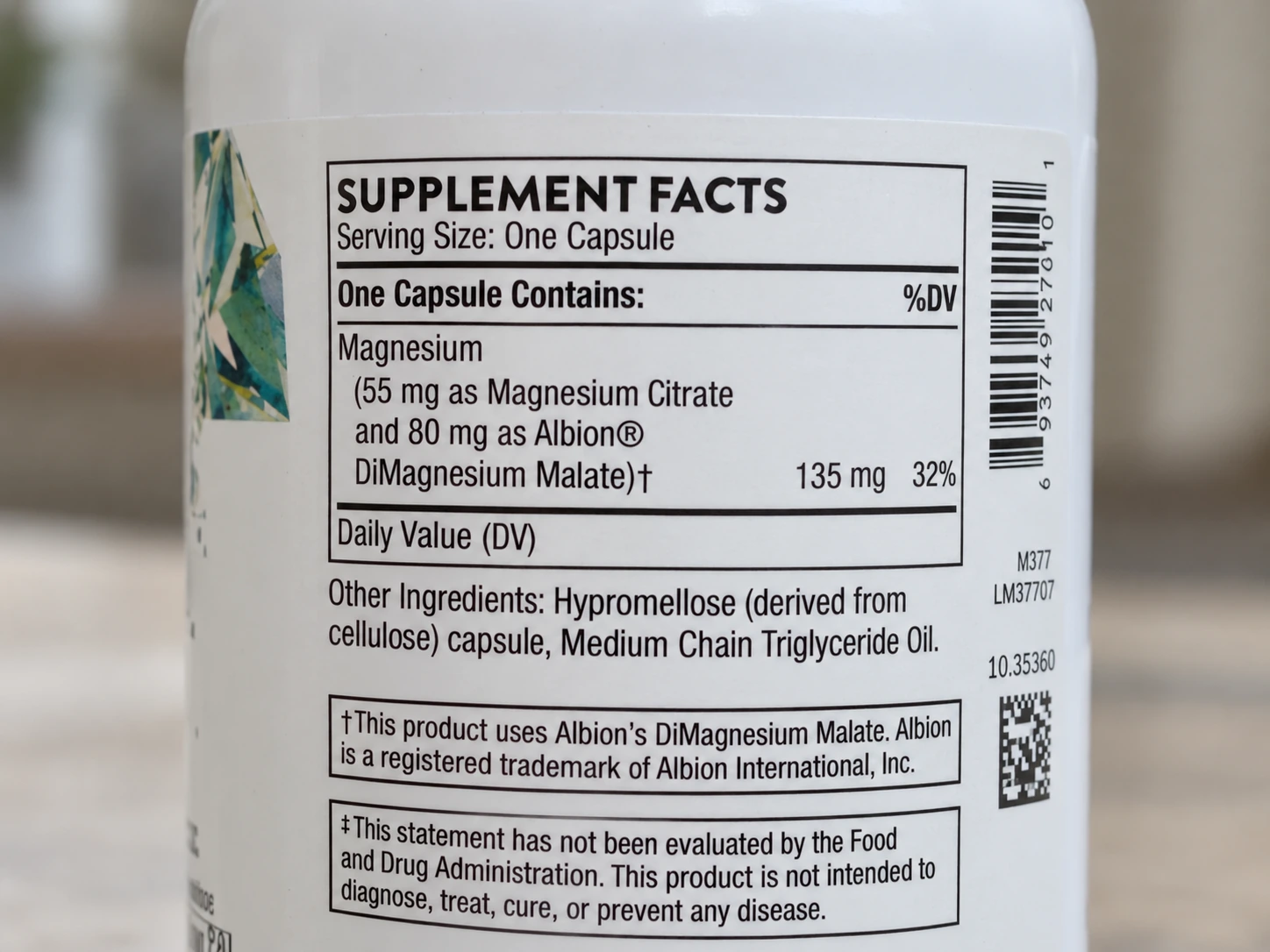
The good news is that US Supplement Facts panels list the elemental amount on the magnesium line. The number in front of the parentheses is what you’re actually getting.
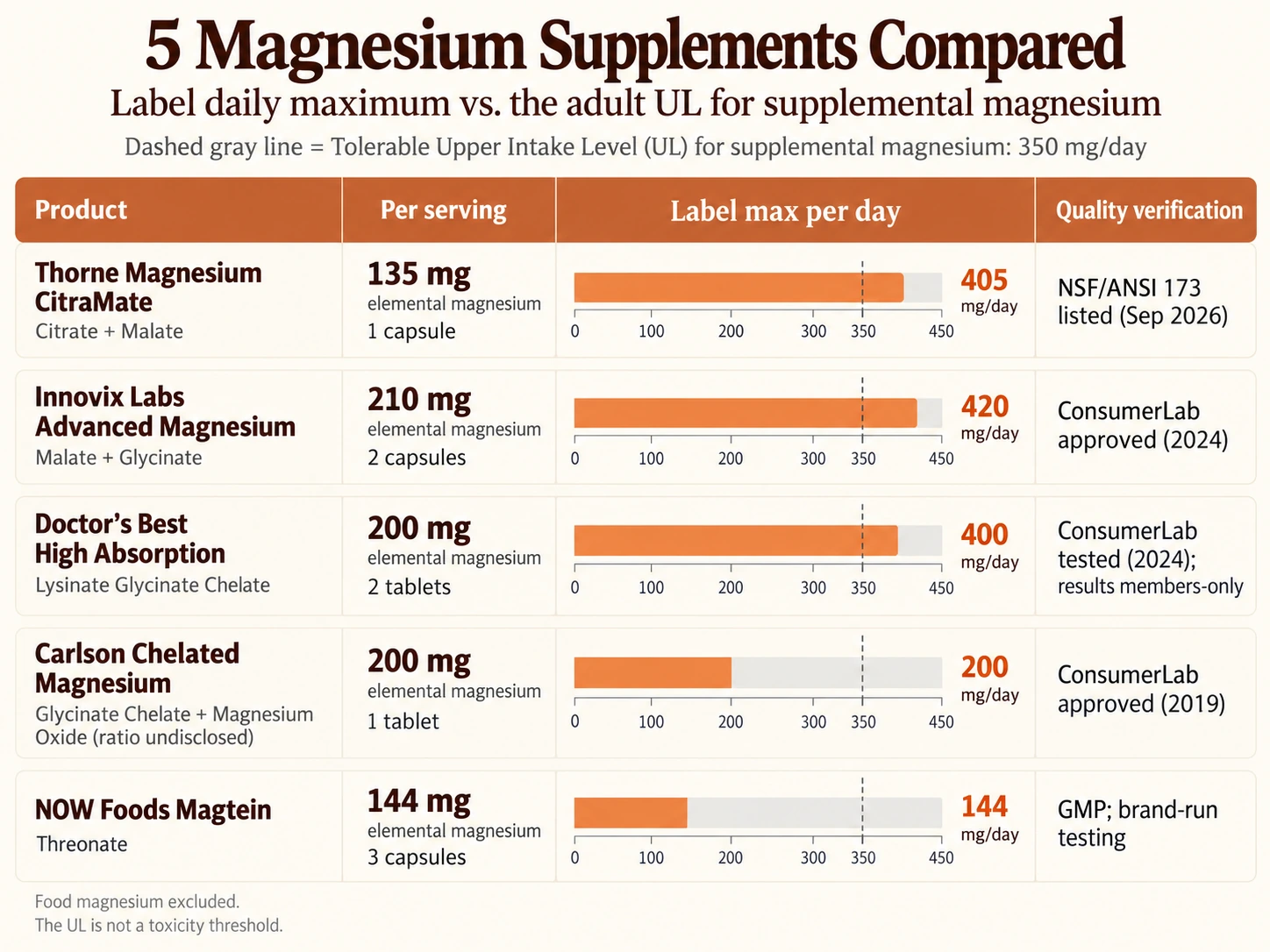
Before you choose a magnesium supplement, there’s one more number to know. In the US, the tolerable upper intake level for supplemental magnesium is 350 mg a day for adults. Magnesium from food doesn’t count toward it.
This limit isn’t a line where things suddenly turn dangerous. It was set mainly around diarrhea and stomach upset, which are what you’d likely notice first past it.
I assumed every label would keep its top dose under that line. Three of my five didn’t.
Doctor’s Best says two tablets twice a day, which is 400 mg. Thorne says one capsule up to three times a day, which is 405 mg. Innovix Labs says two capsules up to twice a day, which is 420 mg. Follow any of them to the maximum, and you’re past the US limit.
2. I Check How Many Capsules Make One Serving
The same 200 mg can come in one capsule or three. So I look at the Serving Size line first. Then I work out how much magnesium one capsule holds.
This changed how I read my own results. When I took more capsules of the same product, I noticed a difference in my sleep. That doesn’t mean more is better. It means that before you decide a supplement “doesn’t work,” you should know how much magnesium is in each capsule, and check your daily total against the limit in check #1.
Check Your Supplement Label
3. I Look for Independent Testing
“Third-party tested” covers a lot of ground. When I choose a magnesium supplement now, I sort that phrase into a few buckets.
USP Verified. The US Pharmacopeia tests the product itself. It checks that the ingredients are there in the amounts listed, that contaminants like heavy metals stay under set limits, that the pill breaks down in time, and that it was made to proper standards. This is a quality check. It says nothing about whether the ingredient works.
NSF Contents Certified. NSF is another outside certifier. This program checks that what’s on the label matches what’s in the bottle, and screens for contaminants.
ConsumerLab. An independent testing company, with two routes in. Sometimes ConsumerLab buys products off the shelf and tests them on its own. Other times a company pays to join its voluntary certification program. The standards are the same either way, but I still note which route a product took, and when.
GMP. This covers how the factory runs. It doesn’t mean an outside lab tested what’s in your bottle.
“Third-party tested” on the brand’s own page. If it doesn’t say who tested what, I file it as “couldn’t confirm.”
I use the same filter for every supplement I buy, and I walked through it in The Sleep Supplement Buying Guide: What I Actually Check Before I Buy.
4. I Check the Form Last
Form does matter for absorption. In a 60-day study of 46 healthy adults, citrate and chelated forms were absorbed better than magnesium oxide. The oxide group’s blood and urine magnesium looked no different from the placebo group’s. In other words, very little of it seemed to get in.
But absorbing well is one thing. Having a special job is another. I couldn’t find a head-to-head human trial that compared magnesium forms for sleep. That missing comparison is exactly where the “this form is for that” marketing lives. (Each form’s backstory is in the questions at the end.)
Magnesium for sleep in general is still a maybe. A 2026 review of 12 trials called the evidence mixed. The trials varied a lot in who was studied, which form and dose they used, and how sleep was measured. If sleep is why you’re here, I put everything else I tried in Sleep After 40: The Complete Guide to What Actually Helps.
So now I use the form for two things only. Is magnesium oxide the main ingredient? And does my stomach handle it?
Absorption and stomach comfort are separate questions. Magnesium citrate, for example, is well absorbed, yet in large doses it’s used as a laxative. A form that absorbs well can still upset your gut, so my own stomach gets its own check.
5. I Check What Else Is in the Bottle
Carlson’s Chelated Magnesium says “chelated” on the front and “buffered magnesium glycinate” in the description. Inside the parentheses on the label, though, it lists magnesium glycinate chelate and magnesium oxide. “Buffered” usually means another form was mixed in.
The label doesn’t say how much of the 200 mg comes from each. That’s exactly why I don’t treat “glycinate” on the front as the whole story, especially with the absorption gap from check #4.
Innovix Labs, on the other hand, states outright that it uses no magnesium oxide. A line like that makes checking much easier.
This is also where I filter out marketing math. Doctor’s Best says it’s absorbed up to six times better than other forms. The label doesn’t say which forms, or under what conditions. A multiplier with nothing to compare it to doesn’t go into my decision.
6. I Work Out the Real Cost per Serving
The bottle price can fool you. A bottle with a three-capsule serving lasts a third as long as one with a one-capsule serving, even if both hold 90 capsules. So I run two numbers:
- Cost per serving = bottle price ÷ servings in the bottle
- Cost per 100 mg of magnesium = cost per serving ÷ (magnesium per serving ÷ 100)
Here’s how that plays out with made-up prices. A $24 bottle with 60 servings of 200 mg costs $0.40 a serving, or $0.20 per 100 mg. A $15 bottle with 30 servings of 144 mg costs $0.50 a serving, or about $0.35 per 100 mg. The cheaper bottle turns out to be the pricier one.
Online prices change almost daily, so I’m not listing real ones here. Run the math on the day you buy.
The 5 Magnesium Supplements I Compared
Here’s how the five bottles I looked at line up on the checks above.
Products I’ve Personally Tried
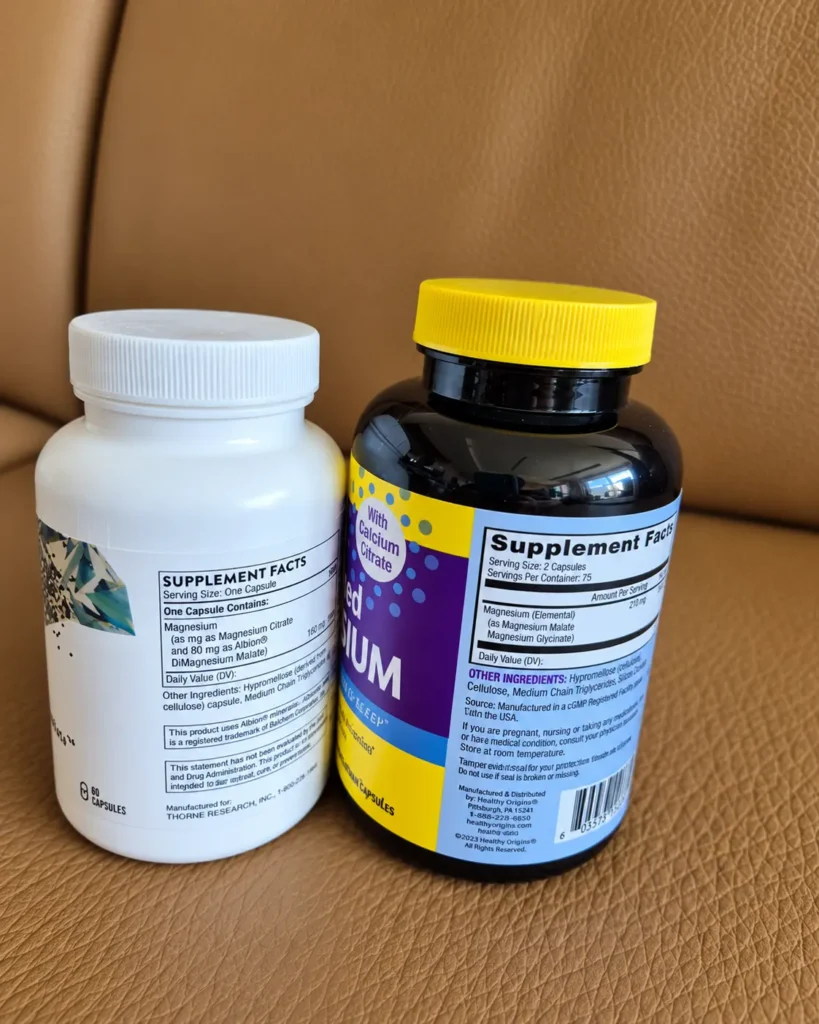
Thorne Magnesium CitraMate. I first chose it for the malate. It also had a decent 135 mg per capsule, and the capsule was easy to swallow. Of everything I tried, it sat easiest on my stomach and did the most for my sleep.
The label splits the two forms, 55 mg from citrate and 80 mg from malate, which made it easy to check. Thorne’s product page says it’s third-party tested and certified, so I looked for the certifier. Magnesium CitraMate appears in NSF’s official listing for dietary supplements, which is the check I mean in #3. (I looked in September 2026.)
Innovix Labs Advanced Magnesium. I picked this one for its 2024 ConsumerLab approval, earned through the voluntary program, and its 210 mg per two-capsule serving. I still feel it helps my sleep to some degree. It also says plainly that it contains no magnesium oxide, which saved me a step.
Other Products I Compared
Doctor’s Best High Absorption Magnesium. With 200 mg of magnesium inside a 2,000 mg compound, it’s the clearest example of the big-number problem from check #1. ConsumerLab picked it for its 2024 magnesium testing, but the results are members-only, so I can’t tell you how it scored. If you want a chelate-only product, it belongs on your list.
Carlson Chelated Magnesium. At 200 mg per tablet, it’s the one to look at if you want fewer pills. It was approved in ConsumerLab’s 2019 review through the voluntary program. Just go in knowing there’s magnesium oxide in the mix, in an amount the label doesn’t break out.
NOW Foods Magtein. Three capsules give you 144 mg of magnesium. NOW itself describes the benefits in terms of laboratory studies. If you’re after threonate’s brain angle, read the limits in the questions below first.
Talk to a Doctor Before You Choose a Magnesium Supplement If…
- Your kidneys don’t work well. Extra magnesium normally leaves through the kidneys. When they’re weak, it can build up in the blood to dangerous levels.
- You have myasthenia gravis. Magnesium dampens the signal nerves send to muscles, and with this condition that signal is already weak. The clearest warnings are about IV magnesium, but check with your doctor before taking a supplement too.
- You take an oral osteoporosis drug (a bisphosphonate). Magnesium gets in the way of the drug’s absorption. Keep them at least two hours apart.
- You take a tetracycline or quinolone antibiotic. Take the antibiotic at least two hours before magnesium, or four to six hours after it.
- You have an irregular heartbeat or take heart medication. Very high magnesium levels can slow the heart. There’s no clear sign that supplement doses cause this, but it’s safer to ask first.
Which Magnesium Would I Choose Today?
Thorne Magnesium CitraMate. My reasons are personal. It was the gentlest on my stomach of the ones I tried, and it helped my sleep the most.
It also holds up on the checks. Each form is listed with its own milligrams, NSF’s official listing includes it, and one capsule is one serving. That last part makes it easy to watch my daily total. One catch: its top label dose goes past the upper limit, so I’d watch the capsule count rather than follow the maximum.
Common Questions
Is magnesium glycinate better for sleep?
Not better than other forms, as far as I could find. Part of its calming reputation comes from glycine, the amino acid it’s paired with. Glycine at bedtime has improved sleep in studies, but the amount used was 3 grams, far more glycine than a magnesium capsule provides.
The stronger evidence is newer. A 2025 trial of 155 poor sleepers gave 250 mg of magnesium as bisglycinate for four weeks, and insomnia scores improved more than with a placebo. The effect was small, though. And the trial didn’t compare glycinate with citrate or malate, so it can’t tell you glycinate is the one to pick.
Does magnesium L-threonate help with memory or brain fog?
Maybe, but the evidence still can’t show that it beats other magnesium forms. Its “brain magnesium” reputation started with a 2010 rat study, led by a researcher who cofounded a company developing the compound.
Human evidence now exists. In a 2026 trial of 100 adults, six weeks of Magtein improved overall cognitive scores and one working-memory test more than a placebo. People also rated their sleep problems as less disruptive by day, but a sleep-tracking ring found no change in sleep itself.
The ingredient’s maker funded the study and helped design it. And it compared threonate with a placebo, not with another magnesium form. If threonate costs more per serving, check #6 shows how to weigh that. I looked at the bigger picture in Do Brain Fog Supplements Actually Work? Evidence vs. Hype.
Is magnesium malate good for fatigue?
Not shown. The study usually cited for this didn’t test magnesium malate as it’s sold. It tested a tablet combining malic acid and magnesium in 24 people with fibromyalgia.
And in the phase where nobody knew who was getting the real tablet, there was no clear effect. Pain only improved later, once everyone knew they were taking it and the dose went up. That makes it impossible to tell whether the dose or the expectation did the work.
Does magnesium citrate prevent kidney stones?
Not the kind you buy off the shelf. The strong result here comes from a combination made for the study. In a study of 64 people with repeat stones, new stones formed in 63.6% of the placebo group and 12.9% of those taking potassium-magnesium citrate for up to three years.
That mix delivers large amounts of potassium and citrate along with the magnesium. When an earlier trial gave magnesium hydroxide by itself, it did no better than placebo. If stones are your concern, that’s a conversation for your doctor, not the supplement aisle.
My first pick, chosen by form, wasn’t a mistake. It’s still the one I’d buy.
But if I were choosing again, I’d flip the order. I’d read the number in front of the parentheses first. Then I’d count the capsules in a serving and look up who tested the bottle. The form would come last.
Keep Reading
Wondering which other supplements actually hold up after 40? Start with 9 Supplements for Midlife Women: An Honest Guide to What Actually Works.
Hoping magnesium might help your mood too? Supplements for Mood: What Actually Helps—and What Doesn’t looks at what the research supports.
Still waking up at 3 a.m. no matter what you take? The 3 A.M. Wake-Ups Started Right After My 47th Birthday — Here’s What I Tried is where I started.
This article is based on personal experience and publicly available research. It is not a substitute for medical diagnosis or treatment. Please consult a healthcare professional about any health concern or medication.