
When the 3am wake-ups started, I assumed it was just perimenopause doing what perimenopause does. What surprised me was that running — something I’d started years earlier for a completely different reason — seemed to make a real difference.
I’d picked up running just to build some basic stamina. I’d always thought of myself as someone with weak stamina — low blood pressure, tires easily — so for years I actually avoided exercise because of that. What running taught me was almost embarrassingly simple: avoiding exercise was why my stamina kept getting worse. At some point I also noticed my sleep had changed. I’d lie down and be out before I even registered falling asleep.
Then the 3am wake-ups arrived, and one rough night would throw off my whole next day. So I rebuilt my routine. I used to run 5K every other day and 10-15K on weekends — now it’s a gentle 5K daily, with strength work on weekends, almost always in the morning after sunrise. This is what worked for me. I’m not claiming it’s the formula for anyone else.
I also tried a few sleep supplements alongside the running changes, and between the two, the 3am wake-ups dropped noticeably. But it got me wondering — is “tire your body out and you’ll sleep” really the whole story? Why does exercise affect sleep at all? Does every type of exercise do this? That’s what sent me looking into the research on exercise and sleep quality.
The Research on Exercise and Sleep Quality
There’s actually a decent amount of research on this — meta-analyses and systematic reviews specifically. What caught my attention were the studies focused on women, especially midlife and postmenopausal women.
A 2025 systematic review pulled together 16 randomized controlled trials of adult women with insomnia symptoms and found regular exercise meaningfully improved PSQI scores — the standard sleep-quality measure. Interestingly, the timeline mattered: programs under 12 weeks showed more benefit for sleep quality and daytime function, while programs running 12+ weeks showed a bigger drop in sleep-medication use. (PubMed)
A separate 2017 meta-analysis looked only at midlife women — 660 participants across 4 trials — and found low-to-moderate intensity exercise lowered PSQI scores by about 1.3 points on average, with moderate-intensity aerobic exercise showing the strongest effect. Yoga alone didn’t produce a statistically significant change. (PubMed)
To be clear, a 1-3 point PSQI shift isn’t “you’re a different person” territory — it’s closer to “noticeably better.” But honestly, that was enough for me. It confirmed I wasn’t imagining things.
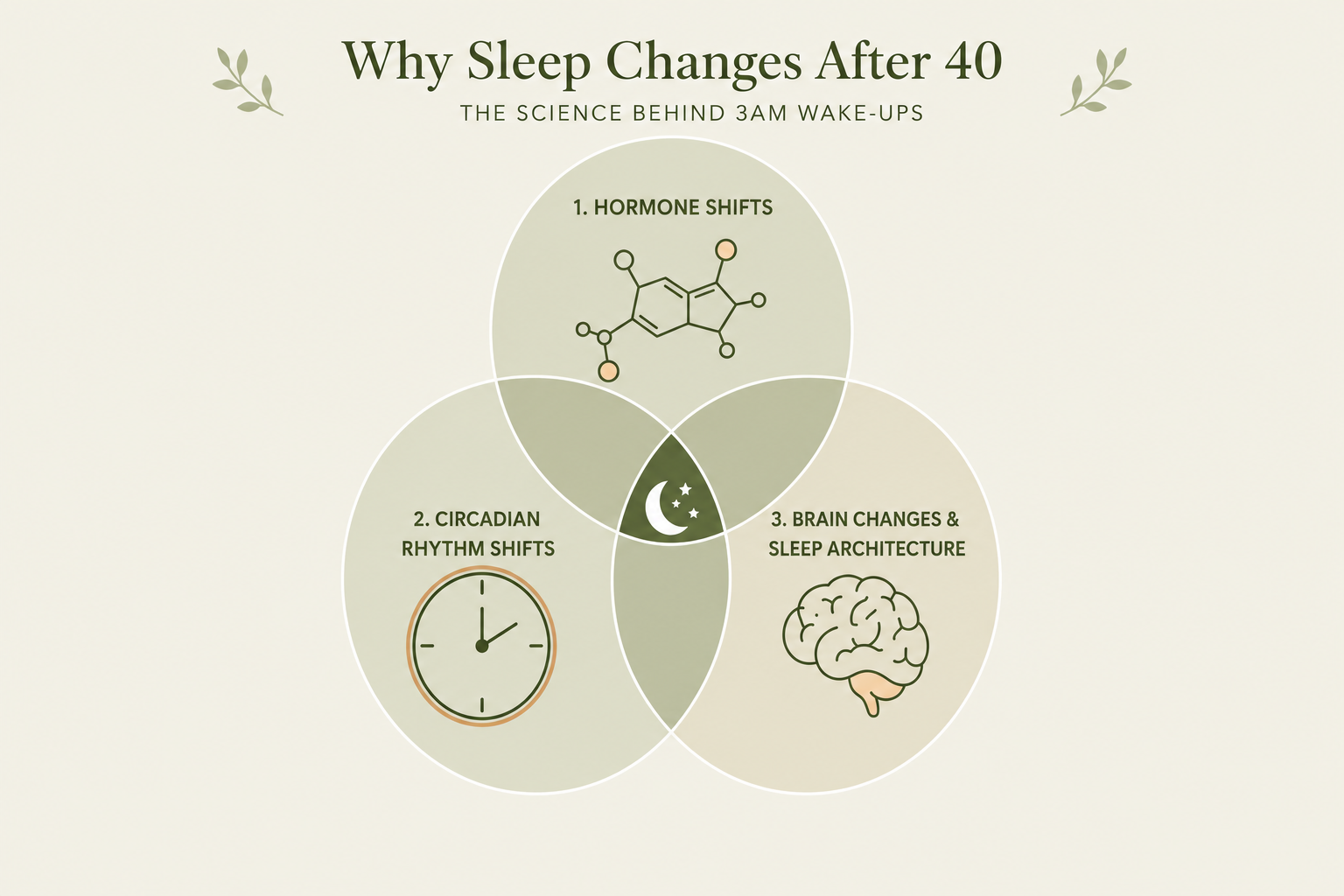
Still wondering why sleep gets so fragile once you hit your 40s? Why Sleep Changes After 40 gets into the hormone and circadian-rhythm shifts behind those 3am wake-ups.
How Exercise Helps You Sleep Better
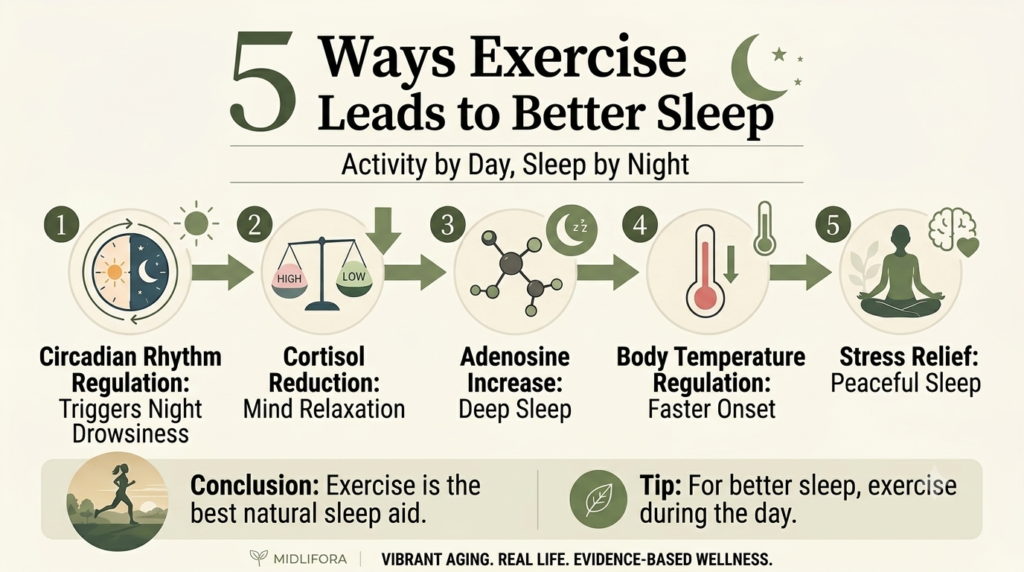
So why does moving your body help you sleep? I found a handful of explanations, each tied to a different system in the body.
Circadian Rhythm and Melatonin
Exercise seems to act as a kind of time cue for your internal clock. Morning exercise in particular appears to shift melatonin release slightly earlier than evening exercise does. A 10-week morning step-aerobics program in postmenopausal women with poor sleep found increased melatonin levels alongside better PSQI scores. It’s a small study — 19 women total, split between a training group and a control group — so I wouldn’t treat it as the final word. (PubMed)
Cortisol and Stress Hormones
A 12-week morning treadmill program was linked to lower cortisol right after waking, along with a higher share of deep (stage 3) sleep. The catch: this particular research skewed heavily male and wasn’t large, so how well it applies to midlife women isn’t fully clear. (source)
Adenosine
Adenosine builds up in the brain as you burn energy, and it’s thought to create a kind of “sleep pressure.” This one is more established in animal research than in direct human studies, so it’s more of a working theory than a settled fact.
Body Temperature
Exercise raises your body temperature, and it drops again over the 30-90 minutes afterward — that drop is thought to help trigger sleepiness. That’s part of why finishing exercise 1-2 hours before bed can actually work in your favor: it gives your temperature time to come back down. Given how often I deal with hot flashes and heat waves these days, this one landed particularly well for me.
Stress and Mood
Across several studies, more physical activity tends to track with lower perceived stress — and lower stress tracks with better sleep. Between work, caregiving, and hormonal shifts all hitting at once during this stage of life, this connection felt very familiar.
Of everything I read, the stress-and-mood link is probably the clearest thread tying exercise and sleep quality together for women my age.
What Is the Best Exercise for Sleep?
Naturally, I wanted to know which type of exercise actually works best. Here’s how they stack up based on what I found:
- Walking — Lowest barrier to entry, shows up consistently in studies on midlife women. Brisk walking, 3-5x/week over 8-16 weeks, has reported sleep benefits.
- Running — Similar or slightly stronger effects than walking in some studies, but sample sizes are too small to say “running is definitively better.”
- Cycling — Usually grouped with walking and running as general aerobic exercise.
- Resistance training — Shows sleep benefits comparable to aerobic exercise, especially when combined with it.
- Yoga — Helpful for stress relief, but studies specifically on midlife women haven’t shown a significant reduction in insomnia symptoms itself.
If I had to boil down everything I read into one honest sentence, it’s this: the best exercise is the one you’ll actually keep doing. Running happened to become my routine, but the research doesn’t suggest it’s uniquely powerful — consistency matters far more than the specific activity. For someone else, that might mean walking or strength training instead.
Is It OK to Exercise Before Bed?
I used to hear a lot of “evening exercise is bad for sleep.” Digging into the research, that turned out to be more nuanced than I expected.
A 2019 systematic review covering 23 studies found evening exercise generally didn’t disrupt sleep — if anything, it slightly increased deep sleep and reduced light sleep. The one exception: vigorous exercise finished within an hour of bedtime, which was linked to lower sleep efficiency. (Sports Medicine, 2019)
So it’s less about “evening exercise, yes or no” and more about intensity plus proximity to bedtime. Light-to-moderate exercise seems fine at almost any time except right before sleep. Even vigorous exercise seems okay as long as you wrap up 1-2 hours before bed.
Individual differences matter too — if you’re dealing with frequent hot flashes or night sweats, intense evening workouts may feel more uncomfortable than they would for someone else.
What Is the Best Time to Exercise for Sleep?
Morning, afternoon, evening, or right before bed — I looked into all four.
One randomized controlled trial had participants do gentle walking either in the morning or the evening. Both groups saw improved sleep — though interestingly, the evening group actually showed a slightly bigger improvement in sleep latency and overall satisfaction than the morning group did. So “morning is objectively better” isn’t quite right; the timing mattered less than simply doing it. (PubMed)
That said, from a circadian-rhythm angle, morning exercise does appear to shift melatonin timing earlier and may have a slight edge for lowering post-waking cortisol long-term. So if early waking is your specific issue, morning or daytime exercise is worth prioritizing first.
But pulling all of this together, the theme that kept repeating was: consistency and total activity level matter more than clock time. How regularly you move your body each week seems to affect sleep more than the exact hour you do it.
What the Research Says
Here’s the short version of everything above:
| Factor | General Trend in Research |
|---|---|
| Sleep quality | Tends to improve with regular exercise |
| Time to fall asleep | Tends to shorten |
| Deep sleep proportion | Often increases |
| Stress / cortisol | Tends to move in a healthier direction |
| Timing vs. consistency | Consistency matters more than the specific hour |
Worth repeating: this table reflects general tendencies, not a formula that applies identically to everyone.
My Take After Looking at the Evidence
My own experience was the starting point here. But after digging into the research on exercise and sleep quality, I found there’s real backing for what I felt — even if that backing isn’t “guaranteed results” territory. Plenty of these studies are small, and results don’t always agree with each other.
What does seem solid: whether it’s running, walking, or strength training, the goal isn’t finding the “perfect” method — it’s building a habit of moving consistently. If your goal is simply to improve sleep naturally rather than reach for another pill, that consistency is where the real payoff seems to be. For me that meant morning runs plus weekend strength work. For someone else, it might be an evening walk.
If you’re going through a stretch of frequent early wake-ups, or just feel like your energy isn’t what it used to be, starting with “something I can actually keep doing” is a far more realistic place to begin than an ambitious workout plan.
Better sleep after 40 probably won’t come from finding the perfect workout. It comes from building a routine you can still see yourself doing months from now. The research supports that idea—and, in my own experience, it’s where things finally started to change.
Keep Reading
Wondering why your sleep changed in the first place?Why Sleep Changes After 40 walks through what’s actually happening hormonally.
Curious what else might help with those early wake-ups? Magnesium for Better Sleep looks at the supplement side of this equation.
Common Questions
How long before I actually notice a difference?
Based on what I found, most studies show benefits building over several weeks to a few months of consistency — not overnight. Some effects (like feeling more rested) showed up faster than others (like reduced sleep-medication use), which took closer to 12 weeks.
Is evening exercise really okay, or should I stick to mornings?
For most people, evening exercise is fine as long as it’s not vigorous and finished right before bed. If you wake up early and that’s your main frustration, morning exercise has a slight edge — but it’s not a hard rule.
Is yoga enough on its own?
Yoga seems genuinely good for stress relief, but the research specifically on midlife women hasn’t shown it reduces insomnia symptoms as clearly as aerobic or strength training does. It might work better as an addition than a replacement.
I’ve always considered myself low-energy — is this still worth trying?
That was basically my starting point too. The studies that showed benefit often started with people who had poor sleep or lower baseline fitness, not athletes. Starting small and staying consistent seemed to matter more than starting strong.
Does hot flashes or night sweats change any of this?
It can. If evening heat and night sweats are already an issue, intense evening workouts may make you feel more uncomfortable at bedtime, simply because your body temperature is already elevated. Lighter evening movement, or shifting harder workouts earlier in the day, may feel more comfortable.
References
- Effects of exercise on sleep quality in women — A systematic review and meta-analysis (2025). PubMed
- Effects of exercise on sleep in menopausal women, meta-analysis (2017). PubMed
- Cai ZY, Chen KWC, Wen HJ. Effects of a group-based step aerobics training on sleep quality and melatonin levels in sleep-impaired postmenopausal women. J Strength Cond Res, 2014. PubMed
- Effects of exercise timing and intensity on physiological circadian rhythm and sleep quality: a systematic review (2023). PMC
- Stutz J, Eiholzer R, Spengler CM. Effects of Evening Exercise on Sleep in Healthy Participants: A Systematic Review and Meta-Analysis. Sports Med, 2019. Springer
- Seol J, Fujii Y, Inoue T, Kitano N, Tsunoda K, Okura T. Effects of Morning Versus Evening Home-Based Exercise on Subjective and Objective Sleep Parameters in Older Adults: A Randomized Controlled Trial. J Geriatr Psychiatry Neurol, 2021. PubMed
This article is based on personal experience and publicly available research. It isn’t a substitute for medical diagnosis or treatment. Please talk to a healthcare professional about any health concerns or medications.