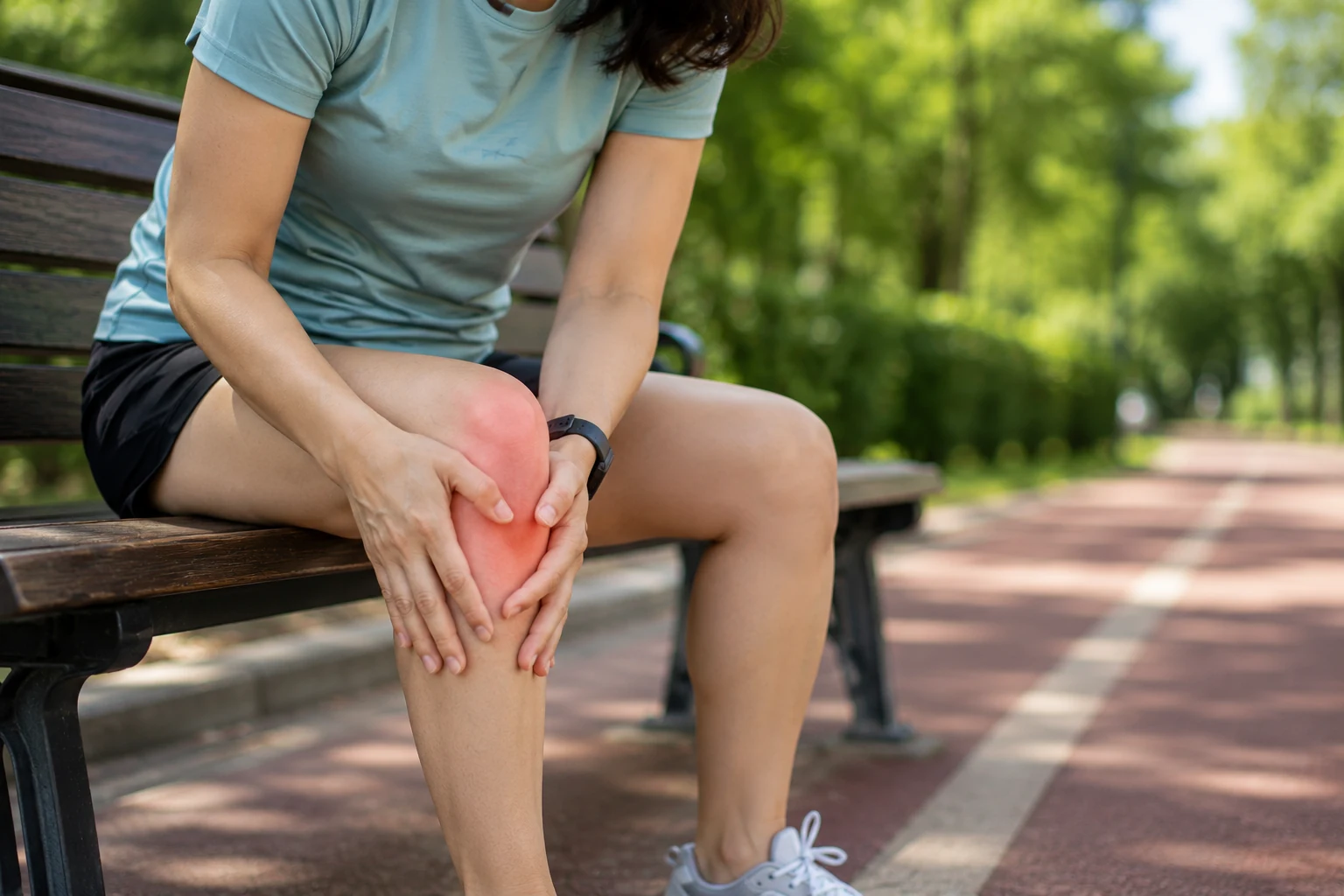
I’ve been running for about five years. I never pushed my pace or distance much, which is probably why I almost never had to stop for knee or ankle pain. Then, about a year into perimenopause, my knees started feeling off after runs, and a low, nagging ache showed up in my ankles while I was still moving. Slowing down didn’t fix it. Shortening my routes didn’t either. That’s when I started looking into exercise for arthritis after 40, half-expecting the answer to be “do less.”
Instead I started lifting. A few months later, when I eased back into running, my knees felt noticeably calmer.
I want to be careful here, because I also spent that stretch barely running at all, which took a lot of load off the joint. So I can’t hand the credit to strength training and call it settled.
But the experience left me with two questions. When a joint hurts, is backing off always the right move? And why did any of this start around perimenopause of all times?
Why Joint Pain After 40 Isn’t Automatically Arthritis
The first thing I wanted to sort out was whether menopause causes arthritis. What I kept running into was that this is the wrong opening question.
Arthritis, or Joint Pain Without Arthritis?
A rheumatologist’s clinical overview published in the journal Menopause in March 2026 walks through how a clinician approaches a woman between 40 and 60 who comes in with joint pain. The first move isn’t naming a cause. It’s establishing whether arthritis is present at all.
Roughly three outcomes follow. Osteoarthritis announces itself through gradual onset, bony changes on exam or imaging, a history of joint injury, and a preference for weight-bearing joints — knees, hips, lumbar spine — plus the base of the thumb and the finger joints.
Inflammatory arthritis looks different: pronounced morning stiffness, swelling, synovitis, warmth. Rheumatoid arthritis affects around 1% of the population, skews female, and peaks in onset between ages 30 and 60. Which is to say it sits inside this age bracket rather than safely past it.
Then there’s the third outcome, and this is where a lot of midlife joint pain lands. Pain and stiffness across several joints at once, without obvious swelling. The overview notes this doesn’t generally lead to a destructive joint process — and in the same breath, that it can be genuinely disabling. That second half matters, because “not damaging” gets misheard as “not serious.”
Joint pain without arthritis has a long list of possible sources: acute or chronic viral infection, medication toxicity from statins, bisphosphonates or fluoroquinolones, overuse injuries, vitamin deficiency (vitamin D in particular), food sensitivities such as celiac disease, thyroid dysfunction, and estrogen deficiency.
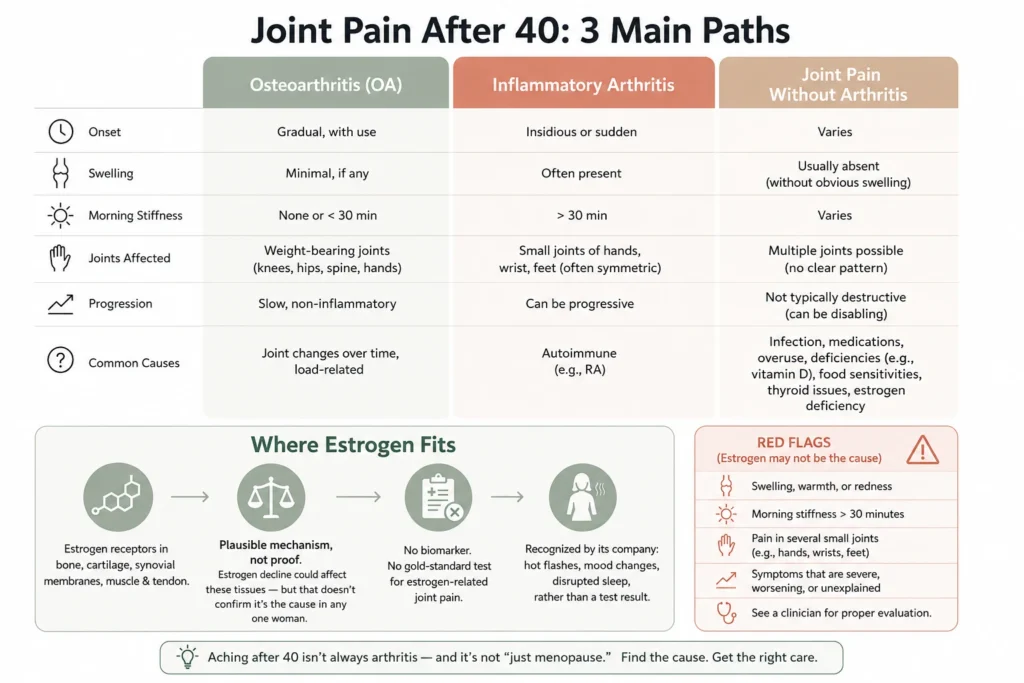
NICE gives clinicians a rough dividing line for osteoarthritis specifically: age 45 or over, joint pain that comes on with activity, and either no morning stiffness or stiffness that clears within 30 minutes.
Where Estrogen Fits
Around 70% of women report musculoskeletal symptoms during menopause. Estrogen receptors sit in bone, articular cartilage, synovial membranes, muscle and tendon, which gives researchers a plausible biological route from falling estrogen to aching joints.
A plausible mechanism is not proof of cause, though, and the gap between those two things is wider than most articles let on. It explains why estrogen decline could affect a joint. It can’t tell any particular woman that estrogen decline is what’s affecting hers.
What doesn’t exist is a test. The overview is blunt about it: there’s no biomarker and no gold-standard test for joint pain caused by estrogen deficiency. It tends to be recognized by the company it keeps, arriving alongside hot flashes, mood changes and disrupted sleep, rather than confirmed by a result.
Which leaves the position roughly where it started. Aching and stiffness after 40 isn’t automatically arthritis, and it also isn’t something to file under “menopause, nothing to be done.” Swelling, warmth, morning stiffness that outlasts half an hour, several small joints flaring together: that pattern belongs in front of a clinician. I went through the fuller picture of what drives joint pain in midlife separately, if you want causes rather than fixes.
Does Exercise for Arthritis After 40 Actually Help?
Before any of the numbers, something I had to be straight with myself about.
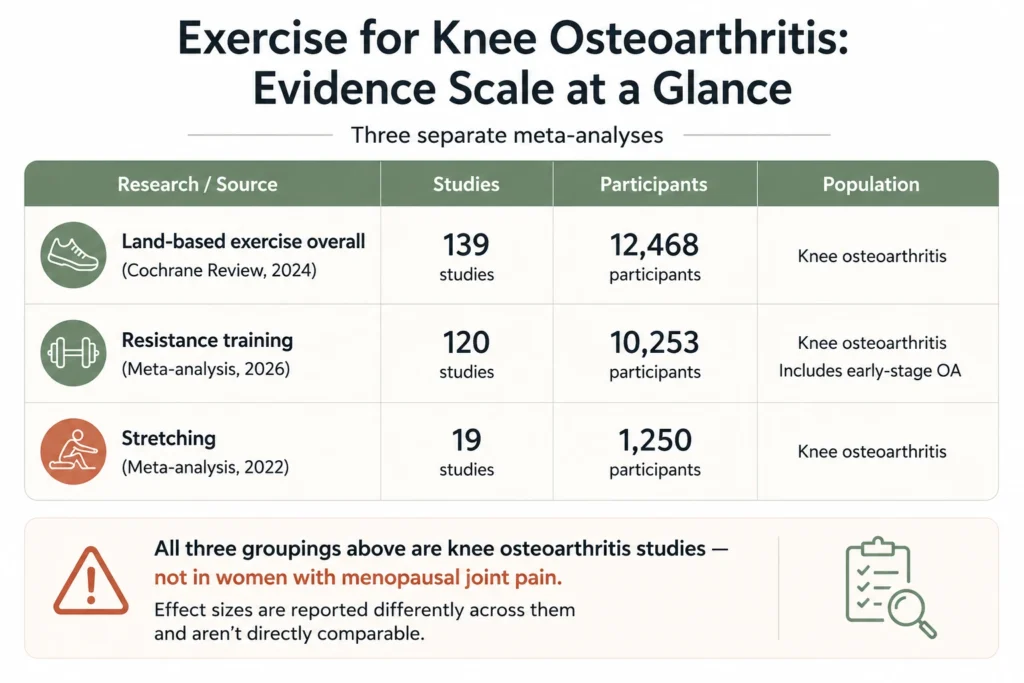
Nearly every trial I’m about to cite was run in people with knee osteoarthritis. Not menopausal arthralgia. Not aching hands or a stiff shoulder at 47. There’s a substantial evidence base for exercise in knee OA, and as far as I could find, nothing comparable for the diffuse joint pain that shows up during the menopause transition.
So when I apply this research to my own knees, I’m borrowing from an adjacent population and hoping it transfers. That may well be reasonable. It isn’t demonstrated, and borrowing isn’t the same as knowing.
With that on the table: international guidelines for knee osteoarthritis almost uniformly put exercise in the first line of management, which still struck me as backwards. Rest the sore thing, surely.
The anchor is the 2024 Cochrane review of land-based exercise for knee osteoarthritis, pooling 139 trials and 12,468 participants. Exercise improved pain and physical function by around 13 points on a 0-to-100 scale against usual care or no treatment.
What decides how you read that number is the comparison threshold. The review set the minimal important difference, meaning the smallest change a person would actually register, at 12 points for pain. So the benefit lands right on the line. The reviewers concluded that its clinical importance is uncertain, and most included trials carried unclear or high risk of bias.
That’s a deflating set of numbers, and it’s exactly why I trusted them. Nobody was selling cartilage regrowth. Exercise takes some edge off, helps you keep moving, and the claim stops there. If you want the broader case for training after 40 beyond joints specifically, I laid out what the research says about exercise in midlife in more detail.
Strength Training: Why It Matters More in Midlife
How Strength Training Supports Joints
My habit of running while endlessly postponing the weights turns out to be relevant. My assumption, when I finally picked up a barbell, was that stronger muscles would give the joint better support and help me handle what running asked of it. That was a hunch about my own knees, not something I’d read anywhere.
What the research does say is narrower. A 2026 systematic review and meta-analysis pooled 120 trials and 10,253 participants on resistance training for knee osteoarthritis, and split them by stage: 88 trials in early knee OA, 13 before surgery, 19 after knee replacement.
In the early-stage group, resistance training significantly improved self-reported knee pain, stiffness and symptoms, and function, all at moderate certainty under GRADE, plus quality of life at high certainty. On objective measures it improved Timed Up and Go, chair-stand performance, and knee extension strength.
“Early-stage” here means a diagnosis with a stage attached to it, which is not the same as an undiagnosed knee that has started complaining. I don’t actually know which group I’d fall into.
Two things it didn’t improve in that same group: walking capacity and knee flexion range of motion. Both fell short of significance.
The stage split mattered more than I expected. In the pre-surgery group, resistance training improved stiffness and function but showed no significant effect on pain at all. Same intervention, later disease, different answer. And in seven trials comparing resistance training head-to-head with aerobic exercise, resistance training came out ahead on knee extension strength and on stair and chair-rise tasks, with no difference for pain, function, stiffness, or walking.
So the fair reading isn’t “lifting fixes knee pain.” It’s that lifting has decent support for pain and function in earlier-stage disease, its clearest edge over other exercise is in strength and getting up and down stairs, and the answer shifts depending on how far along the joint is.
Strength Training During and After Menopause
Muscle mass and strength tend to decline in this stretch of life. Less muscle means less capacity to absorb and distribute load through a joint, which follows logically enough.
Here’s where I’d slow down, though. It’s tempting to draw a straight line: menopause reduces muscle, reduced muscle causes arthritis, therefore lift or else. That line doesn’t hold. The menopause–joint pain relationship sits at the level of observational association, with no confirming test behind it.
The better reason to strength train in midlife isn’t that it shields you from menopausal arthritis. It’s that strength and function decline in this window, and training slows that down.
Stretching for Stiff Joints
When Stretching May Help
I’d always filed stretching under “warm-up,” something you do before the real thing. Researchers have studied it as a pain intervention in its own right.
A 2022 meta-analysis in Physiotherapy screened 373 studies and settled on 19 randomized trials covering 1,250 participants, 18 of which entered the pooled analysis.
The result went further than I expected. Stretching done on its own reduced pain by 1.86 points on a visual analogue scale, which the authors classed as both statistically significant and clinically meaningful. In trials where stretching was combined with other exercise, the pain reduction came to 1.31 points — still significant, but the authors flagged its clinical meaningfulness as questionable.
One thing to be careful about, though. Each of those groupings was measured against a control, not against each other, so this isn’t a finding that stretching alone outperforms stretching plus other exercise. It’s two separate comparisons that happened to land differently. The authors do lean that way in their own conclusion, while naming the limitation themselves: the trials using stretching alone had small sample sizes, and some of the pooled studies were heterogeneous.
So: meaningful evidence, sitting on a much smaller base than the research behind resistance training, with its most favourable finding resting on the smallest studies in the set.
Stretching vs. Strengthening: Different Roles
The comparison that finally made it click: strength training is putting up the support beams, stretching is oiling the hinges on the door. One builds capacity to hold load around the joint. The other keeps the range of motion you already have and takes the edge off stiffness. Public health guidance for people with arthritis places flexibility work alongside aerobic and strengthening activity rather than in place of either, with daily range-of-motion work recommended specifically to keep joints moving through their full range.
Which means this was never a choose-one situation. When I compare my running-only stretch to the months after I added weights, the thing that shifted wasn’t something more stretching would have covered. That’s my own experience, and I can’t promise it generalizes.
How to Exercise When Your Joints Hurt
Start Slowly
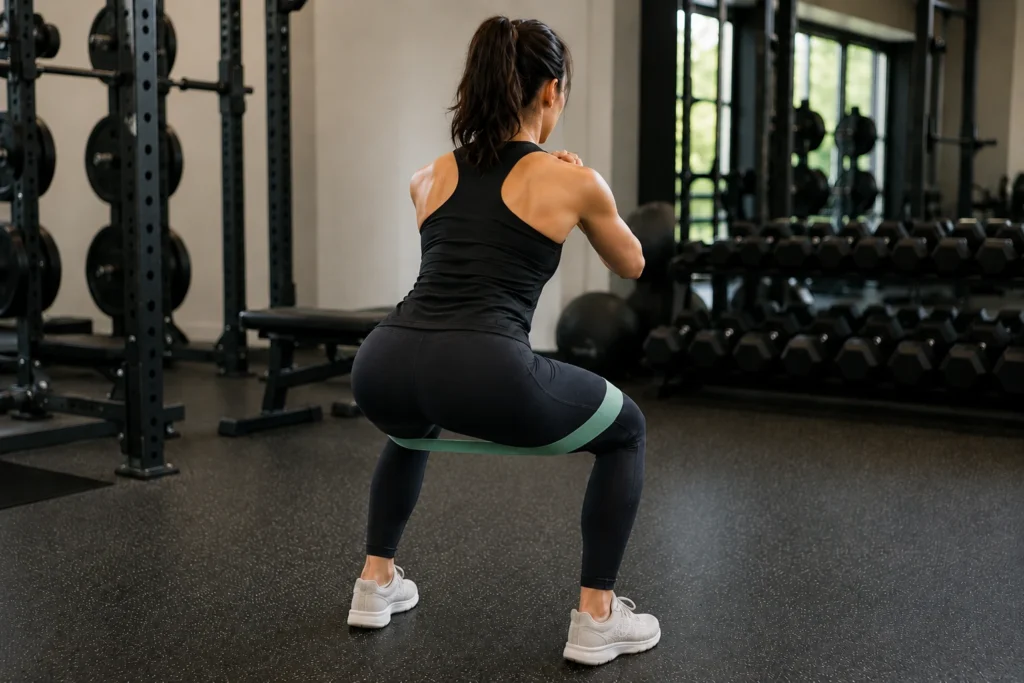
Ramping up hard on an already-sore joint isn’t the move. Guidance repeats the same starting point: lower volume, lower resistance, shorter sessions than whatever you’re aiming for, and build from there.
Progress Gradually
NICE is unusually direct on this point. Its osteoarthritis guideline instructs clinicians to warn people that joint pain may increase when therapeutic exercise begins, and then to explain that regular, consistent exercise benefits the joints even when it’s uncomfortable at first, and that staying with it over time reduces pain and improves function and quality of life. The committee’s stated reason for adding that line was to reassure people that exercise is not harmful to osteoarthritic joints.
Feeling rough in week one, in other words, isn’t evidence that you’re grinding something down. That reassurance covers tolerable, temporary discomfort and nothing past it.
What to Do When Pain or Swelling Increases
Tolerable discomfort and a flare that doesn’t settle are different animals. My own rule, arrived at by trial and error rather than lifted from a guideline, is that a noticeable flare means dialling something back next session rather than pushing through it: resistance, reps, range of motion, or impact, whichever seems likeliest to be the culprit.
Persistent swelling, symptoms that keep worsening, or a real drop in what you can do belong in a different category. Those deserve a clinical assessment, not a self-directed tweak.
When Joint Pain Needs More Than Exercise
Mild stiffness after a workout is one thing. Joint pain that persists or keeps escalating is another. Visible swelling, one specific joint that keeps flaring, or morning stiffness that won’t loosen inside half an hour all point toward arthritis or another underlying cause that deserves a proper look. In that situation, seeing someone before you start adjusting your own program is the right order of operations.
Exercise also isn’t the only lever people reach for, and if you’ve been eyeing the supplement aisle, I went through which joint supplements hold up to the research and which don’t with the same skepticism I brought here.
Common Questions
My joints feel stiff. Should I stretch first or can I go straight to strength training?
Personally, I’d loosen up with light stretching or a short walk first. It’s not that lifting on stiff joints is dangerous, more that starting cold on a joint that’s already complaining tends to make the session unpleasant enough that you don’t come back.
Should I rest completely on days when it hurts?
Not necessarily. If the discomfort is tolerable, the guidance leans toward staying in motion at reduced intensity rather than stopping. Complete rest is for the flare signs: heat, visible swelling, a sharp drop in function.
Can I do strength training without a gym?
Yes. None of the guidelines specify equipment or a location. Bodyweight work and resistance bands are a reasonable place to begin. Because the right approach shifts depending on your joint status and any existing conditions, having a physical therapist look at your plan early is a sensible move if you can manage it.
Does any of this research actually apply to menopausal joint pain?
Not directly, and I’d rather say so. The trials behind everything above enrolled people with knee osteoarthritis. If your pain is the diffuse, unswollen kind that showed up alongside other menopause symptoms, you’re in a group these studies didn’t measure. The mechanisms overlap enough that transferring the findings seems reasonable. It hasn’t been tested.
How long before I notice anything?
The trials ran over weeks to months, not days. My knees didn’t feel different after two sessions. Expect to give it a season, not a week.
Where I’ve Landed for Now
These days I’m running again, lifting a couple of times a week, and doing short stretches before and after. I won’t claim this solved my joint pain. The ache hasn’t vanished, and some days it comes back depending on how I’ve slept or what I did the day before. But there are clearly fewer days when my knee is on my mind than there were before I started lifting, and that’s enough reason to keep going.
I can’t tell you the same thing will happen for you. The causes vary, the bodies vary, and a fair amount of what I read was measured in people whose joints aren’t in the same state as mine. What I’d pass along is narrower: pulling back on movement isn’t automatically the answer when a joint hurts, strength training and stretching are doing two different jobs, and figuring out which kind of joint pain you have comes before deciding what to do about it.
Keep Reading
Still trying to work out what’s behind the ache in the first place? Joint Pain After 40 lays out the causes before the fixes.
Wondering whether any joint supplement holds up under scrutiny? Joint Pain Supplements for Menopause goes through them one by one.
Curious how training after 40 fits together beyond joints? Exercise After 40: What the Research Actually Says is the wider view.
This article is based on personal experience and publicly available research. It is not a substitute for medical diagnosis or treatment. Please consult a healthcare professional about any health concern or medication.