For years, running was not something I had to think about. I ran, my knees stayed quiet, and joints were simply not a category in my head.
Then a vague stiffness moved into my ankle and hip and declined to leave. I was still warming up, still stretching, still lifting. Nothing about my routine had changed except the number of years behind it.
My first assumption was that I had gotten precious about my own body. Then I remembered my mother at roughly the age I am now, mentioning her knees and her lower back. The question rearranged itself. Maybe joint pain after 40 has less to do with what you put your joints through and more to do with how they start reporting back.
So I went reading. The picture was more tangled than I expected, and a couple of things I had believed without examining turned out to be flatly wrong.
Is Joint Pain After 40 Normal, or a Warning Sign?
This was the first thing I wanted settled. Are aching joints in your forties an ordinary part of the decade, or a signal that something is off?
Population surveys across several countries show the same shape: the share of people reporting joint pain or stiffness climbs noticeably once you pass 40. So “a lot of people in their forties have sore joints” is close to accurate.
Here is where I started being careful. Common and normal are not the same word. Reading through the material, a rough dividing line kept reappearing.
- Brief stiffness when you stand up after sitting a while, or soreness in the day or two after a hard session, sits in the ordinary column.
- Morning stiffness that drags on rather than easing off, visible swelling, or several joints complaining at once belongs in a different column altogether.
One more thing complicated my tidy self-assessment. Plenty of people have clear degenerative changes on an X-ray and no symptoms whatsoever, while others hurt considerably with imaging that looks unremarkable. Pain does not reliably mean the cartilage is gone, and clean imaging does not mean you are imagining things.
I took some comfort in that, and I also took it as a reason to stop diagnosing myself from my kitchen table.
Why Joints Start Hurting in Your Forties
No source I read pinned this on a single cause. What came up repeatedly instead was a set of changes that happen to overlap in the same stretch of life.
Cartilage isn’t what it used to be
Reviews of cartilage aging describe a fairly consistent pattern. Cell numbers inside the tissue drop, the collagen structure stiffens, and compounds called advanced glycation end products accumulate and make the whole thing more rigid.
The comparison that made it click for me was my own shoe rack. A new running shoe compresses under impact and springs back. A shoe I have worn for three years has gone hard underfoot and passes the shock straight through to me. Same road, same stride, different amount of force reaching the joint.
The detail that caught my attention was that some researchers treat roughly age 40 as a turning point, after which cartilage cells lose some of their capacity to maintain themselves (Source: PMC review on cartilage aging). This reads as a proposal built on accumulated observation rather than a settled fact, and I would rather say so than round it up.
Less muscle means the joint works harder
Muscle mass declines gradually through midlife. As strength drops, the muscles around a joint become less effective at guiding movement and distributing load, which shifts more of that work onto the joint itself.
Of everything I read, this explanation landed hardest. If you picture a joint as a part that wears out with use, there is nothing constructive to do about it. If you picture it as something muscle helps steer and cushion, the constant drumbeat about strength training suddenly makes sense.
Too little movement, and too much, both cost you
Long hours of sitting weaken the surrounding muscle and raise the stress the joint carries. Pushing hard with no recovery built in also creates problems for some people.
What did not appear anywhere in the material was a simple verdict that moving a lot is bad for you.
Weight, inflammation, and old injuries
Extra body weight loads the knee and hip directly, since those joints carry you. Low-grade inflammation across the body tends to rise with age, and fat tissue itself releases inflammatory signals. For women, hormonal change stacks on top of all of this, which is a large enough subject that I gave it its own section below.
Past injuries came up in nearly every source too. The ankle I rolled in my twenties having a say in how I feel now seems a little unfair, but it was mentioned too consistently to dismiss.
Can Perimenopause and Menopause Cause Joint Pain?
This section changed my thinking more than any other.
A 2026 systematic review and meta-analysis pooled data from more than 90,000 women and compared rates of muscle and joint pain by menopausal stage. Premenopausal women came in at 40%, women in the transition at 57%, and postmenopausal women at 59%. Women in the transition were about 1.35 times more likely to report pain than premenopausal women (Source: PMC meta-analysis).
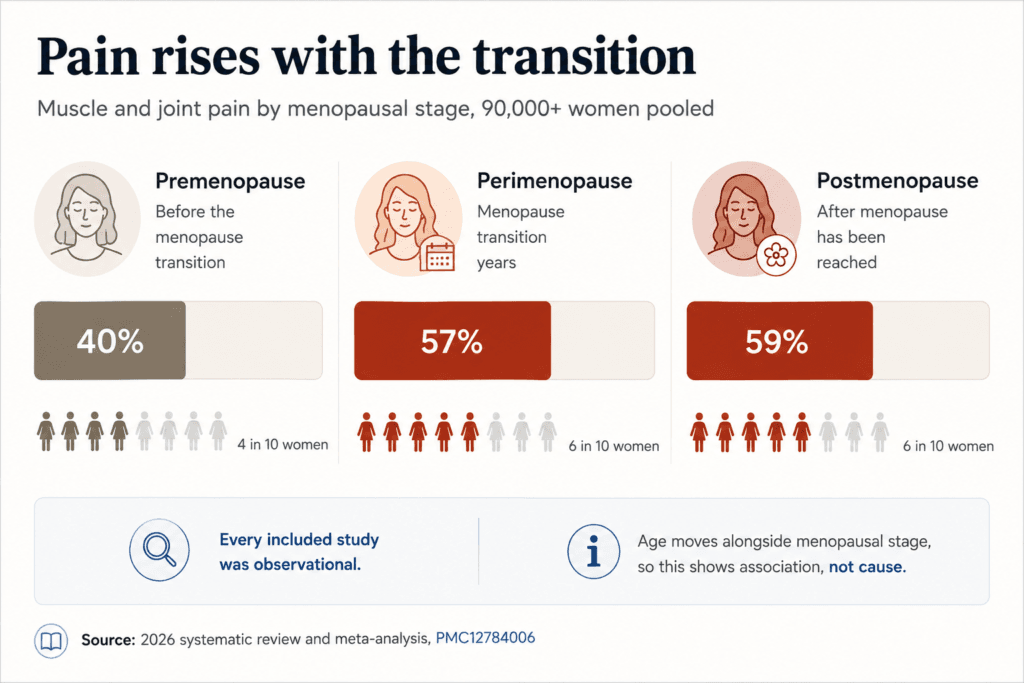
The gap looks striking on paper. The authors themselves point out that every included study was observational, and that age moves alongside menopausal stage in a way that is hard to separate. What the data supports is that more women in the transition report joint pain, not that menopause produces it.
The proposed mechanism is reasonable enough. Estrogen receptors sit in cartilage, synovium, bone, muscle, and tendon, and estrogen appears to act in an anti-inflammatory direction. Less estrogen could plausibly mean more inflammation and a shift in how pain registers.
A 2024 review went further and proposed gathering these complaints under a single term, the musculoskeletal syndrome of menopause. The idea is that the aches, the stiff mornings, and the sore tendons are not a scattered set of unrelated complaints but one pattern with a shared driver.
That paper deserves a caveat. It is a review proposing new terminology, not the result of a large trial. Whether hormone therapy helps joint pain specifically has barely been tested in large randomized trials at all.
So I filed the topic like this. Knowing that my aching hip might be connected to hormones is useful context. Building decisions on that assumption is more than the current evidence can carry.
Learn more: 🌿 what’s actually happening to your hormones during the menopause transition
Joint Pain or Arthritis? Reading Your Own Symptoms
People use “joint pain” and “arthritis” interchangeably, and once I started reading properly, the distinction turned out to matter quite a lot.
Mechanical vs. inflammatory: the dividing lines
Osteoarthritis is the most common form. Cartilage thins and the joint structure changes over time, and it often stays localized to one or a few joints. It hurts more with use and settles with rest, and morning stiffness tends to ease fairly quickly.
Rheumatoid arthritis behaves differently. It is an autoimmune condition in which the immune system attacks the joint lining, and it frequently arrives on both sides at once. Small joints in the hands, wrists, and feet are common starting points, morning stiffness tends to drag on rather than clear, and fatigue, low fever, or appetite loss can come along with it (Source: Michigan Medicine).
Psoriatic arthritis is another form, an inflammatory arthritis in people with psoriasis. Joint symptoms sometimes arrive before skin symptoms do. A whole finger swelling like a sausage, pain where tendons attach to bone, and nail changes are described as characteristic.
Gout and other crystal arthritis, lupus, and thyroid problems can also show up as joint symptoms.
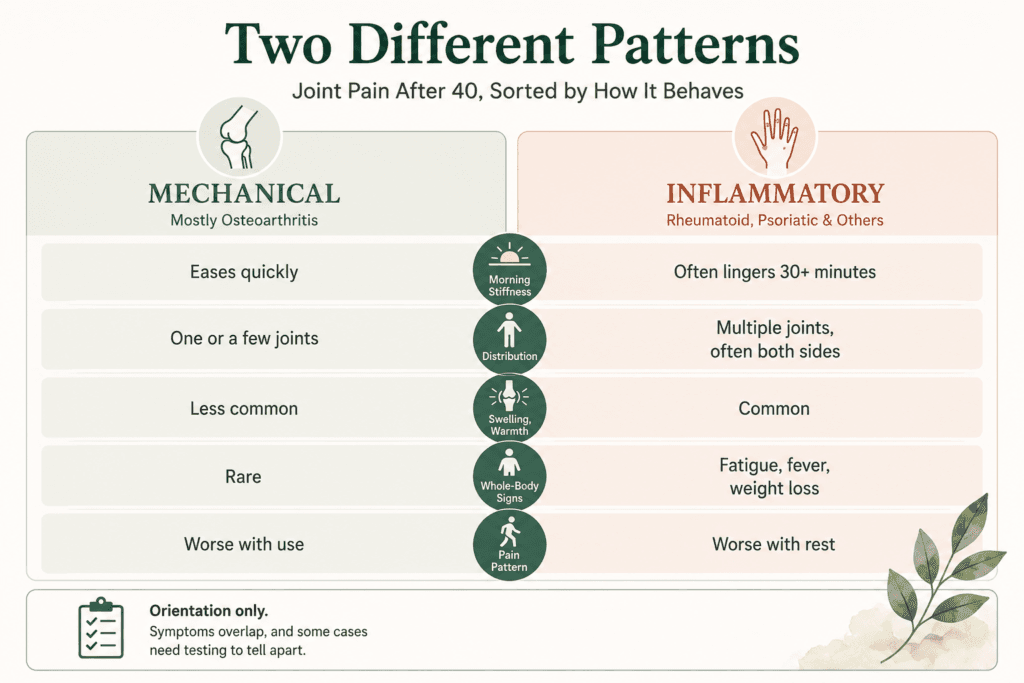
Broadly, joint problems split into two patterns: mechanical, which is mostly osteoarthritis, and inflammatory, which covers rheumatoid and psoriatic arthritis.
| Mechanical | Inflammatory | |
|---|---|---|
| Morning stiffness | Eases quickly | Often lingers 30+ min |
| Distribution | One or a few joints | Multiple, often both sides |
| Swelling, warmth | Less common | Common |
| Whole-body signs | Rare | Fatigue, fever, weight loss |
| Pain pattern | Worse with use | Worse with rest |
Where it tends to show up
By location, the knee dominates the discussion. The hip comes next, followed by fingers, shoulders, and the neck. Ankles, elbows, and wrists appear less often.
- Knee — where body weight and declining strength meet. Descending stairs is often the first place it announces itself.
- Hip — several possible sources sit behind hip pain, including osteoarthritis, tendon problems, and pain referred from the lower back. It can also present in the groin, which makes it easy to mistake for something else entirely.
- Fingers — a common site for osteoarthritis, and also a common starting point for rheumatoid arthritis. Finger symptoms deserve closer attention for that reason.
- Neck and spine — degenerative changes in discs and facet joints tend to travel together.
- Jaw — comes up often in searches, with noticeably thinner material behind it. I do not know enough here to say anything useful.
Mine were the ankle and hip, and the absence of knee pain confused me at first. “Joint” and “knee” had fused in my head somewhere along the way.
The signs that matter more than pain does
Pain is not the only symptom, and the others may carry more information.
Stiffness is about duration. Waking up stiff is ordinary. Whether it clears in ten minutes or is still there at lunchtime is the useful question. Swelling shows up more with inflammatory arthritis or acute injury than with osteoarthritis. Losing range of motion can happen with either. And several joints hurting at once is treated less as more pain and more as a sign the cause may be different in kind.
What I started tracking was narrower than I expected. Not how much it hurts, but when it hurts, how many minutes until it loosens, and how many places are involved. Pattern holds more information than intensity.
One variable I had not been accounting for: a short night seems to move the dial. Poor sleep is commonly described as lowering the pain threshold, and my own bad joint days do tend to follow my bad nights, though I am reading my own small sample here rather than a study. If that pattern sounds familiar, the sleep side is a reasonable place to look — how sleep changes after 40
What Actually Helps Joint Pain After 40
This was the section I most wanted to reach, and the answer was more consistent than I anticipated.
What the guidelines put first
A review comparing 11 major international clinical guidelines found broad agreement on first-line management for osteoarthritis: exercise, patient education, and weight management where relevant. Medication comes after (Source: Arthritis Care & Research).
I will admit to a small deflation. Some part of me was hoping for something more interesting than “move more and learn about your condition.” Turned around, though, it means the most ordinary interventions are the ones carrying the deepest evidence behind them.
Weight management applies to people whose weight has increased, not as a blanket instruction. Heat and cold get recommended constantly with fairly thin evidence, so I treat them as personal experiments rather than prescriptions.
Which kind of exercise, specifically
“Exercise more” is generic enough to bounce off. Once you ask which exercise, the conversation gets more interesting.
A 2025 network meta-analysis in the BMJ pooled 217 randomized trials in knee osteoarthritis specifically and compared exercise types head to head. Among that group, aerobic exercise had the strongest overall showing across pain, function, walking, and quality of life, with certainty rated as moderate (Source: PubMed). Walking, cycling, and swimming all sit in that category.
The scope is narrower than the headline suggests, and I want to be careful with it. This tells us about knee osteoarthritis, not about every aching joint in your forties. Strength training shows steady benefits for pain and function too, and the finding is not that strength work should be swapped out for aerobic work. It is that a program built without any aerobic component is missing the piece with the strongest showing. Stretching alone produced mixed results and generally performed as part of a broader program.
Learn more: what the exercise research actually says for people over 40
Is running bad for your joints?
The question I actually came for.
A 2017 meta-analysis pooled data on more than 114,000 people and compared hip and knee arthritis prevalence. Recreational runners came in at 3.5%, non-runners at 10.2%, and elite or competitive runners at 13.3% (Source: PubMed).
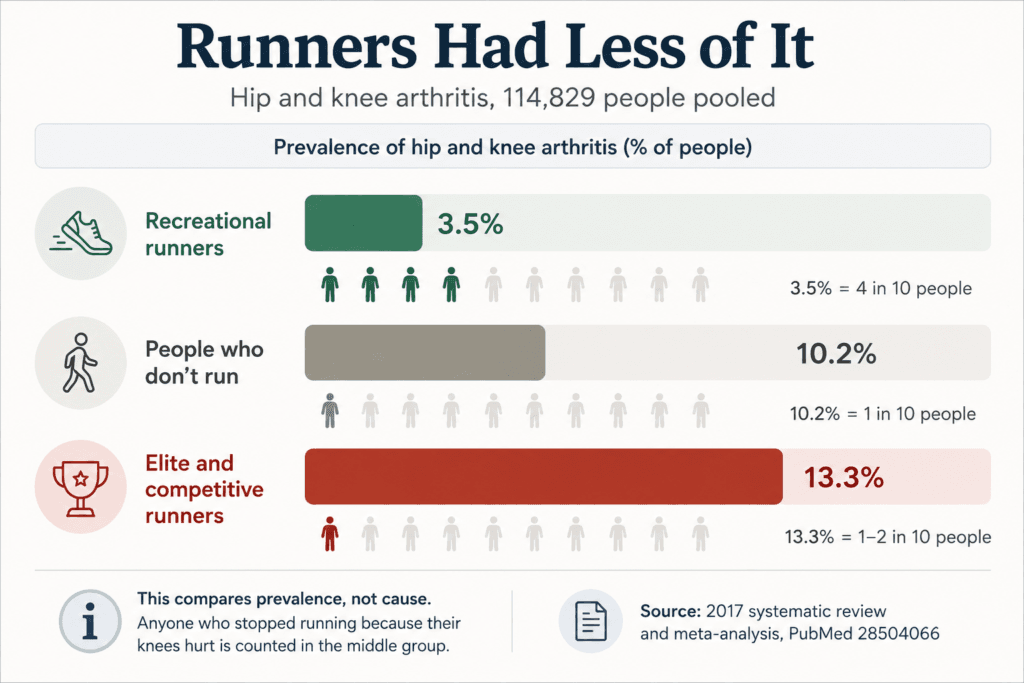
My first reaction was relief. My second, after sitting with it, was more measured. This compares prevalence in observational data, which cannot establish cause, and there is a structural problem underneath it: anyone who stopped running because their knees hurt is now counted in the non-runner group. The authors also state that obesity, occupational load, and injury history were outside the scope of their analysis.
What I take from it is not that running protects your joints. It is that the assumption recreational running ruins them rests on weaker ground than its confidence suggests. For me that was enough. I did not stop running. I adjusted the recovery spacing and gave strength work a larger share of my week, which is a decision about my own ankle rather than a recommendation.
Medications and Supplements: Where Each One Sits
Search data around this topic fills up with product names, so leaving the category out would mean ignoring what people actually want to know. Below is a sketch of where each option sits, written on the assumption that what you take and how you take it belongs in a conversation with a clinician, not a blog post.
Topical and oral anti-inflammatories
Topical NSAIDs carry their strongest evidence and guideline support for joints closer to the skin surface, like knees and hands. Less of the drug reaches the rest of the body, which lowers the stomach, cardiovascular, and kidney burden.
Their role is less clear for deeper joints such as the hip. That surprised me. I had vaguely assumed a topical worked much the same wherever you applied it.
Oral NSAIDs relieve pain effectively and bring gastrointestinal bleeding, cardiovascular, and kidney risks along with them. Guidelines repeat a version of the same phrase: lowest effective dose, shortest duration. People with existing stomach risk are often steered toward different combinations.
Acetaminophen: the surprise
This one genuinely reset an assumption. Acetaminophen was treated for decades as the default first-line painkiller for arthritis. Recent evidence suggests its effect on knee and hip osteoarthritis pain falls below what most researchers would call clinically meaningful, and several major guidelines no longer place it first.
It also carries a reputation for safety that does not extend to high doses, where liver risk gets flagged.
Writing this section left me with one thought. Drug selection is not ordered by how well things work. It is ordered by which risks a particular person can afford to take. Which is why other people’s reviews are close to useless here.
Vitamin D, glucosamine, and the rest
“What vitamin am I lacking if my joints hurt?” is a heavily searched question with a flaw built into it. Treating joint pain as the signal of a specific nutrient deficiency starts you off in the wrong direction most of the time.
Vitamin D. Observational studies report links between severe deficiency and chronic pain. Association is not causation, and evidence that supplementing when you are not deficient reduces pain is not compelling. Deficiency is testable, so testing beats guessing.
Glucosamine. The first name most people think of. A 2026 umbrella review pooled 19 existing systematic reviews and found a small but statistically significant reduction on the VAS pain scale (SMD −0.36), no significant difference on WOMAC pain, and no confirmed improvement in function. The authors flag the part that matters most: the effects that reached significance sat at or below the threshold generally considered clinically meaningful. Most of the included reviews were rated low or critically low quality (Source: Frontiers in Nutrition).
I sat with that result for a while. Calling it useless overstates the case, since one pain measure did move. But a change too small for a person to notice is not the same as a benefit, and the evidence does not support treating glucosamine as a reliable answer to joint pain. Side effects matched placebo, so this was never a safety question. It is a question of what the realistic ceiling looks like.
Chondroitin, collagen, omega-3, MSM, and curcumin left a similar impression. Small studies produce encouraging signals, evidence quality runs low, and results scatter between trials.
Where I landed: supplements do not belong in the solution slot for joint pain, and nothing here should occupy the space where exercise and weight management need to go. That is the summary I arrived at after reading all of it, and it is less satisfying than I wanted.
Learn more: how to tell which supplement claims have research behind them
When to See a Doctor About Joint Pain
I consider this the most important part of the article. Everything above is orientation. What follows calls for an appointment rather than another search.
Seek care immediately if:
- A single joint suddenly becomes swollen, red, and hot, with a fever
- You cannot bear weight or move the joint
- Swelling or deformity is worsening rapidly
- Joint symptoms arrive alongside chest pain, difficulty breathing, or neurological changes, since that combination points at something systemic rather than a joint problem
Do not put off an appointment if:
- Morning stiffness lasts a prolonged stretch on most days, particularly half an hour or longer
- Multiple joints stay swollen for more than a couple of weeks
- Small joints in your hands, wrists, or feet hurt symmetrically on both sides
- Pain persists or keeps returning without an obvious explanation
- Fever, fatigue, weight loss, or rash accompany the joint symptoms
- You have psoriasis and new joint pain has appeared
Every source repeated that starting treatment early in inflammatory arthritis affects how things go afterward. “Let’s watch it a bit longer” is not automatically the safe choice.
Common Questions
Why does my whole body ache at 40?
Several joints hurting simultaneously rarely traces back to one cause. Hormonal change during the menopause transition may be involved, it could be the beginning of an inflammatory arthritis, or factors that lower your pain threshold like poor sleep and sustained stress may be stacking up. Keep in mind that “multiple joints at once” is itself on the list of reasons to get seen.
Isn’t 40 too young for arthritis?
Every source said no. Osteoarthritis can begin in your forties given prior injury, weight, or family history, and rheumatoid and psoriatic arthritis commonly start between 30 and 50. Ruling out the possibility on the grounds of being young mostly succeeds at delaying diagnosis.
What vitamin am I lacking if my joints hurt?
There is no clean answer, mostly because the question assumes joint pain works as a deficiency signal. Severe vitamin D deficiency has been linked to chronic pain in observational research, but that is an association rather than a cause, and topping up when you are not deficient has not shown convincing benefit. If you suspect a deficiency, a test settles it faster than a guess.
Can perimenopause cause joint pain?
The data clearly shows higher rates of muscle and joint pain during the transition and after menopause. All of it comes from observational studies, and the limitation researchers keep naming is how difficult it is to separate menopausal stage from age itself. Holding it as a plausible explanation rather than a settled one matches where the evidence currently stands.
What helps joint pain and stiffness the most?
Exercise has the deepest evidence behind it, with aerobic exercise showing the strongest results in knee osteoarthritis specifically. Weight management follows where relevant, and medication is a decision to make with a clinician based on your situation and risk profile. Leaving the joint still for long stretches was not recommended anywhere I looked.
The biggest thing that shifted for me was the picture I had been carrying of a joint as a part that wears down. Looking only at cartilage leaves you with nothing to do. Looking at muscle, activity, hormones, and inflammation together left me with more options than I expected.
The stiffness in my ankle has not vanished. What has changed is that it no longer slides into a vague dread about the day I stop being able to run. I have criteria now for what to watch and where the line for seeing a doctor sits, and that turns out to be most of what I needed.
If you are somewhere in a similar stretch, I would start with the pattern rather than the intensity. When it hurts, how long until it loosens, how many places are involved. That information tells you what to do next better than the pain score does.
Keep Reading
If you want to know which ones I actually ended up taking and which I quietly dropped, what I tried on my own joints and what came of it
If you want the mechanism rather than the overview, why joints start reacting at exactly this stage of life goes deeper into the causes.
Not sure how to train around a joint that already hurts? moving with sore joints covers what the research supports.
And if you’d rather zoom out, seeing joints as part of the whole picture instead of a part that wears out is where this all fits.
This article is based on personal experience and publicly available research. It is not a substitute for medical diagnosis or treatment. Please consult a healthcare professional about any health condition or medication.