I never liked hard workouts. Swimming and walking were the extent of my movement for years, and I assumed that was enough. Then my forties arrived and something shifted — weight started settling in ways it hadn’t before, and once it arrived, it didn’t leave the way it used to.
That’s what pushed me into running, five years ago now, with weight loss as the goal. What I got instead was different from what I expected, and it eventually pulled me into strength training too. This article is what happened when I went looking for explanations — what the research says about exercise after 40, and where it honestly runs out.
Why Weight Gets Harder to Manage After 40
The frustrating part wasn’t that I’d started eating differently or moving less. I hadn’t. Same body, same habits, different rules.
So I went looking for whether this was just me. The study that stuck with me followed 156 premenopausal women over four years. The women who reached menopause during that window showed a steeper drop in sleeping energy expenditure (-7.9% vs -5.3%), a 32% decline in fat oxidation, and a significant increase in visceral fat.
The women who stayed premenopausal gained subcutaneous fat, but not visceral fat. Everyone gains some padding with age — but the shift toward the deep abdominal kind appears to be its own separate event, tied to the menopause transition.
Muscle told a similar story. One review comparing lean mass across the transition reported roughly -2.5% in perimenopause and -5.7% postmenopause. A systematic review of sarcopenia prevalence in menopausal women landed on a range of 10% to 43.6% — wide enough that I wouldn’t quote the number with confidence, but narrow enough to say it isn’t rare.
The concept that unsettled me most: your weight and BMI can stay nearly identical while muscle declines and visceral fat climbs. One review described it as a recomposition you can’t see from the outside.
The box weighs the same. What’s inside it has changed. The scale tells you nothing about that.
Does Cardio Really Burn Off Midlife Weight?
My response to all this was straightforward: move harder. So I ran, for months, waiting for the number to drop. It moved a little. Not much.
Apparently I had company. A crossover study of 27 women with overweight or obesity tracked free eating after a 60-minute cycling session. Average intake was almost identical on exercise and rest days — about 666 vs 665 kcal — but individual differences ranged from -234 kcal to +279 kcal.
Averaged out, nothing happened. Person by person, people were moving in opposite directions.
Another study looking at 24-hour energy balance in 48 women found that 63% compensated for the energy they’d burned, either by eating more or moving less. The bigger factor was sitting time after the workout.
I recognized myself in that one immediately. I have a very clear memory of running in the morning and then not moving off the couch all evening.
A larger supervised trial — 141 participants, five sessions a week for ten months — also found weight loss smaller than the calorie math predicted. One proposed reason: the body gets more efficient at the same exercise, so identical sessions gradually cost less energy.
Running didn’t transform the scale. Something else showed up instead.
What Cardio Actually Gives You: Stamina and Endurance
Early on, a few minutes of running left me gasping. At some point I could cover the same distance and hold a conversation. Stairs stopped registering. The day after a long walk felt noticeably different.
The research lines up with that. A 12-week trial in 49 women with moderate obesity found cardiorespiratory fitness improved 3–5% while body weight dropped only about 2%. A trial in 31 inactive adults with obesity showed improvements in both body composition and fitness.
A review comparing intensities found higher intensity had an edge for VO₂ max — but no meaningful difference in fat loss between intensity levels.
Two limits are hard to ignore here. Most of these studies enrolled inactive adults or people with obesity, and most ran around 12 weeks. Mapping those results onto someone five years into a running habit isn’t clean. And long-term data on how much cardiorespiratory fitness predicts health outcomes after midlife wasn’t in the material I reviewed.
Still, the sensation of a lighter body mattered more to me than the number ever did. This was the first point where I wondered whether I’d picked the wrong goal from the start.
The Mental Health Effect I Didn’t Expect
The effect I never signed up for was mental. On hard days, before-the-run and after-the-run were different states. The problem wasn’t solved — my relationship to it had changed.
The research on this turned out to be more substantial than I expected. A study of 289 perimenopausal women in an aerobic program reported significant improvements in anxiety, depression, and sleep quality scores, and the more often women practiced on their own, the higher their improvement rate.
A meta-analysis of randomized trials in menopausal and postmenopausal women reported SMD -0.66 for depressive symptoms and -0.55 for anxiety, with larger effects in postmenopausal women (-0.94 and -0.96). A separate meta-analysis of 17 studies on leisure-time physical activity and depression reported SMD -1.23.
The detail I keep coming back to isn’t the effect size. It’s this: both low and moderate intensity produced benefits, with no clear trend toward better outcomes at higher intensity. You don’t have to suffer to get the mood effect.
The mechanism side was interesting too. A meta-analysis of 12 randomized trials in adults with depression (757 people, 66% women, mean age 43) found BDNF increased in exercise groups (SMD 0.44) while depression scores fell (SMD -0.72).
Cortisol surprised me. In a small crossover study of 16 middle-aged adults, cortisol actually rose right after exercise. The proposed reading is that the benefit isn’t a stress hormone going down — it may be the rise-and-recover cycle itself. At 16 participants, I’d hold that one loosely.
This single effect explains why I’m still running five years later.
Read next: if the mood lifts but the mental static doesn’t, that’s a different problem — Brain Fog in Midlife: A Complete Guide.
Why Strength Training Still Matters (Even If You Hate Gyms)
Running eventually sent its own signal: to keep going without injury, I needed muscle underneath it. I’d never enjoyed lifting. Once my body made the case, ignoring it stopped being an option.
I started with YouTube videos in my living room. These days I take two sessions a week with a trainer. The unexpected part was how satisfying it is — the thing you couldn’t do yesterday, you can do today, and it’s far more visible than progress in running.
Watching my parents during this same period taught me something else. Walking got harder, so they stayed home more, and staying home made them weaker still.
That loop appears repeatedly in the literature: strength declines, activity and gait speed drop, muscle wastes further, weakness deepens. Some papers add another turn — fear of falling after a fall reduces activity even more.
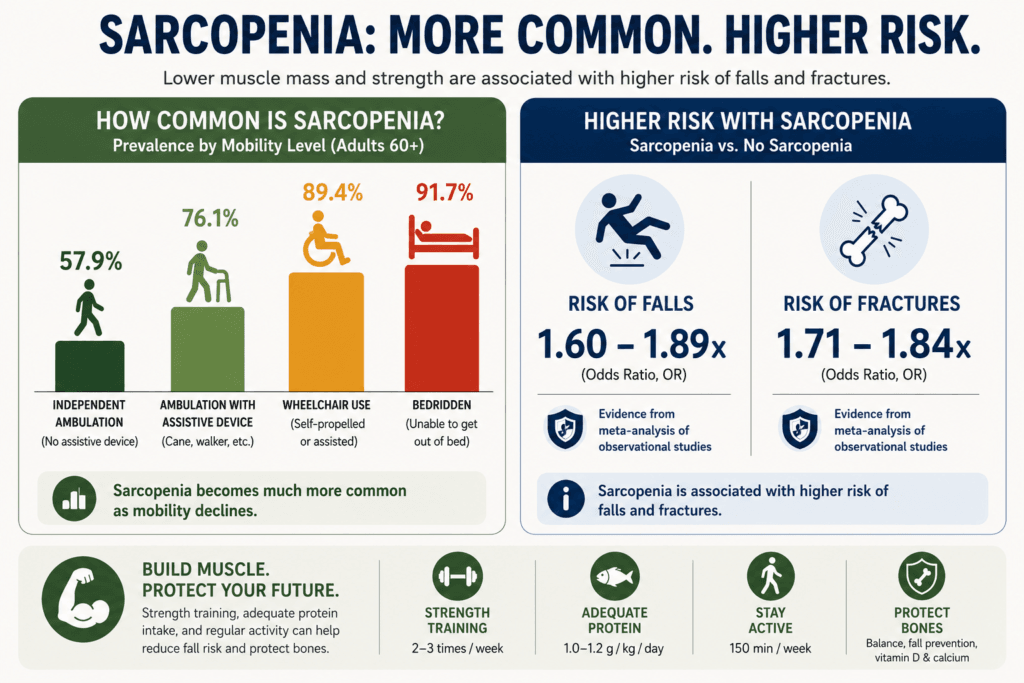
The numbers show the same pattern. In hospitalized older patients grouped by mobility, sarcopenia prevalence climbed steadily: 57.9% among those walking independently, 76.1% with assistance, 89.4% in wheelchairs, 91.7% among those unable to move. That design can’t tell you which came first, but it shows how tightly the two travel together.
The consequences aren’t minor. A systematic review of 36 studies covering 52,838 people found roughly 1.9× the fall risk and 1.7× the fracture risk in people with sarcopenia. And across multiple studies, strength was more closely tied to balance and falls than muscle mass was. You can hold onto the tissue and still lose the capacity.
Nearly all of this data comes from adults over 65. None of it is a prediction about a woman in her forties. What I took from it was a direction, not a forecast.
My strength sessions aren’t just running support anymore. Watching my parents, I understood that protecting muscle now is the same project as protecting the ability to walk later.
Read next: for the nutrition side of holding onto muscle, see 9 Supplements for Midlife Women: An Honest Guide to What Actually Works.
Gentle vs Intense: What Exercise After 40 Should Actually Look Like
Someone who disliked hard workouts has now been running for five years and lifting consistently. If I’d started with an intensity target, I’d have quit long ago.
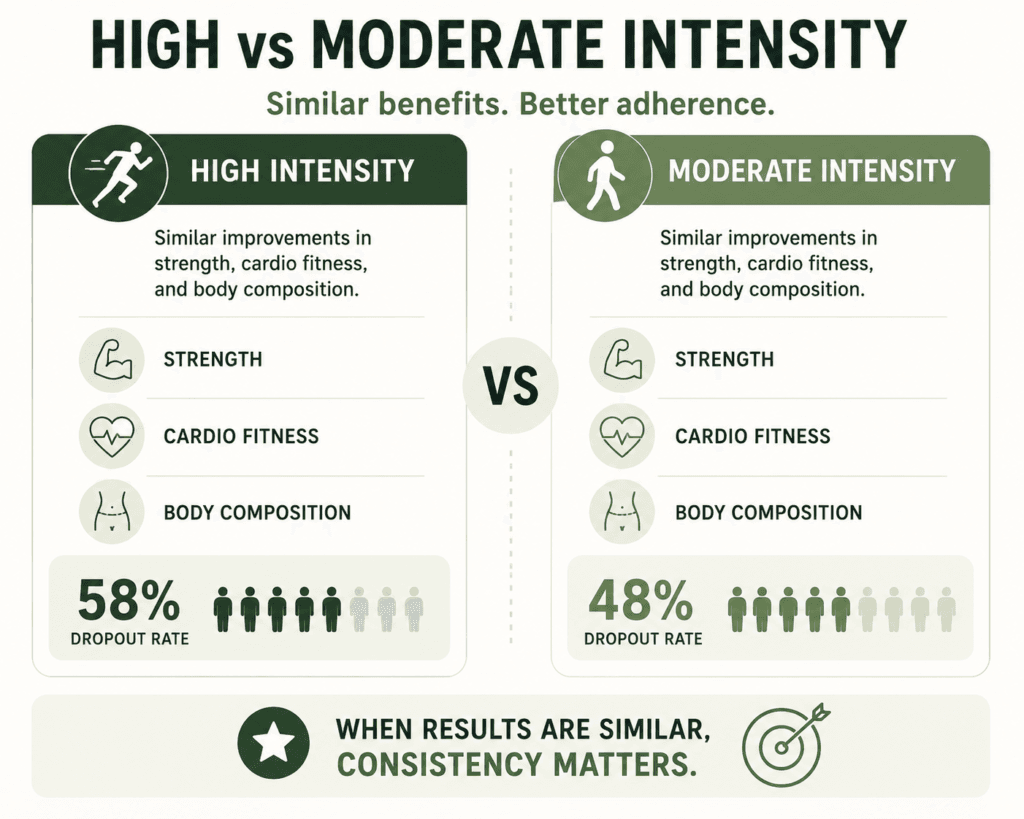
On effectiveness, randomized trials comparing high-intensity intervals with moderate continuous training found them broadly similar. When total volume was matched, differences in body composition and cardiorespiratory fitness weren’t significant. A meta-analysis of 25 studies in cardiac patients found no difference in quality of life, depression, or anxiety scores.
But there was another number inside those same studies. In a 12-week trial, dropout was 58% in the high-intensity group and 48% in the moderate group. The researchers themselves noted this raises questions about how well any of it transfers outside the lab.
A perspective paper on adults with overweight and obesity put it more bluntly: prescribing higher intensity reduces adherence, which reduces the amount of exercise actually completed.
So what produces persistence? A study following 174 adults (mean age 66) for 18 months found self-efficacy strongly linked to activity levels, with the model explaining 40% of the variance at 18 months. What raised self-efficacy: social support, positive emotion during exercise, and early experiences of success.
A six-month study of 575 gym members found enjoyment was the strongest mediator. In a comparison of high-intensity functional training and moderate exercise, the people who dropped out had lower enjoyment scores at baseline — how the exercise felt mattered more than how hard it was.
That explains my five years better than willpower does. I didn’t persist because I’m disciplined. I started at an intensity I didn’t hate, which made continuing possible.
The gaps here are real. Most of these studies looked at adults with obesity, cardiac patients, or older adults, and almost none targeted midlife women around the menopause transition specifically. Follow-up ranged from 12 weeks to 18 months.
In trials where nearly half the participants dropped out, only the survivors get analyzed — which can make results look better than they are. And nothing in this material suggests someone already enjoying high-intensity training should change anything.
What decides the outcome of exercise after 40 isn’t how hard you go. It’s how long you keep going. I’m still learning both.
Common Questions
Is strength training more important than cardio after 40?
I’d hesitate to rank them. In my case running came first and strength followed out of necessity, but the research assigns them different jobs — cardio shows up in fitness and mood outcomes, strength training in the sarcopenia literature. The point that repeats is that cardio alone doesn’t prevent muscle loss.
Should I keep exercising if the scale isn’t moving?
I nearly stopped at exactly that point. What changed my mind was realizing weight isn’t the only measurement. Muscle and visceral fat can shift proportions while the number holds steady, and the scale won’t show you that. The fitness and mood effects were observed independently of weight change.
What exactly counts as moderate intensity?
The common guideline is 150 minutes of moderate or 75 minutes of vigorous activity per week. Without knowing someone’s health history, moderate continuous exercise tends to be preferred for safety and feasibility.
Is it too late to start in my forties?
I can tell you that a large share of participants in the studies above were inactive before they started. What I can’t tell you is what happens over a decade — there was no long-term follow-up of people who began in their forties in anything I read. Past that point, I don’t know either.
Do I need to change my diet too?
Exercise-only programs repeatedly produced less weight loss than calorie math predicted, with compensatory eating and reduced activity offered as explanations. Diet is outside the scope of this article, but claiming exercise alone solves it would overstate what the evidence shows.
Five years in, the goal I started with turned out to be the least interesting thing I got. The weight was never the story. What changed was how my body handles a long day, how a hard afternoon lands, and how much I trust my legs on a staircase.
I’m still figuring this out, still taking lessons twice a week, still occasionally sitting on the couch all evening after a run. That seems like a reasonable place to be.
Keep Reading
Wondering whether all this movement is doing anything for your nights? Sleep After 40: The Complete Guide to What Actually Helps
Want the timing and intensity details specifically? Can Exercise Improve Your Sleep Quality?
If the fog is the thing bothering you most right now — Brain Fog in Midlife: A Complete Guide
Dealing with joint pain? Strength Training and Stretching for Joint Pain
This article reflects personal experience and publicly available research. It isn’t a substitute for medical diagnosis or treatment — please consult a healthcare professional about your own health concerns or medications.