This article contains affiliate links. We may earn a small commission if you purchase through them, at no extra cost to you.
Before I picked a vitamin B complex, I looked up a lot. The words on the front of the bottle made it harder, not easier: B-50, B-100, methylated, high potency.
Here’s what I learned about how to choose vitamin B complex without letting those words decide for you.
Some of what I read surprised me. One number on the front of the bottle tells you almost nothing. One B vitamin has safety limits that differ by a factor of ten depending on the country. And one popular marketing claim looks different once you read the fact sheets.
- If you already take a multivitamin → add up the amounts first, because the same vitamins show up in both bottles.
- If you’re over 50, eat no animal foods, or take certain stomach or blood sugar medicines → health agencies single out one B vitamin for you, so a single-vitamin product or a doctor’s check may fit better than a big blend.
- If a bottle says B-100 and you assume bigger means better → the back label decides, because “B-100” isn’t a standard recipe.
- If you could still become pregnant → one B vitamin comes in two forms, and the pregnancy research is built on the older one.
- If you take a hair-and-nails formula and get blood tests → one ingredient can change lab results, so the lab needs to know.
- If you’re tired or foggy and hoping a B vitamin fixes it → the studies are mixed, so it helps to ask a doctor about the cause too.
Here’s the reasoning behind each one.
How to Choose Vitamin B Complex: Reading the Label
B-50 and B-100 are not set recipes. The FDA doesn’t define them. They’re names companies use, and the amount of each vitamin changes from bottle to bottle.
Three label words matter. The Daily Value (DV) is the number printed on the label so you can compare products. The RDA is the amount that covers almost everyone, about 97 to 98 out of 100 healthy people. The UL is the highest daily amount unlikely to cause harm.
Think of the UL like the weight limit sign in an elevator. It tells you where trouble starts, not how much to carry.
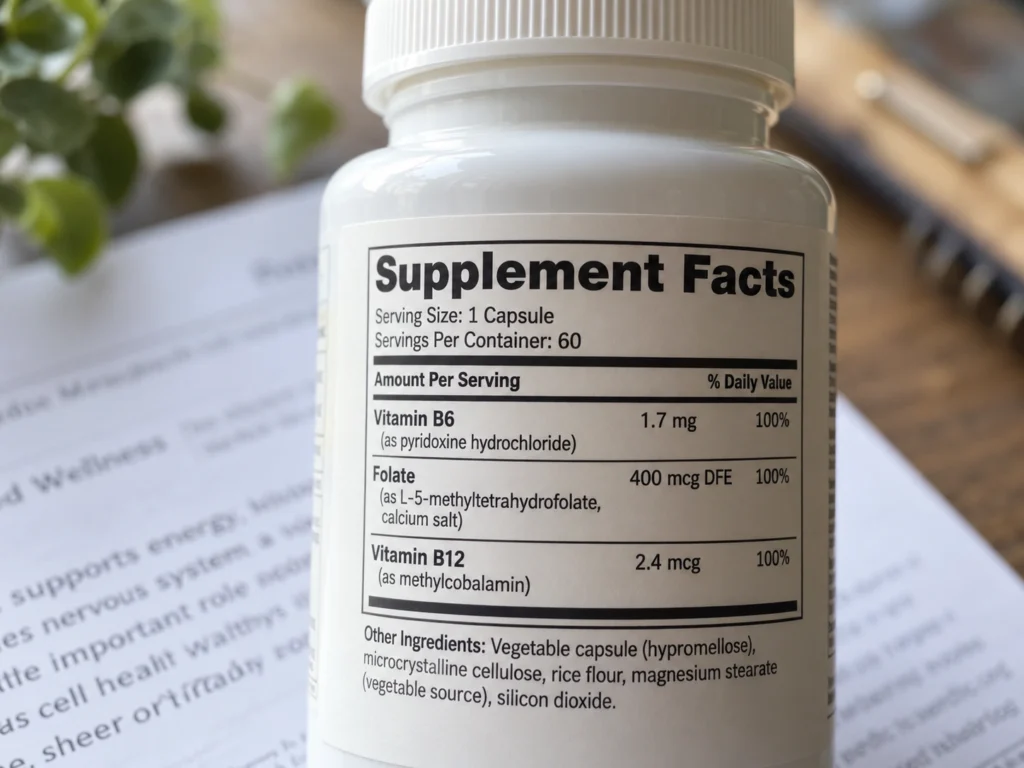
A bottle’s front tells you its name. The back tells you what’s inside. That’s the core of how to choose vitamin B complex.
I use the same label-first habit for other supplements, which I wrote about in How to Choose a Magnesium Supplement: 6 Things I Check Before Buying. The bigger picture is in 9 Supplements for Midlife Women: An Honest Guide to What Actually Works.
Vitamin B6
B6 is where the rules disagree the most.
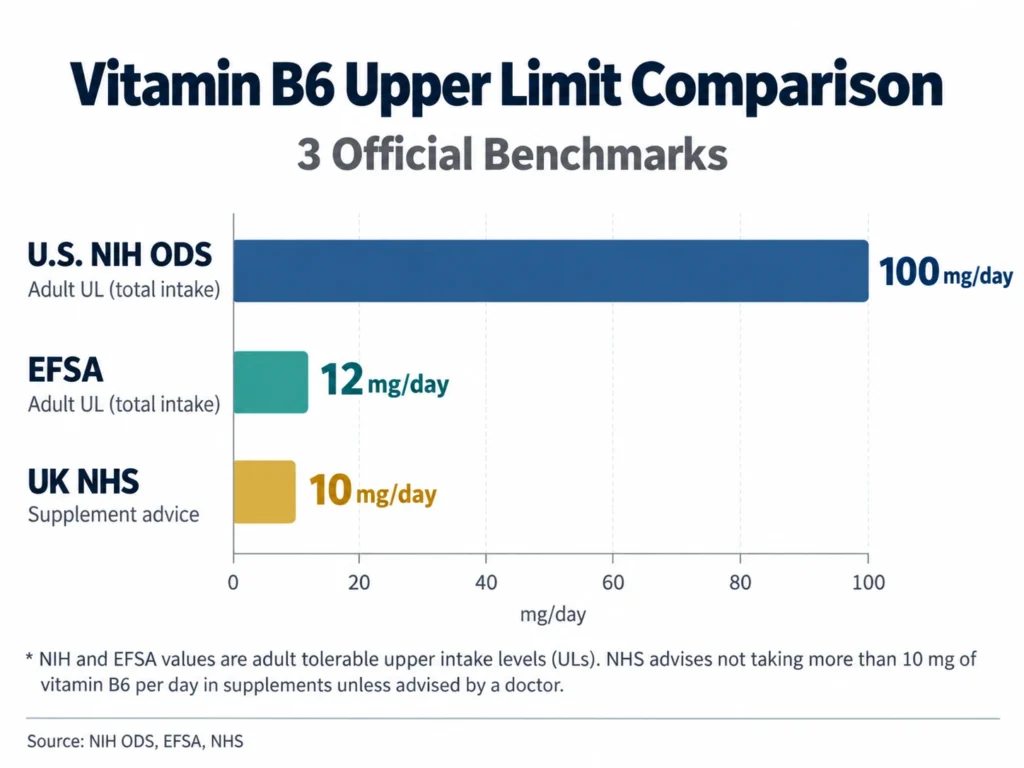
The US sets the upper limit at 100 mg a day for adults. Europe’s food safety agency lowered its limit to 12 mg in 2023, according to the same fact sheet. The UK health service says no more than 10 mg a day from supplements unless a doctor advises it.
The UK page also says 200 mg or more can cause loss of feeling in the arms and legs. Some B-complex bottles list more than 10 mg on the back, and a multivitamin adds more.
The same vitamin has a 12 mg limit in one place and a 100 mg limit in another.
Vitamin B12
B12 is the vitamin health agencies single out after 50.
As we get older, many of us make less stomach acid, and stomach acid helps release B12 from food. NIH says metformin and acid-reducing medicines can also lower how much B12 the body takes in. Plant-based diets contain very little of it.
NIH doesn’t say these groups need a full B complex. It says they’re more likely to run low on B12.
On the form, cyanocobalamin is the usual one in supplements. NIH doesn’t say methylcobalamin is absorbed better or works better in healthy adults.
More B vitamins in one bottle isn’t the same as more of the one you’re short on.
Folate
For pregnancy planning, the research points to folic acid, the older form.
NIH says 400 mcg of folic acid a day before and during early pregnancy helps prevent birth defects of the brain and spine. That holds even for women with a gene variant called MTHFR C677T. NIH doesn’t recommend the “active” form, methylfolate, over folic acid for this purpose.
High folate has its own catch. When B12 is low, anemia and nerve damage can show up together. Extra folic acid can fix the anemia, so blood tests look normal, but the nerve damage can keep getting worse underneath. That’s why folic acid has an upper limit of 1,000 mcg a day.
“Active” sounds better, but the pregnancy research is built on the plain form.
Biotin and Niacin
Biotin can change blood test results. The FDA warns that it can make some lab tests read too high or too low, including thyroid tests. Hair, skin, and nail products often hold much more than a standard label amount.
Niacin has a different problem. At 30 to 50 mg or more of nicotinic acid, many people get flushing: a hot, red, itchy face or chest. The US upper limit for supplemental niacin is 35 mg a day.
A vitamin in a hair formula can end up in your blood test results.
Third-Party Certification
A seal on the bottle tells you about quality, not about results.
USP checks that a product contains what the label says, in the amount listed, and tests for certain contaminants. NSF reviews labels and audits factories, and it says it doesn’t test whether a product works.
So a seal is a good sign that the bottle matches its label.
Fatigue and Brain Fog
The research on B vitamins and tiredness is mixed.
A 2025 review of 17 trials with 5,275 older adults found a small gain in thinking scores. The studies varied a lot, and the researchers rated how sure they could be as very low. An earlier review of 31 trials, where some people got a dummy pill, found no clear change in memory test scores in people without memory problems.
Most of these studies looked at older adults, not women in their 40s. I go deeper on this in Do Brain Fog Supplements Actually Work? Evidence vs. Hype.
Feeling tired is a symptom, and a B complex only answers one of its possible causes.
Common Questions
Is bright yellow urine a problem?
Usually not. Riboflavin (B2) is yellow, and the body clears the extra through urine. NIH says riboflavin hasn’t been shown to cause harm. It also doesn’t mean the vitamin is “working.”
Can I add a B complex to a multivitamin I already take?
Check both labels first. The same B vitamins appear in each, so the B6 and folic acid amounts add up.
I take metformin or an acid reducer. Does that change anything?
NIH lists both as things that can lower B12 levels. A pharmacist or doctor can say whether a B12 blood test makes sense for you. If you take levodopa, a pharmacist can also check the B6 amount.
Should I get a blood test before buying one?
It can help. B12 can be measured in blood, and the result shows whether that vitamin is actually low. If you take biotin, tell the lab before any test.
I prefer methylated B vitamins. How should I choose?
That’s a fair preference, and the label checks are the same. NIH doesn’t say methylcobalamin works better than cyanocobalamin in healthy adults. It does say methylfolate might be easier to use for some people with the MTHFR C677T variant, though for pregnancy planning it points to folic acid.
Here are three I came across. None of them fits every check above, so I’ve noted where each one falls short.
Codeage Methylfolate B Complex+ isn’t a full B complex. It has four B vitamins (B2, B6, folate, and B12) in methylated or active forms, plus betaine, and no biotin or niacin. The label carries an NSF Contents Certified mark. A full serving is two capsules and has 15 mg of B6. That’s under the US limit but above the 10 mg and 12 mg limits mentioned earlier.
Thorne Basic B Complex is a full B complex with 10 mg of B6, methylfolate, and methylcobalamin. Each capsule also has 400 mcg of biotin and 140 mg of niacin. That’s far above the 30 mcg biotin Daily Value and the 35 mg niacin limit. I couldn’t confirm an NSF certification on Thorne’s own page.
Pure Encapsulations B-Complex Plus is also a full B complex with methylfolate and methylcobalamin. The listing I read shows about 17 mg of B6, 400 mcg of biotin, and 108 mg of niacin, so check your bottle. I couldn’t find a third-party certification for it.
Back to the Shelf
Back to those words on the front of the bottle: B-50, B-100, methylated, high potency. After all that looking up, they mean less to me than the small print on the back.
How to choose vitamin B complex came down to a few plain questions. What’s in it, how much, and do I need it. The numbers I read differ by country, and that disagreement is real.
Keep Reading
Wondering how fish oil labels compare? Read How to Choose an Omega-3 Supplement: What Actually Matters.
Curious whether any supplement helps with low mood? See Supplements for Mood: What Actually Helps—and What Doesn’t.
This article is based on personal experience and publicly available research. It is not a substitute for medical diagnosis or treatment. Please consult a healthcare professional about any health concern or medication.