This article contains affiliate links. As an Amazon Associate I earn from qualifying purchases, at no extra cost to you.
Ashwagandha Benefits at a Glance
I read the research on ashwagandha benefits and the supplement labels side by side. Stress and sleep have the most trial data. Fatigue and menopause symptoms have less. And two bottles with the same milligram number can hold very different things.
Here is where each situation lands.
- If you want it for everyday stress, trials show lower cortisol after 6 to 8 weeks, and the results on perceived stress are mixed.
- If sleep is the main goal, the effect is small overall and clearer at 600 mg a day for at least 8 weeks.
- If you are in perimenopause or menopause, two small trials in midlife women reported lower symptom scores.
- If you are comparing labels, the extract name and plant part tell you which trials apply, and the dose per serving shows how it compares with the doses those trials used.
- If you want an outside check on what is in the bottle, a public NSF/ANSI 173 listing is the easiest one to verify.
- If you take thyroid, diabetes, blood pressure, or sedative medication, are pregnant, or have liver disease, the safety section comes first, along with a call to your prescriber.
Here is the evidence behind each one.
Stress, Sleep, and Fatigue: What the Studies Measured
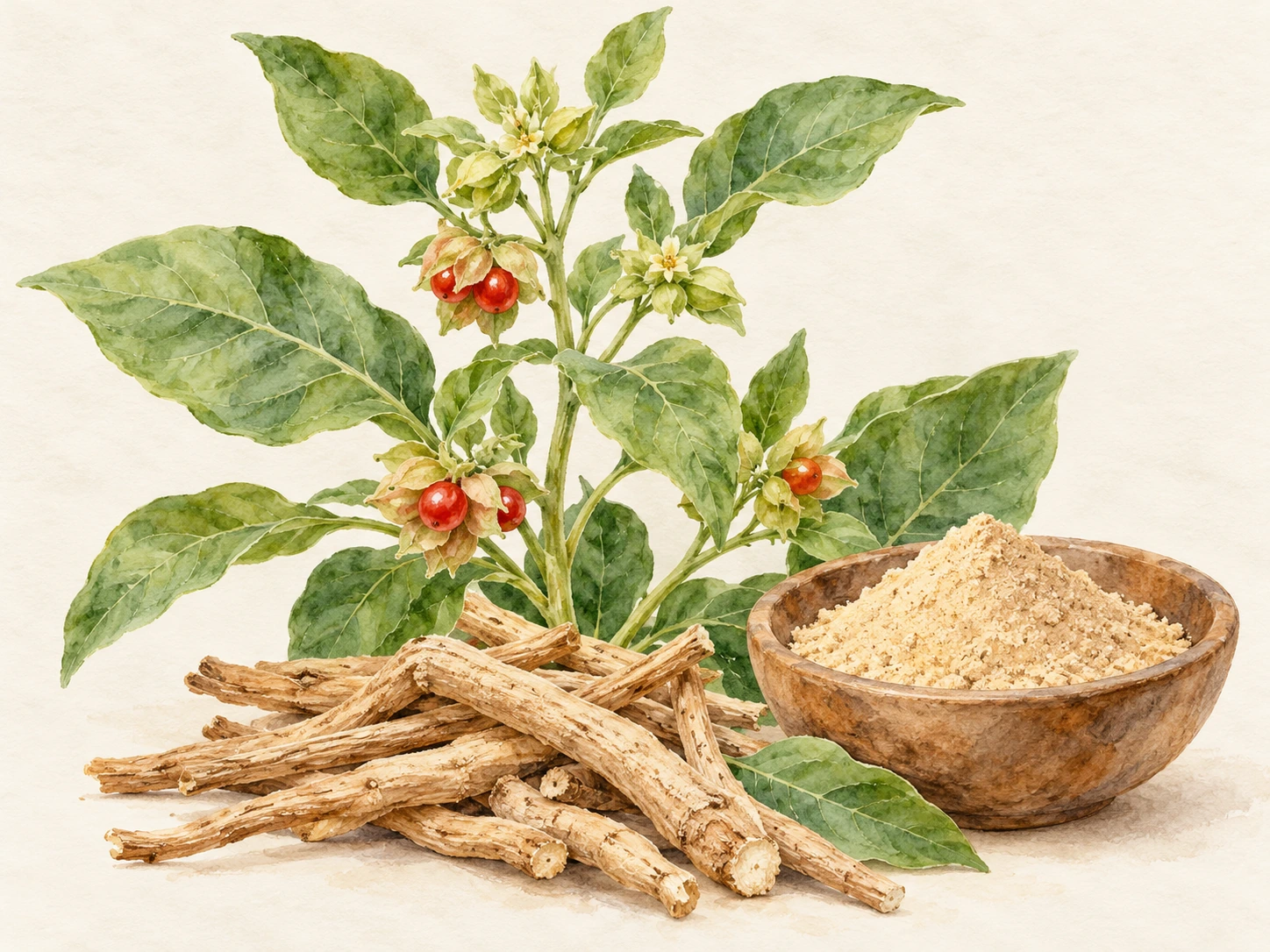
Ashwagandha supplements usually contain an extract of the root, or of the root and leaf. NIH’s fact sheet points out that the trials used different extracts and doses, so results do not line up neatly.
Stress and Anxiety
Stress has the most trial data, and the picture is split. A 2021 review of seven trials, summarized by NIH, covered 491 adults who took ashwagandha or placebo for 6 to 8 weeks. Stress, anxiety, and cortisol all came out lower than placebo, and the effect looked bigger at 500 to 600 mg a day.
A 2025 meta-analysis of 488 participants found lower cortisol but no significant change in perceived stress. All participants in the earlier review lived in India, and NIH calls most of these studies small and short. I compared other mood options in Supplements for Mood: What Actually Helps—and What Doesn’t.
Sleep Quality
The benefit is small, and it is clearer for some people. A 2021 meta-analysis of five trials, covering 400 participants for 6 to 12 weeks, found a small but significant improvement in sleep over placebo, rated as moderate-quality evidence. The effect was larger at 600 mg a day, after at least 8 weeks, and in people with insomnia.
I cover how I read sleep supplement labels in The Sleep Supplement Buying Guide: What I Actually Check Before I Buy.
Fatigue and Energy
Fatigue shows a thinner signal. The 2021 review reported less fatigue than placebo. A separate 12-week trial in 120 adults with low energy, average age about 54, found the same, even though perceived stress did not change.
Ashwagandha Benefits for Women Over 40
Two small trials in midlife women point the same way. In a 2021 trial, 100 women with perimenopausal symptoms took 300 mg of a root extract twice a day for 8 weeks. Their scores on the Menopause Rating Scale and a menopause quality-of-life scale improved more than placebo.
A 2026 trial of 60 women aged 45 to 55 used the same dose for 56 days. Total Menopause Rating Scale scores fell from 31.4 to 18.5 on ashwagandha, against 30.7 to 30.0 on placebo. Lower means milder symptoms.
Both trials used one branded extract (KSM-66) and both were in India. The authors of the newer one say the results may not carry over to other extracts.
I covered the wider menopause picture in Natural Supplements for Hormone Balance: What Research Says.
How Long Does Ashwagandha Take to Work?
The trials measured results in weeks, not days. The seven stress trials in the 2021 review ran 6 to 8 weeks, and the five sleep trials in the meta-analysis ran 6 to 12 weeks, with a clearer sleep benefit at 8 weeks or longer. Both women’s trials ran 8 weeks.
Doses varied a lot. In NIH’s summary, those stress trials used 240 to 1,250 mg a day of extract, and several saw bigger effects at 500 to 600 mg. Those are study ranges for specific extracts, not a standard dose.
How to Choose an Ashwagandha Supplement
The ashwagandha benefits in trials belong to specific extracts, so the label matters more than usual. Four things on it tell you most.
Root Powder vs. Extract
An extract and a powder are not the same thing at the same milligram number. Powder is ground root. An extract is concentrated, and KSM-66 is described as a 12:1 extract, so 600 mg of it stands in for far more plant than 600 mg of powder.
One trial in NIH’s review used whole-root granules equal to about 6,000 mg of root powder a day.
KSM-66 vs. Sensoril
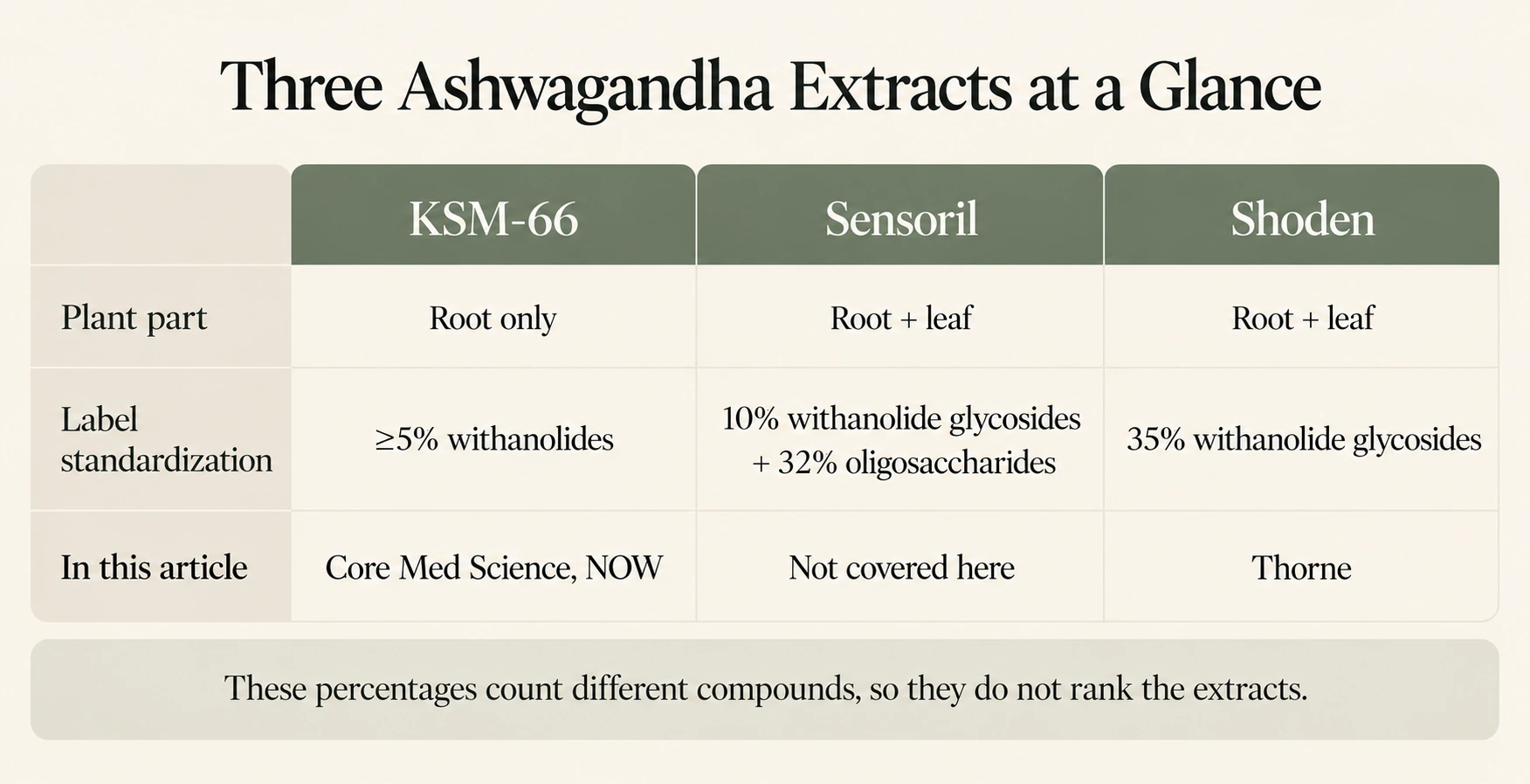
They are different extracts, and NIH says the mix of preparations makes it hard to name a best one. KSM-66 uses root only and is standardized to 5% withanolides. Sensoril uses root and leaf and is labeled 10% withanolide glycosides plus 32% oligosaccharides. Shoden, the extract in Thorne’s capsule, uses root and leaf at 35% withanolide glycosides.
These percentages count different compounds, so they do not rank the extracts. They differ because each extract is made differently, and each spec matches the extract its own trials used. I did not find a trial that compared the extracts head to head.
Root-only versus root-and-leaf is also a regulatory question. India’s food regulator issued an advisory against leaf use in food products in April 2026, and a court paused it in May for eight petitioning companies. I could not confirm what happened after that, and the advisory applies in India only.
What the Withanolide Percentage Means
Withanolides are the plant compounds researchers use to measure an ashwagandha extract. NIH calls them steroidal lactones and says they are believed to explain many of ashwagandha’s effects, though other compounds may play a part.
Lab and animal studies credit individual withanolides, such as withaferin A and withanolide A, with anti-inflammatory and nerve-protective effects. The human trials tested whole extracts, not withanolides on their own.
The percentage on a label is how much of the extract is withanolides. At 5%, a 600 mg capsule holds about 30 mg.
Whether a higher percentage works better is an open question. The sleep meta-analysis cites a mouse study in which a withanolide-rich extract did not induce sleep. In practice, the number is most useful for checking a bottle against its label.
Labels use related terms too. Withanolide glycosides are withanolides with a sugar attached, and aglycones are the form without one. The USP standard for ashwagandha root adds the two together, so “withanolides” on one label and “withanolide glycosides” on another are not counting the same thing.
That check matters. In 2024, ConsumerLab reported that 8 of 13 ashwagandha supplements it tested held just 7.8% to 83% of the withanolides their labels implied, and most held less than half. For a label that implies 30 mg, that is about 2 to 25 mg.
Three of the eight that fell short contained the same popular branded extract, so an extract name alone is not a guarantee.
Third-Party Testing
A public listing is the check you can verify yourself. NSF/ANSI 173 certification tests that the supplement facts panel matches the contents and screens for contaminants, with annual audits and periodic retesting. Those checks cover what is in the bottle, not whether it works.
NSF’s public list showed 18 ashwagandha products from 16 companies when I searched it on October 15, 2026, including gummies and blends. Some brands write “third-party tested” without naming a program. I report those as the brand’s own wording.
Ashwagandha Side Effects and Who Should Check First
Most people in the trials tolerated ashwagandha for about three months. NIH lists loose stools, nausea, stomach upset, and drowsiness as the common effects, usually mild. Long-term safety is not known.
Three areas need attention. Rare liver injury has been reported, thyroid hormone levels may shift, and it may interact with thyroid, diabetes, blood pressure, immune, and sedative medicines. France’s ANSES advised people with thyroid, liver, or heart conditions, pregnant or breastfeeding women, and people taking sedatives to avoid it.
Regulators are watching. Denmark banned it in 2023. In July 2026 Australia’s TGA reported 11 possible liver injury cases and called the risk very rare. European regulators are considering a review.
Extract makers point to larger studies, including a September 2026 report of a placebo-controlled trial in 1,002 adults on KSM-66 for eight weeks, with no serious adverse events.
Ashwagandha Supplements I Looked At
I picked these three by what I could confirm: the extract, the dose per serving, and what testing a public listing or the brand shows. One I have used myself.
Core Med Science KSM-66 600 mg
Core Med Science KSM-66 600 mg is a single-ingredient capsule with 600 mg of KSM-66 root extract, a dose used in the trials above. NSF’s list includes “Ashwagandha KSM-66 600 mg” from Core Med Science under NSF/ANSI 173.
The brand also advertises NSF Certified for Sport on its label. The listing I confirmed is the 173 one.
Thorne Ashwagandha
Thorne Ashwagandha has 120 mg of Shoden extract per capsule, from root and leaf, with no other active ingredient. Thorne’s capsule appears on NSF’s NSF/ANSI 173 list.
The Shoden sleep trial in NIH’s summary used 120 mg a day, the amount in one capsule.
NOW KSM-66 600 mg
NOW KSM-66 Ashwagandha is the one I have used. Each capsule has 600 mg of organic KSM-66 root extract.
NOW states “Made and quality tested in the USA” and says its manufacturing holds GMP certifications, including a 2026 renewal through Eurofins. I did not see this product on NSF’s list.
Common Questions
Is It Better to Take Ashwagandha in the Morning or at Night?
No trial I read set out to answer this. NIH’s summary reports doses and durations, and in the 2026 women’s trial people took one capsule after breakfast and one after dinner. The Thorne and NOW labels both say one capsule daily.
Is Ashwagandha Safe to Take Every Day?
NIH says the studies support daily use for up to about three months and that long-term safety is not known. Most trials ran 6 to 12 weeks, which is the window the evidence covers. The side effects section above lists the groups who should check with a prescriber first.
Can I Take Ashwagandha with Thyroid Medication?
Ask your prescriber first. NIH says ashwagandha might affect thyroid function and interact with thyroid hormone medicine. In one 8-week trial of 50 people with subclinical hypothyroidism, 300 mg twice a day lowered TSH and raised T3 and T4 compared with placebo, and there are case reports of thyrotoxicosis. NOW’s label also cautions people who take thyroid hormones.
The research gives ashwagandha benefits a clear shape. Stress and sleep have the most support, menopause symptoms and fatigue less, and almost all of it comes from short trials of specific extracts.
That is why I started with the label. The extract name, the plant part, the dose per serving, and a listing you can check told me more than the front of any bottle.
If you take medication or have a thyroid or liver condition, the conversation with your prescriber comes before any of this.
Keep Reading
Want to read labels the same way for another supplement? Here is how I did it in How to Choose a Magnesium Supplement: 6 Things I Check Before Buying.
This article is based on personal experience and publicly available research. It is not a substitute for medical diagnosis or treatment. Please consult a healthcare professional about any health concern or medication.