
This article contains affiliate links. We may earn a small commission if you purchase through them, at no extra cost to you.
My sleep had been unsteady, so I tried melatonin. I grabbed 10 mg, because that was the dose the shelves seemed to be full of. The nightmares got more frequent and I woke up foggy, so I decided melatonin just wasn’t for me.
Then I started reading, and I realized I had never really thought about how to choose melatonin. I dropped to 2 mg. The nightmares nearly stopped and the morning fog eased a lot.
That’s one person with one bottle, and I’m not a doctor. What follows is what I wish I’d read first: dose, type, form, and whether the bottle can be trusted.
What Are the Benefits of Taking Melatonin?
Trial reviews point to small gains in how fast people fall asleep and, in some analyses, a little more total sleep time.
For adults with long-term insomnia, the picture is mixed. A 2022 review of adults 50 and older found modest gains in falling asleep, total sleep time, and sleep quality, though it also pooled a related drug called ramelteon.
A 2022 review of 24 trials found no significant benefit in adults without other conditions. The two used different trials and age groups, which may explain the difference.
What Is the Best Melatonin Dosage for Sleep?
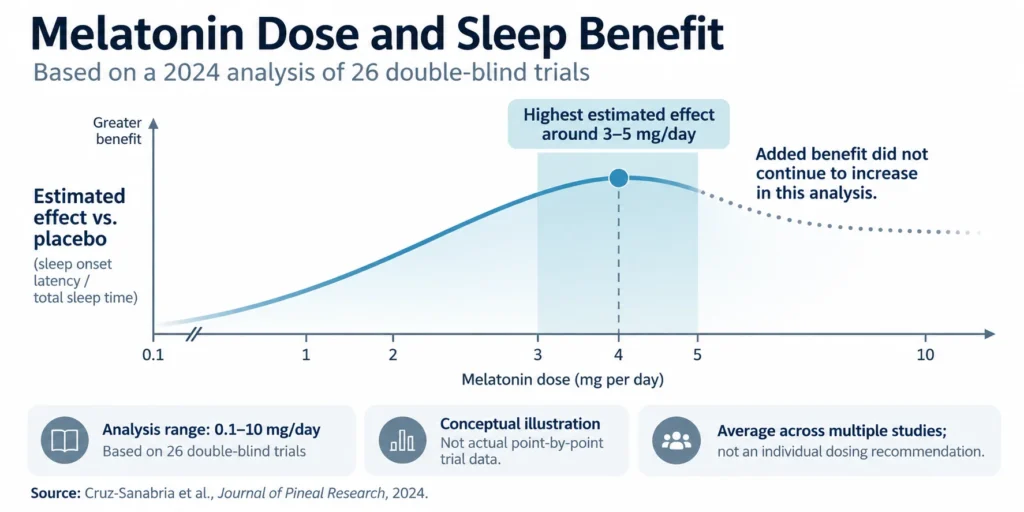
A 2024 analysis of 26 double-blind trials found that melatonin’s effect on falling asleep and on total sleep time rose with dose, then peaked at about 4 mg a day. The benefit peaked there rather than continuing to climb.
That’s an average across studies, so it isn’t a prescription. The analysis also pooled people with insomnia and healthy volunteers, and people differ.
Is More Melatonin Always Better?
In the 2024 analysis, the average benefit peaked at about 4 mg a day rather than continuing to climb. Side effects such as headaches, dizziness, nausea, and daytime sleepiness show up more often at high doses.
My 10 mg bottle was well past that peak. I can’t say whether the dose alone explains my nightmares and foggy mornings.
Which Type of Melatonin Is Best for Your Sleep Needs?
Immediate-Release vs. Extended-Release Melatonin
Immediate-release melatonin acts all at once. Extended-release is built to let it out slowly over several hours.
Most of the support for extended-release comes from one prescription product, 2 mg prolonged-release melatonin, tested for three weeks in adults 55 and older.
In one of those trials, 354 adults aged 55 to 80 took part, and 26% of those on melatonin improved in both sleep quality and morning alertness, versus 15% on placebo. The trials were industry-sponsored and tested a prescription product. Whether over-the-counter extended-release supplements behave the same is not something they address.
Melatonin for Falling Asleep vs. Staying Asleep
Marketing often splits them by problem: immediate-release for falling asleep, extended-release for staying asleep. The trial above measured sleep quality and next-morning alertness, not how often people woke at night.
How to Choose Melatonin You Can Trust
Picking a dose is half of how to choose melatonin. The other half is whether the bottle actually holds that dose.
A 2017 analysis of 31 supplements bought in Canadian stores found melatonin content anywhere from 83% less to 478% more than the label said. More than 71% missed the label by over 10%. Another 26% contained serotonin, which wasn’t listed.
I keep a longer version of my general label checks in The Sleep Supplement Buying Guide: What I Actually Check Before I Buy.
The three sections below cover what the melatonin data says about form, label, and testing.
Melatonin Gummies vs. Tablets
A JAMA analysis of 25 gummy products found 22 were inaccurately labeled, with actual melatonin from 74% to 347% of the stated amount. One had CBD and no melatonin at all.
Only gummies were tested, with one sample per brand. The 2017 analysis covered liquids, capsules, and chewables, and the product type didn’t predict accuracy. Whether tablets or capsules would have done better is not something the gummy analysis tested.
A 2024 ConsumerLab test of 20 melatonin products, covering capsules, tablets, lozenges, liquids, and gummies, reported that all of them contained their listed amounts within a reasonable margin. It tested different products from the JAMA analysis.
Check the Supplement Facts Label
The label shows three things relevant here: milligrams per serving, how many pieces make a serving, and what else is in the product. In the 2017 analysis, most products were blends with herbs such as valerian or passionflower. Added herbs can make it harder to tell which ingredient is responsible for an effect or a side effect.
Look for Independent Quality Testing
The American Academy of Sleep Medicine suggests looking for the USP Verified mark when you compare supplement labels. It’s a check on what’s in the bottle, not proof that melatonin will help you.
In the 2017 analysis, one product varied by 465% between lots.
Several marks and test programs exist, and they don’t cover the same things. These are the ones that show up on melatonin products.
USP Verified. USP says verified products contain the listed ingredients in the declared amounts, have no harmful levels of specified contaminants, and break down within a set time. Verified products are listed in USP’s online Verified Product Finder. Two melatonin examples are Nature Made Melatonin 3 mg Tablets and Nature Made Melatonin 2.5 mg Gummies.
NSF Certified for Sport. Thorne describes this program as testing every batch for compliance with label claims and for more than 200 substances banned by major athletic organizations. Thorne Melaton-3 is a 3 mg capsule that carries it, and NSF’s public listing shows the 60-capsule size with certified lot numbers.
ConsumerLab. ConsumerLab buys products and tests them itself. It also runs a voluntary Quality Certification Program for products that pass the same testing. Full results are behind a paid membership.
Manufacturer-stated testing. Some labels and retailer pages carry claims such as “Third Party Tested” or “GMP” without naming the outside program or what was tested.
USP and NSF both publish searchable product listings, so a logo on a label can be compared with the listing.
When Should You Take Melatonin for Best Results?
In the 2024 analysis, a longer gap between taking melatonin and going to sleep was linked to a bigger drop in the time it took to fall asleep.
Mayo Clinic advises not driving or using machinery within five hours of taking it.
What Should You Know Before Taking Melatonin?
Short-term use is generally considered safe.
Some medicines don’t mix well with it. The Merck Manual says melatonin may raise the effects of warfarin, which increases bleeding risk, and may strengthen the sedation from benzodiazepines. It may also weaken antiseizure medicines, according to the same source. If you take any of these, it may be a good idea to have a pharmacist check your specific combination.
The same source says there’s little evidence melatonin treats chronic insomnia. CBT-I for Menopausal Insomnia Improves Sleep, Study Finds covers a different approach to long-lasting sleep trouble.
A Simple Checklist for Choosing Melatonin
Here is how to choose melatonin, step by step, with what the evidence says at each one:
- Dose: In the 2024 analysis, the average benefit peaked near 4 mg a day. Side effects are reported more often at higher doses.
- Type: Evidence for extended-release comes mainly from one prescription product tested in adults 55 and older.
- Form: In the JAMA analysis, 22 of 25 gummies missed their labels. A 2024 ConsumerLab test of 20 products found all within a reasonable margin of their labels. The 2017 analysis found no pattern by product type.
- Label: Milligrams per serving, pieces per serving, and added herbs or CBD.
- Verification: USP Verified, NSF Certified for Sport, ConsumerLab testing, and manufacturer-stated testing each cover different things. Lab testing found wide gaps between label and bottle.
- Timing and safety: In the 2024 analysis, taking it earlier was linked to faster sleep onset. The Merck Manual flags warfarin, benzodiazepines, and antiseizure medicines as interactions.
Common Questions
Is 10 mg of melatonin too much?
The dose analysis peaked at about 4 mg a day, and side effects are reported more often at higher doses. A pharmacist or doctor can say what makes sense for a specific person.
Can I take melatonin every night?
The Merck Manual says long-term safety is unknown. Mayo Clinic says dependence is unlikely, which is a separate question from long-term safety data. Anyone using it nightly for months can raise it with a doctor.
Does melatonin work differently for women over 40?
I didn’t see dosing studies specific to women over 40. The National Center for Complementary and Integrative Health notes that melatonin may stay active longer in older adults, which can mean daytime drowsiness.
What if melatonin doesn’t seem to help?
In adults with long-term insomnia, that 2022 review found no significant benefit, and the dose analysis peaked near 4 mg. A doctor can look at what else may be affecting sleep.
My 10 mg bottle taught me the main thing about how to choose melatonin: the number on the label is only where the decision starts. I still don’t know whether the dose caused my nightmares. But 2 mg did what 10 mg didn’t.
For sleep trouble that goes beyond picking a product, Sleep After 40: The Complete Guide to What Actually Helps covers the wider picture.
Keep Reading
Wondering whether your nights need a better routine before any supplement? Start with Sleep Hygiene After 40: A Better Sleep Routine That Actually Works.
Curious how the same label-checking works for another supplement? See How to Choose a Magnesium Supplement: 6 Things I Check Before Buying.
This article is based on personal experience and publicly available research. It is not a substitute for medical diagnosis or treatment. Please consult a healthcare professional about any health concern or medication.