This article contains affiliate links. We may earn a small commission if you purchase through them, at no extra cost to you.
Search for creatine and you get a long list of options: monohydrate, HCl, micronized, Creapure, powder, capsules, gummies. Some of those names mean a real difference. Others are just labels.
How to Choose Creatine: Quick Answers by Situation
Here’s what surprised me. The fancy-sounding forms didn’t beat plain monohydrate in the studies. What seemed to matter was boring: how pure the product is, how much creatine is in a serving, and whether anyone tested it.
If you’re wondering how to choose creatine, find the situation that sounds like yours.
- If the label is full of fancy form names, the plain, oldest form has the most research behind it. None of the newer ones has been shown to beat it.
- If a premium ingredient brand is tempting you, the extra money buys purity. A lab report or third-party certification shows purity better than a logo does.
- If you want to know a product matches its label, look for independent testing of the finished product.
- If you’re over 50 and don’t plan to exercise, most of the research in older adults paired creatine with strength training. What it does on its own is less clear.
- If you have kidney disease, or aren’t sure about your kidneys, talk to your doctor first. The reassuring studies were done in healthy adults.
- If you can’t decide between powder and capsules, compare how much creatine you actually get per day and what that costs.
The next sections go through the evidence.
What the Research Says About Creatine Monohydrate
Almost every creatine study used monohydrate, so I’ll start there.
Muscle and Strength
It helps a little, mostly when you’re also lifting. Several reviews that pool studies of adults over 50 or 60 point the same way: creatine plus strength training gives a small extra gain in strength compared with training alone.
One big review of 69 studies found smaller gains, or gains that weren’t statistically significant, in older adults and women. Not many of them took part, so it’s too early to say creatine doesn’t help them.
Think of the creatine in your muscles like a battery. Training drains it, and a supplement tops it back up. If you’re not training yet, Exercise After 40: What the Research Actually Says covers where to begin.
Kidney Safety
For healthy adults, creatine doesn’t seem to harm the kidneys. A 2025 review of 21 studies found that the kidneys’ filtering speed didn’t change, even though creatinine, a common kidney marker on blood tests, went up a little. I explain why in the questions near the end.
People with kidney disease are a different story. There’s much less research on them, so talk to your doctor before starting.
Brain and Aging
The brain research is still early. A 2024 review of 16 trials saw a small improvement in memory, and the researchers were moderately confident in it. Attention and processing speed also got better, but they were less confident there. Overall thinking and planning skills didn’t change.
Most of creatine’s evidence is about muscle, so the brain part is a side note for now.
Creatine Monohydrate vs. HCl vs. Micronized
Creatine HCl
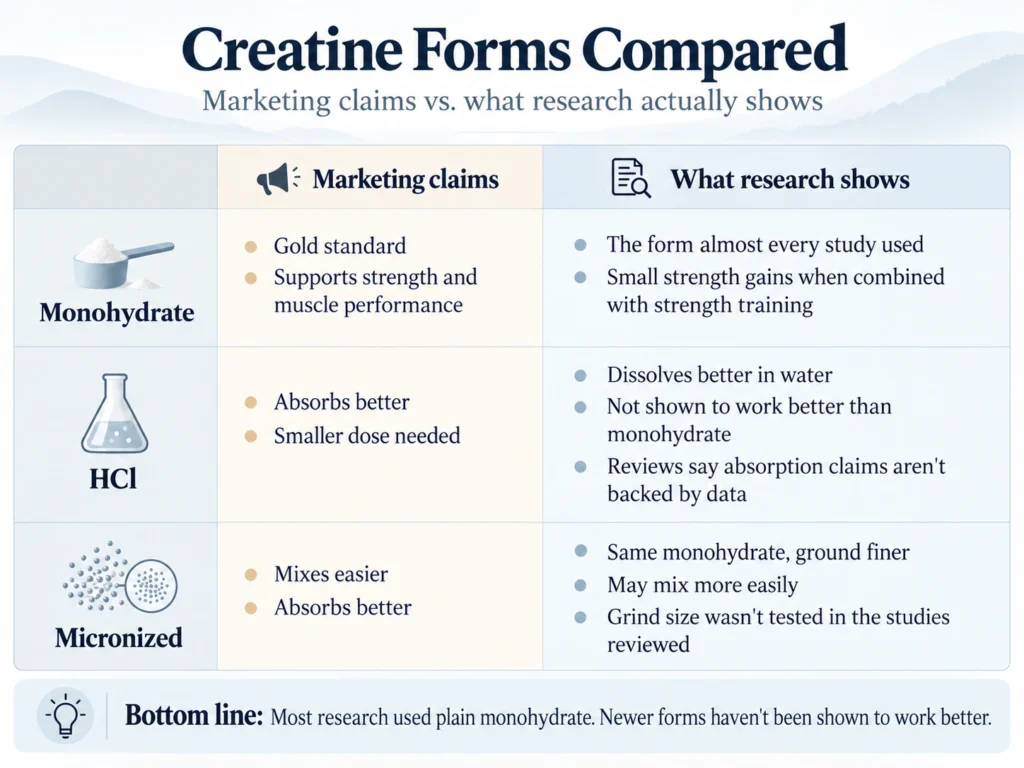
HCl dissolves better in water, but that hasn’t been shown to improve strength or exercise performance. A 2022 review concluded that the claims of better absorption for HCl aren’t backed up by the data.
A second 2022 review looked at 17 placebo-controlled trials of other forms, like citrate, malate, and nitrate. Only three compared a form head-to-head with monohydrate, and none of them came out ahead. A form that dissolves easily still has to prove it works better in people.
Micronized Creatine
Micronized just means the powder is ground finer. It’s like coarse sugar versus powdered sugar. The fine one dissolves faster, but it’s just as sweet.
With creatine, that might mean less grit and less powder sinking to the bottom of your glass. The studies I read compared different forms of creatine, not different grind sizes, so I can’t tell you whether particle size changes how well it works.
Creapure vs. Regular Creatine
Creapure is creatine monohydrate with a brand name. It’s the same form, not a stronger one. The extra money goes toward purity.
Creatine is made in a lab from chemical ingredients. Its maker says a dedicated German facility keeps the leftover byproducts from that process very low. For something you take every day, that’s a real plus.
The studies I read compared forms of creatine, not Creapure against other monohydrate brands. Other brands can show similar purity with lab reports or third-party certification, so the paperwork matters more than the logo.
How to Check Creatine Quality Before Buying
This part of how to choose creatine doesn’t depend on any study. You just read the package.
Reading the Ingredient Label
Start with the form listed: monohydrate, HCl, or something else. Then find how much actual creatine is in one serving. In a blended product, a serving can hold far less creatine than a scoop of plain powder.
Finally, look at what else is in there, like sweeteners or caffeine.
Third-Party Testing
Independent testing means an outside organization checks the finished product, not just the raw ingredient. NSF Certified for Sport, for example, tests each lot for banned substances, checks that the label matches what’s inside, and screens for contaminants.
It doesn’t test how well a product works. It only tells you what’s in the tub. I go through the same kind of label check for magnesium in How to Choose a Magnesium Supplement: 6 Things I Check Before Buying.
How Much Creatine Do You Need?
The usual daily amount is 3 to 5 grams, according to the 2017 position stand of the International Society of Sports Nutrition. Some products and trials start with a loading phase instead, which is about 20 grams a day for five to seven days.
Muscles can only store so much creatine, and a supplement fills them up to that limit. Loading isn’t required. In a 1996 study in men, 3 grams a day for 28 days got muscle creatine to about the same level as a week of loading. It mostly comes down to speed: about a week with loading, three to four weeks without. The same position stand adds that there’s less support for the early performance effects of the slower route.
To work out how long a tub lasts, divide the grams of creatine in the tub by your daily grams. A 300-gram tub at 5 grams a day lasts 60 days. If you have kidney disease, check with your doctor first, since the dose studies were done in healthy adults.
Creatine Powder vs. Capsules
Powder makes it easy to set your dose, and a scoop is usually around 5 grams. Capsules are easier to carry, but 5 grams can take several of them, because each one often holds less than a gram.
Check the creatine per capsule on the label, then divide your daily grams by that number to get the capsule count. To compare cost, divide the price by how many days it lasts at your dose.
Gummies come in lots of formulas, so check how much creatine is in each serving.
Creatine Products With Third-Party Testing
These three fit the checks above: plain monohydrate, 5 grams per serving, and testing of the finished product. All three are listed as NSF Certified for Sport.
Thorne Creatine lists 5 grams of creatine monohydrate per scoop. Klean Athlete Klean Creatine lists 5 grams per serving too.
Momentous Creatine also lists 5 grams per serving. Momentous sells several formats, so make sure the page you open is the powder if that’s what you want.
Certification and serving size can change between versions, so read the label on the exact tub you buy. You can look a product up on NSF’s certified product listings.
Common Questions
Do I need a loading phase?
No. Loading mainly speeds up how quickly your muscles fill up with creatine.
In a 1996 study in men, 3 grams a day for 28 days reached about the same muscle creatine level as 20 grams a day for six days. A 2026 review of 11 trials in adults 60 and over also found that loading and dose didn’t change the benefit. The authors said there weren’t enough studies to be sure, though.
Why did my creatinine go up on creatine?
Creatine is a quick-energy store that muscles use when they work hard. What’s left over turns into a waste product called creatinine. Your kidneys clear it out in urine, and blood tests use creatinine to check how your kidneys are doing. More creatine means more creatinine, so the number can go up even when your kidneys are working just as well.
The 2025 review I mentioned above saw a small rise in creatinine and no change in how fast the kidneys filter. Kidney estimates based on creatinine alone can read low when you take creatine, so other tests are sometimes used. It helps to tell whoever orders your blood work that you take creatine.
Does creatine help muscle and strength in women over 50?
Possibly a small boost to muscle and strength when paired with training, but the results in women are mixed.
In a two-year trial of 237 postmenopausal women who all did strength training and walking, the women taking creatine gained more lean mass and walked faster over 80 meters. Bone density didn’t change. Squat strength went up about the same as it did with placebo.
Do I have to exercise for it to work?
Most of the research in adults over 50 paired creatine with strength training, so what it does on its own is less clear.
Reviews of older adults, including one from 2014 and one from 2025, compared creatine plus strength training with training alone. That tells you what creatine adds to lifting. It doesn’t tell you what it does without lifting.
Back to that long list of options. Most of the names turn out to be packaging around the same ingredient. What differs is purity, how much creatine you actually get, and how the product was tested.
So when it comes to how to choose creatine, the fancy names matter less than purity, the amount in each serving, and whether the finished product was tested. The strength evidence for midlife and older adults is real but small, and it depends on training. If your kidneys are a question, ask your doctor first.
Keep Reading
Curious how the same label-first approach works for another supplement? How to Choose an Omega-3 Supplement: What Actually Matters
Wondering what to look for on a collagen label? How to Choose a Collagen Supplement: What the Studies Used and What to Check on the Label
Looking for a gentle way to start strength training? Exercise for Arthritis After 40: Strength Training and Stretching for Joint Pain
This article is based on personal experience and publicly available research. It is not a substitute for medical diagnosis or treatment. Please consult a healthcare professional about any health concern or medication.