
Why “vibrant aging” is about more than living longer, and what the research actually supports.
We hear it constantly. Age well. Stay healthy. But ask five people what healthy aging actually means and you get five different answers. No illness? More years? Fewer wrinkles?
The World Health Organization has the clearest answer on offer: healthy aging is the process of developing and maintaining the functional ability that lets you live well as you age. Not the absence of disease. What you can still do.
Somewhere in my late forties, this stopped being a topic about other people. So I went through what’s available, from WHO position papers to systematic reviews, and this article is what came out of that.
It reads less like an answer and more like a map. Where the evidence is solid, where it thins out, and where it’s still mostly educated hope.
What Is Healthy Aging?
The WHO Definition
That one-sentence version leaves out most of what WHO actually means by functional ability.
It covers a lot: meeting your basic needs, learning and growing and making decisions, being mobile, building and keeping relationships, and contributing to your community (Source: WHO).
What struck me was the absence. Disease isn’t at the center of that definition. The focus sits on what a person can still do, not on what shows up on their chart.
One caveat belongs here. This is a conceptual framework, not a validated clinical metric. It reflects expert consensus and policy thinking rather than a trial result.
What Healthy Aging Doesn’t Mean
The most common misreading is that healthy aging means having nothing wrong with you. WHO pushes back on that fairly directly.
You don’t need to be free of disease or disability. If the conditions you have are managed well enough that you can keep doing what matters to you, that counts.
The shift is bigger than it first appears. You move from counting deficits, meaning what has been lost, to reading function, meaning what remains possible.
Lifespan vs. Healthspan
Lifespan and healthspan are separate conversations. If living longer is the only goal, the measurement gets simple. Most current frameworks weight function and wellbeing more heavily than years.
Here’s where the field admits a problem. A 2023 commentary in Age and Ageing points out that there’s still no universally agreed measurement standard. Some studies use disability-free survival, others use quality of life, others use cognition or activities of daily living (Source: PMC).
The concept is elegant. The ruler is missing.
Is Healthy Aging the Same as Vibrant Aging?
The overlapping vocabulary kept tripping me up, so I sorted it once.
Healthy Aging is the WHO-style definition above, centered on functional ability. It’s the research and policy term, and WHO has used it as its primary framework since 2015.
Active Aging aims to optimize opportunities for health, participation, and security to improve quality of life. It leans toward policy and civic participation, and WHO has stated it now uses healthy ageing as the lead framework instead.
Successful Aging usually describes low disease and disability, high function, and active engagement. It’s also the most contested of the group. Critics argue that requiring the absence of disease is too narrow and quietly excludes anyone living with a chronic condition.
Healthy Longevity means living longer while keeping function and wellbeing intact. It’s a step up from plain longevity, which can mean nothing more than added years. There’s no single standardized definition here either.
Aging Well is the most everyday phrase and the least formalized. Even in the literature it blends into the others.
None of these genuinely contradict each other. They emphasize different things. At MIDLIFORA we use Vibrant Aging as the umbrella, because we wanted one phrase that holds protecting function, staying engaged, having purpose, and stretching that stretch of time out as long as possible.
It’s our editorial choice, not an academic term, and I’d rather say that plainly than let it sound official.
What the Research Actually Says About Aging Well
A few patterns surfaced repeatedly while reading.
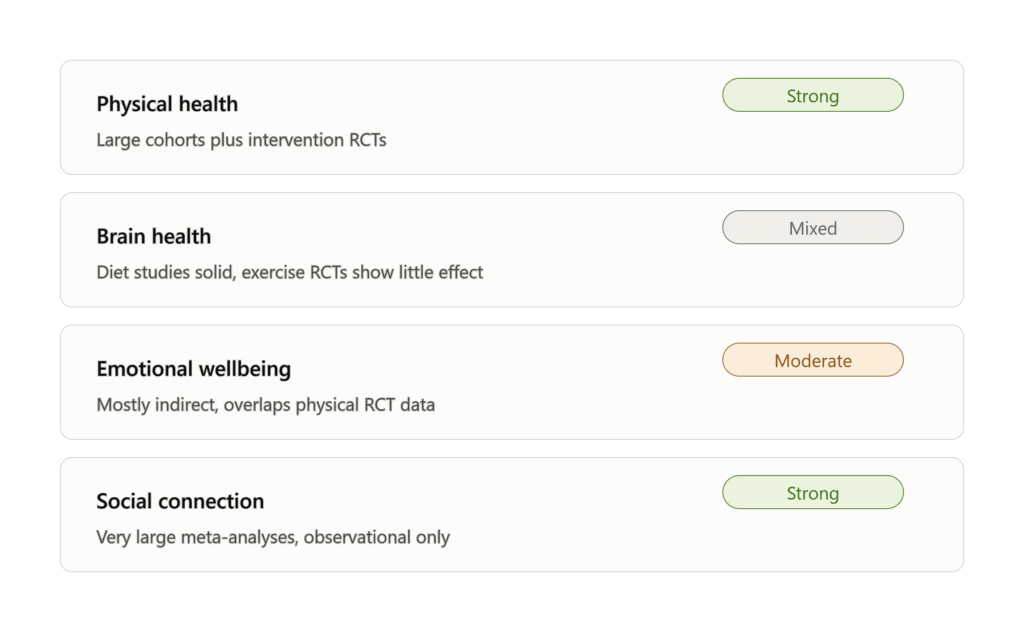
The type of evidence varies enormously by domain. Physical activity and social connection have large observational datasets behind them. Purpose in life doesn’t even have a consistent measurement approach. Treating all four pillars as equally established would misrepresent what’s known.
Combined approaches outperform single interventions. A 2023 meta-analysis pooling 25 randomized trials found multidomain interventions improved cognitive screening scores, depression, physical performance, gait speed, chair-stand results, and grip strength (Source: PubMed). Touching several habits at once produced steadier results than isolating exercise or diet alone.
The field is openly behind on implementation. A 2024 commentary in Lancet Healthy Longevity argued that the Decade of Healthy Ageing framework urgently needs faster execution and better measurement (Source: PubMed). The architecture exists. The delivery hasn’t caught up.
The US National Institute on Aging takes a similar tack, skipping a formal definition and organizing its guidance around lifestyle, independence, and quality of life (Source: NIA).
The Four Pillars of Healthy Aging
Go back to the WHO definition for a moment. Functional ability covers meeting your basic needs, learning and deciding, staying mobile, building relationships, and contributing to your community. Those demands don’t live in one system of the body.
Moving requires muscle and joints. Learning and deciding requires cognition. Keeping relationships requires both the mood to want them and the opportunity to have them. Sort the research by which of those it’s actually addressing, and four areas fall out.
I’ve noted how strong the evidence is in each, because it isn’t equal.
Physical Health
This is where the research is thickest.
A 2017 systematic review and meta-analysis of 23 longitudinal cohorts covering 174,114 participants found physical activity positively associated with healthy aging, with a pooled effect size of 1.39. Because these are observational studies, they establish a strong association rather than causation (Source: PubMed). Reverse causation is hard to rule out entirely, since healthier people tend to move more in the first place.
Resistance training sits on different ground, because that literature is intervention-based. A 2023 meta-analysis of 21 studies and 1,610 adults over 60 reported improvements in physical function, strength, pain, mental health, social function, and depression measures (Source: PubMed). The authors flag some findings as preliminary, and individual trials were small and heterogeneous.
Muscle mass and strength remain the central mediators of maintained function, which is why I’ve put this pillar first in my own planning.
One thing gets skipped in most articles. After 40, the limiting factor is often not how much you exercise but whether your body lets you keep exercising. A bad knee or a stiff shoulder ends a program faster than a bad plan does, which makes mobility as much a joint question as a training question
Learn more: What Exercise Research Actually Says for People Over 40
Brain Health
Expectation and evidence part company a bit here.
On the diet side, a 2019 systematic review of 38 studies found the Mediterranean pattern most consistently linked to protection of cognitive health in later life. DASH, MIND, and anti-inflammatory patterns looked promising but had less research behind them (Source: PubMed).
Exercise and cognition proved more cautious than I expected. A 2024 systematic review and meta-analysis of long-term exercise trials found minimal to no effect on global cognition, and no clear evidence of reduced risk for mild cognitive impairment or dementia. Multidomain interventions again performed better (Source: PubMed).
That isn’t a case against moving your body. It’s a case against the sentence “exercise prevents dementia,” which the current evidence doesn’t support at that confidence level.
Learn more: Brain Fog in Midlife: A Complete Guide
Emotional Well-Being
NIA explicitly folds mental health, depression, stress, and mood into its healthy aging guidance. Observational research repeatedly links depression and reduced emotional wellbeing to worse downstream health and cognitive outcomes.
The resistance training meta-analysis mentioned earlier is interesting on this point, because depression and mental health subscales improved alongside the physical measures. I’d been treating body and mood as separate maintenance projects. They appear to share more machinery than that.
Mood shifts in the late forties also resist being explained by stress or temperament alone, since hormonal change is running concurrently and can’t be factored out of the emotional picture
Learn more: Stress & Mood
Social Connection
This evidence turned out far stronger than I anticipated.
A meta-analysis pooling 90 cohort studies found social isolation and loneliness associated with increased all-cause mortality, with isolation also linked to cardiovascular mortality (Source: PubMed). A separate 2025 meta-analysis reported similar associations between loneliness, isolation, living alone, and mortality risk in older adults (Source: PubMed).
These remain observational, so causal claims deserve restraint. The scale and consistency are still difficult to wave off.
And the WHO definition itself counts building relationships and contributing to society as components of functional ability. Social connection isn’t an add-on to healthy aging. It’s inside the definition.

Daily Habits That Support Healthy Aging
The pillars answer why. This section is closer to what.
Movement
The most reliable card in the deck. Aerobic activity to protect mobility and cardiorespiratory function, resistance work to protect muscle and strength, recommended together across nearly every source.
One frequent misunderstanding involves the scale. NIA notes that exercise can support independence, muscle function, and longevity even when body weight doesn’t change. A stalled number on the bathroom scale is not evidence that the training is pointless.
Nutrition
Diet research is far stronger at the pattern level than at the “how many milligrams of what” level. Vegetables, fruit, whole grains, healthy fats, and adequate protein show up consistently, with the Mediterranean pattern the most studied of the group.
The limits are real. Dietary research struggles with confounding, adherence, and heterogeneity across populations, which is exactly why no single “best diet” verdict has arrived.
Supplements occupy contested territory. Their value relative to whole-diet approaches hasn’t been settled. I treat them as a way to cover specific gaps I can’t close with food, and I evaluate them product by product: ingredient form, actual elemental dose, third-party testing, and cost per serving (The Midlife Symptom-to-Supplement Guide).
Learn more: Gut Health topic pillar
Sleep
A 2023 systematic review and meta-analysis of 23 studies and 21,092 participants found self-reported sleep quality moderately associated with quality of life in older adults. Objective sleep measurements showed no consistent association (Source: PubMed).
That gap fascinated me. Whether you feel rested tracked more closely with quality of life than what your wearable scored overnight.
The reverse reading also holds, of course. Subjective reports are shaped by mood, so which direction the causation runs isn’t settled.
Learn more: Sleep After 40
Stress Management
Stress research has a different shape. I couldn’t find strong randomized evidence that any single technique extends healthspan. It seems to operate through other axes, tangled up with mental health, sleep, and activity levels.
So I’ve stopped thinking of it as a standalone intervention and started treating it as the thing that keeps the other habits from collapsing.
Purpose and Lifelong Learning
A 2022 systematic review on purpose in life found that despite being defined and measured differently across studies, it repeatedly associates with health and social integration in later life (Source: PubMed).
Trials that actively increase purpose and then track health outcomes are still scarce. Association is established. Intervention evidence isn’t.
Learning follows a similar pattern. Cognitively demanding activity and picking up genuinely new skills get positive mentions, while NIA draws a firm line on commercial brain training apps, where conclusive evidence is lacking.
Myths, and Why “Anti-Aging” Is a Different Question
Myths That Keep Showing Up
“Healthy aging means nothing is wrong with you.” The WHO definition contradicts this directly. Chronic conditions that are well managed, with function preserved, fall inside healthy aging.
“The point is living longer.” Current frameworks put healthspan, function, and wellbeing ahead of raw years. How the time is spent has entered the metrics.
“Exercise only counts if you lose weight.” Independence, muscle function, and longevity benefits appear without weight change. Making the scale the only target is a reliable way to quit by March.
“Brain games prevent cognitive decline.” NIA’s position is that evidence for commercial brain training remains inconclusive. Learning a new skill or engaging in cognitively demanding activity is a separate conversation.
“Sleeping less is just part of aging, so don’t worry about it.” Sleep quality keeps connecting to quality of life, mood, falls, and cognitive outcomes. I found no evidence that it matters less with age.
“You can’t build muscle after 50.” Resistance training studies in adults over 60 report gains in strength and function. The response slows compared to your twenties. It doesn’t disappear.
Healthy Aging vs. Anti-Aging
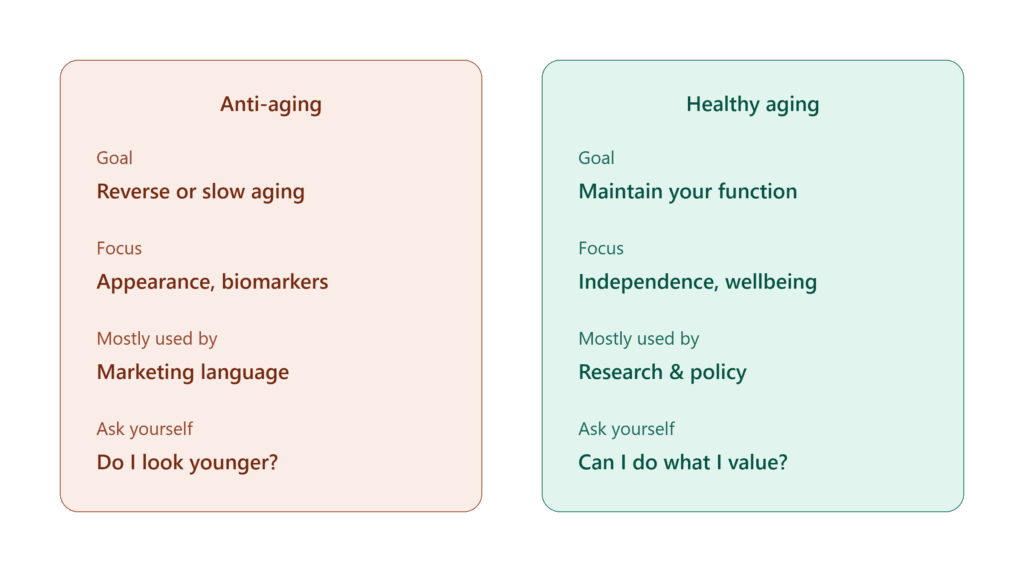
These get used interchangeably, though they begin from opposite premises.
Anti-aging aims to reverse or slow aging itself, and in practice the phrase mostly functions as marketing language pointed at appearance or specific biomarkers. Healthy aging accepts aging as the condition and asks how function and wellbeing can be maintained through it.
Serious research into slowing biological aging does exist. It’s safest to treat consumer products labeled “anti-aging” and actual geroscience as operating on entirely different levels.
The distinction is practical for me because it changes what I measure. “Do I look younger” pulls toward promises nobody can verify. “Can I climb stairs comfortably, do I sleep through the night, is there someone I want to see this week” leaves me with things I can actually check.
Common Questions
What exactly is healthy aging?
By the WHO definition, it’s the process of developing and maintaining the functional ability that supports wellbeing in later life. Moving, learning, forming relationships, contributing to your community. Being disease-free is not part of the requirement.
Can you age healthily with a chronic condition?
Yes, and this is the part WHO states most directly. What matters is whether the condition is managed well enough that you can keep doing what you value. Someone with well-controlled hypertension who walks daily and sees friends weekly fits the definition. The framing measures function, not diagnoses.
When does healthy aging start?
There’s no threshold age in the research. WHO frames it as a life-course process, meaning the trajectory is being set long before anyone would call you old. The forties tend to be when it becomes noticeable rather than when it begins.
Is it ever too late to start?
The intervention data says no. Resistance training studies in adults over 60 report gains in strength, physical function, and mood. The response is slower than it would have been at 25, but it’s still there. I couldn’t find evidence of an age at which the body stops responding.
How many pillars does healthy aging have?
Different sources group them differently. This article uses the four that recurred most across the material: physical health, brain health, emotional wellbeing, and social connection. It’s one reasonable organizing scheme, not a standardized taxonomy.
The Bottom Line
Two impressions stayed with me after all the reading.
The first is that the boundary between the established and the uncertain is sharper than I expected. Physical activity and social connection have deep evidence. Sleep and diet point clearly in one direction while the details stay contested. Purpose and stress management show associations without much intervention data behind them.
The second is that doing several things adequately beat doing one thing perfectly. Chasing the optimal training program matters less than moving, eating reasonably, sleeping, and seeing people, all at a slightly mediocre level, simultaneously.
“MIDLIFORA believes vibrant aging isn’t about chasing youth—it’s about building a healthier, stronger, and more meaningful life as we grow older.”
Keep Reading
If the fog is the symptom that pushed you here, start with Brain Fog in Midlife: A Complete Guide.
Wondering why the wearable score and how you actually feel keep disagreeing? Sleep After 40 goes into it.
And if you’re trying to sort real gaps from marketing, The Midlife Symptom-to-Supplement Guide is where I’d begin.
This article is based on personal experience and publicly available research. It is not a substitute for medical diagnosis or treatment. Please consult a healthcare professional about any health condition or medication.