
This article contains affiliate links. We may earn a small commission if you purchase through them, at no extra cost to you.
I lined up three collagen products on the counter and read the labels. One said 10 g per stick pack. Another said 20 g per scoop. The third was a gummy listing a few hundred milligrams a piece.
I wanted to choose a collagen supplement by comparing numbers, the way I would for anything else. These numbers would not line up.
So I read the research and checked certification registries before I read another label. Here is the short version. The studies are less settled than the packaging suggests. The label math is easier than it looks. And “third-party tested” says less than it sounds like.
- If you’re hoping for fewer wrinkles, aim lower. Hydration and elasticity showed up more consistently in the research than wrinkle changes, and the clearest gains in elasticity and skin barrier took about 12 weeks to appear.
- If two labels look wildly different, compare grams of collagen per serving, not serving size. Serving size counts everything in the scoop.
- If a label says “third-party tested,” look the product up in a certification registry. A registry entry names the exact product and serving size. The phrase on the label names nothing.
- If you avoid beef or pork, marine collagen is an option, but I found no evidence that it works better. Skip it entirely if you have a fish allergy.
- If you take a biotin supplement or have blood work coming up, tell your clinician. High-dose biotin can distort some lab results.
Here’s how I got to those answers.
What the Collagen Studies Actually Used
The research is real. It also disagrees with itself.
A 2025 analysis of 23 randomized trials (1,474 people) found that collagen improved hydration, elasticity, and wrinkles when every trial was pooled. Then the authors kept only trials not funded by supplement or drug companies. The improvements were no longer statistically significant. The same was true when they kept only the highest-quality trials.
A 2026 analysis split the results by outcome. Hydration, elasticity, and skin barrier improved. Wrinkles and dermal density turned out uncertain once the authors tested how sturdy the results were.
Collagen may help skin hold water and stay springy. Wrinkles are another story. The gap between studies comes down to who paid for the trial, how well it was run, and what was measured, so I read everything below as a record of what the trials used, not as a promise.
Source and Type
Most skin trials used hydrolyzed collagen, which is collagen broken into small pieces. Labels also call it collagen peptides.
The sources varied: bovine, fish, and pig all appear. Nothing I read showed that one source beats another for skin.
Labels often add “Type I and III.” Bovine hide naturally contains both, and I couldn’t find direct evidence that the type on the label changes the skin result.
Joint products are a different category. They use undenatured Type II collagen (UC-II) at about 40 mg a day, so don’t compare them with skin peptides gram for gram. I covered that side in 4 Joint Pain Supplements Menopause Runners Should Know: What Actually Worked.
Daily Dose and Duration
Time mattered more than dose.
The 2026 analysis found no clear pattern of bigger doses giving bigger effects. Duration did matter. Hydration improved from week 4, and elasticity and skin barrier were clearly better by week 12. The authors said trials of 24 weeks or longer are still needed.
Duration seemed to matter, so the practical question is simple. Would you realistically take this product every day for a few months?
How to Choose a Collagen Supplement: Reading the Label
Once I knew what the trials used, the label turned into a short list of questions. I run the same routine I described in How to Choose a Magnesium Supplement: 6 Things I Check Before Buying: read the exact grams first. That is how I choose a collagen supplement now.
Serving Size vs. Collagen Grams
“20 g per serving” does not mean 20 g of collagen.
If a product adds vitamins or other ingredients, collagen is only part of that scoop. Find the collagen peptide line on the Supplement Facts panel and read the grams there. If the product is a blend and doesn’t say how much collagen it contains, you can’t compare it gram for gram.
Serving units change too. Many stick packs hold 10 g. Some tub scoops hold 20 g. Within one brand, that is a twofold difference in daily intake.
Protein grams differ from collagen grams as well. A 10 g collagen stick pack can list 9 g of protein. That gap is normal. Compare collagen grams and you won’t get confused.
Added Ingredients and Sweeteners
Extras don’t come with much proof.
Many products add vitamin C, hyaluronic acid, or biotin. One 16-week trial in women aged 40 to 65 compared collagen plus vitamin C with and without hyaluronic acid. Adding hyaluronic acid showed no extra benefit. I couldn’t find a direct comparison for vitamin C or biotin.
Biotin has a separate catch. High-dose biotin can distort some blood tests. The FDA has warned that it can make a troponin test, used to help diagnose heart attacks, read falsely low. If you take it, tell the clinician before any blood work.
Flavored products can carry sweeteners and sugar. If you want none, check that the ingredient list names collagen peptides only. A probiotic or any other extra counts against “single ingredient” too.
Powder, Capsule, or Gummy
I’d pick the form that gets the grams in.
None of the studies I read compared forms, so there’s no evidence that one works better. Powder makes it easy to hit your grams, though taste and mixing vary. Stick packs give an exact amount and travel well.
Capsules and gummies often hold only a few grams per serving. Work out how many you’d need to reach your number before you buy. Gummies also add sugar.
Price per Gram of Collagen
Compare price per gram of collagen, not price per container.
The formula is price ÷ (number of servings × grams of collagen per serving). Prices change by seller and week, so I’m leaving the numbers to you.
Third-Party Testing and Certifications
I asked the same question when I looked at omega-3, in How to Choose an Omega-3 Supplement: What Actually Matters. Four programs came up most often.
What NSF, USP, and Informed Choice Check
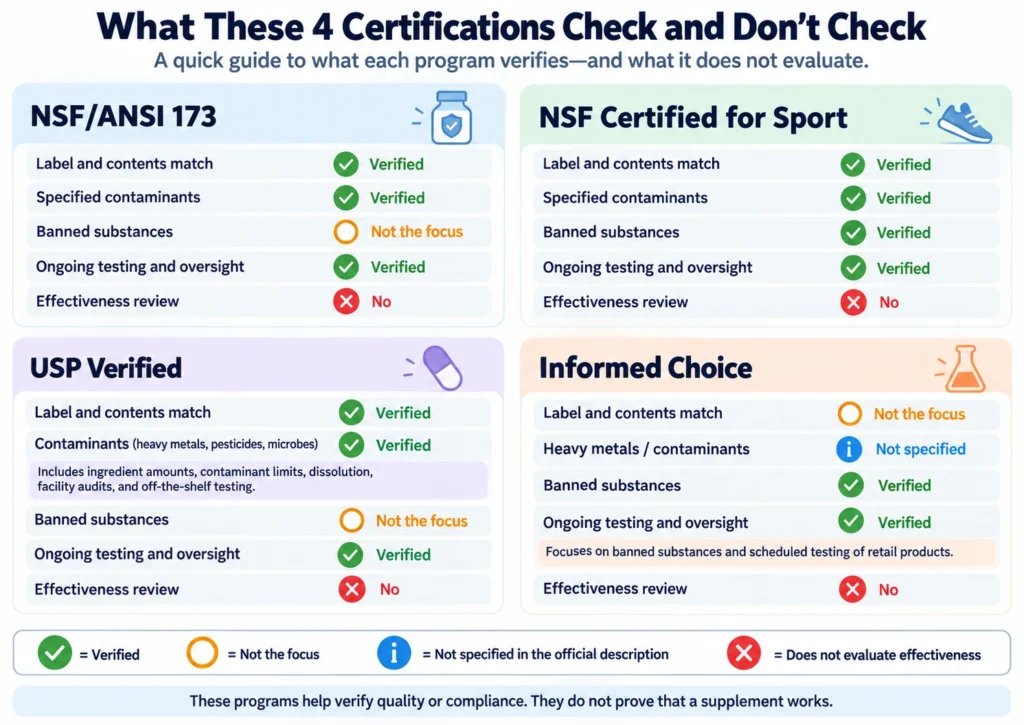
NSF/ANSI 173 checks whether a supplement meets requirements for ingredient content, labeling, and specified contaminants. It doesn’t judge whether the supplement works. NSF Certified for Sport adds testing for banned substances.
USP Verified checks the listed ingredients and amounts, limits for contaminants such as heavy metals, pesticides, and microbes, and whether the product dissolves properly. It also includes facility audits and testing of products already on shelves.
Informed Sport and Informed Choice focus on banned substances. Informed Sport tests every batch before release. Informed Choice tests products bought at retail on a schedule. Neither program’s official description says whether heavy metals are covered for regular supplements.
“Third-Party Tested” vs. a Certification
A phrase on a label proves less than a registry entry.
“Third-party tested” means an outside lab looked at something. The label doesn’t say what, when, to what standard, or whether the product passed. A certification has published standards, and you can search the registry by product name. That one difference changed how I read supplement labels.
Health claims work the same way. “Supports skin elasticity” is a structure-function claim, and the FDA doesn’t approve those in advance. The maker needs support for the claim, has to notify the FDA within 30 days of selling it, and has to print that the FDA hasn’t evaluated it. I treat the phrase as marketing language, not a result.
Heavy Metals in Collagen Products
Collagen comes from animal hides and bones, so heavy metals come up every time. The data are thin, and every source has limits.
What Independent Testing Found
In 2020, the Clean Label Project tested 30 collagen products sold on Amazon. Four exceeded California’s Proposition 65 level for lead. Sixty-four percent had measurable arsenic, from 0.09 to 4.7 micrograms per serving, and none went over the 10-microgram arsenic level.
Those levels mark when California requires a warning label. They are not food safety limits. The industry objected that the product mix wasn’t disclosed and the work wasn’t peer reviewed.
The paper measured total arsenic only, tested one sample of each product, and is six years old.
The consumer group Lead Safe Mama has tested individual products since 2024, and its collagen results so far show trace arsenic. It doesn’t separate organic from inorganic arsenic and tests one lot per product, so a result describes that lot.
In its collagen review, ConsumerLab measures collagen content in every product, but it only runs heavy-metal tests on products with whole herbs or at least 250 mg of minerals per serving. A plain collagen powder may never get a metal test.
Detected is not the same as dangerous. It depends on the limit and on how much you take. These sources don’t let me call any product clean. They let me compare how much each product lets me verify.
Where to Look Up Test Results
Start with a registry. Search NSF’s listings and the Informed Choice registry by brand and product name. Listings are per product, so check that the form and serving size match what you’re buying. A 10 g stick pack and a 20 g tub can be listed separately.
Then look for the manufacturer’s certificate of analysis (CoA), if they publish one. Check which tests it covers (collagen content, heavy metals, microbes), the lab, the lot number, and the test date.
Certification confirms that contaminants stayed under a limit. It doesn’t mean none are present.
Three Collagen Products That Fit These Criteria
I couldn’t find a product that checks every box: a dose like the trials used, a certification I could look up, and heavy-metal data for that exact product. The last one was the thinnest. To choose a collagen supplement from what I could verify, I used two filters: a registry listing and a single ingredient.
For reference, eight trials in a 2019 review used 2.5 to 10 g of collagen hydrolysate a day for 8 to 24 weeks. Two of the tubs below serve 20 g, which is beyond that range. Half a scoop lands at the top of it.
BUBS Naturals Collagen Peptides
This is bovine collagen peptides in a tub of 28 servings, 20 g each. BUBS Naturals Collagen Peptides is the one I linked.
NSF’s registry lists both the 20 g scoop and a 10 g stick pack, each as its own entry. The retailer’s panel shows collagen peptides and nothing else. The label notes that the facility also handles tree nuts, fish, and milk, which matters if you have allergies. No heavy-metal testing turned up for this specific product.
Vital Proteins Collagen Peptides
This is bovine, unflavored, in a 20 oz tub with 20 g servings. Vital Proteins Collagen Peptides is the link. NSF’s registry lists a 20 g entry, and Vital Proteins says the tub carries NSF Certified for Sport certification. Flavored versions are listed separately and contain more than collagen, so I left them out.
Lead Safe Mama tested one lot of the unflavored product in 2024 and reported arsenic at 10 ppb or higher, with other metals below the 10 ppb detection limit. The group doesn’t separate organic from inorganic arsenic, and its thresholds are stricter than legal limits.
Sports Research Marine Collagen Peptides
This is marine collagen peptides from barramundi and/or red snapper, 10 g per scoop, with 34 servings in the 12 oz tub. Sports Research Marine Collagen Peptides is the link.
It is certified through Informed Choice, not NSF, and the registry entry lists test dates for individual batches of the unflavored version. As above, that program centers on banned substances. The panel shows one ingredient, and the product contains fish.
The sales page gives a molecular weight of 3,000 to 5,000 Da and Southeast Asian wild-caught fish. Those come from the sales page, not a lab report, and the FAQ below explains why I wouldn’t pay extra for a lower number.
Older listings name different fish, such as cod, haddock, and pollock, so check the label on the tub you receive. I also saw no heavy-metal testing for this product.
Common Questions
Is Marine Collagen Better Than Bovine?
No head-to-head trial I read shows that either one works better for skin.
A randomized crossover study in healthy adults had volunteers take fish, pig, and bovine collagen on separate occasions and measured collagen-derived compounds in their blood. All three raised those levels. The sources differed on some individual peptides, but the study didn’t test skin, so it can’t tell me which is better for you.
So choose by allergy and diet. Skip fish-derived products if you’re allergic. If you avoid beef or pork, check the source on the label. “Multi collagen” products can mix several animals.
Does the Molecular Weight on the Label Matter?
I couldn’t find an independent trial showing that the number on the label changes skin results.
The same crossover study compared bovine collagen at about 2,000 Da with bovine at about 5,000 Da. The blood levels of the peptides it measured were highly comparable. Da is a unit of molecular size, and a smaller number means smaller fragments.
If a brand sells “low molecular weight,” ask whether that is a measured number. A certificate of analysis showing the molecular weight distribution would answer it.
When Should I Take Collagen?
No study I read compared morning, night, or empty-stomach dosing.
I searched twice for trials that compared timing and skin results and came up empty. The nearest thing to a timing finding is duration: elasticity and skin barrier were clearly better by week 12 in the 2026 analysis. Pick a time you’ll keep every day.
Can I Take It With Other Supplements?
Check for biotin first.
Biotin in a combination product or a separate supplement can affect blood test results, so tell your clinician the dose before testing. If you’re pregnant or nursing, have chronic kidney disease, or take medication, talk to a clinician before adding any new supplement.
I couldn’t find a direct comparison showing that adding vitamin C boosts the effect. The hyaluronic acid trial above compared groups that both took collagen with vitamin C.
Back to the Label Mix-Up
The numbers on my three labels didn’t match because each one defined a serving differently. A 10 g stick pack and a 20 g scoop line up once you convert them to grams of collagen.
The research gave me a firmer sense of what to expect: hydration and elasticity more than wrinkles, and weaker results in trials the industry didn’t fund. So I stopped hunting for the product with the biggest promise. When I choose a collagen supplement now, I look for one I can check myself.
Keep Reading
Taking collagen for achy joints instead of skin? Joint Pain After 40: Why It Happens and What Actually Helps
Curious how supplement labels compare with what’s actually in the bottle? What’s Actually in Menopause Supplements? A Look at 201 Products
This article is based on personal experience and publicly available research. It is not a substitute for medical diagnosis or treatment. Please consult a healthcare professional about any health concern or medication.